Australia
No ABN on your invoice? Your client may have to keep 47%
You invoice an Australian business A$2,400 for a packaging job. They pay on time, which is lovely, except A$1,272 arrives instead of A$2,400. Nobody's made a mistake. Your invoice didn't have an ABN on it, and the law told your client to hold back nearly half.
It's an easy one to miss, especially on a first big job. The fix takes one line on your invoice. Here's what the rule actually says, when it doesn't apply, how you get the money back, and the other thing new freelancers get wrong on Australian invoices: GST.
The rule, in the law's own words
Section 12-190 of Schedule 1 to the Taxation Administration Act 1953 says a business "must withhold an amount from a payment it makes to another entity" when the payment is for a supply made in the course of an enterprise carried on in Australia, and none of the exceptions applies. The main exception is the one you control: the payer doesn't need to withhold if, "when the payment is made," you've given them "an invoice that relates to the supply and quotes the other entity's ABN," or they have some other document for the job that quotes it.
How much? The Taxation Administration Regulations 2017 set it at "the product of the top rate and the amount of the payment," where the top rate is the highest income tax rate plus the Medicare levy. The Income Tax Rates Act 1986 puts the top resident rate at 45%, and the Medicare Levy Act 1986 sets the levy at 2%. Together that's 47%.
On that A$2,400 invoice, 47% is A$1,128 held back, leaving A$1,272 in your account.
When it doesn't apply
The same section lists the situations where no withholding is needed, even without an ABN. The ones most relevant to freelancers:
- The client isn't paying as a business in Australia. The payer doesn't have to withhold if the payment is made "otherwise than in the course or furtherance of an enterprise carried on in Australia by the payer." A household paying you privately, for example, isn't caught.
- Small jobs. No withholding when the payment, leaving out any GST, doesn't exceed $50 or a higher amount set in the GST regulations. The GST Regulations 2019 set that amount at $75.
- It's a hobby, not a business. An individual can give the payer a written statement that the work is a "private recreational pursuit or hobby," or wholly private or domestic for them. That's for genuine hobbyists, not for freelancers who haven't got around to registering.
- The ABN looks right. If your invoice purports to quote your ABN, and the client has no reasonable grounds to believe it's wrong, they don't have to withhold. They aren't required to be detectives, but a number that obviously isn't yours won't protect you.
The money isn't gone, but you'll wait for it
Withheld amounts aren't a fine. They're tax paid on your behalf. The client must give you a payment summary covering the payment "when making the payment, or as soon as practicable afterwards" (section 16-167). Then, under section 18-15, you're entitled to a credit for the amounts withheld once your income tax for the year has been assessed.
The catch is timing. A payment withheld in August may not come back to you until after you lodge your return for that financial year, potentially a year or more later. For a new freelancer, losing nearly half of a job's cash for that long can hurt more than the tax itself. And because the rule bites "when the payment is made," the fix is simple: if you spot a missing ABN before your client pays, send a corrected invoice.
Getting an ABN costs nothing. business.gov.au says it's "free to register for an ABN" through the Australian Business Register, and lists "avoid pay as you go (PAYG) tax on payments you get" among the reasons to have one. If your details are complete, you'll usually find out as soon as you finish the application. The free ABN Lookup lets you, and your clients, check that an ABN is active and see its GST status, with no login.
The second mistake: adding GST you can't charge
New sole traders often copy an invoice template that adds 10% GST. If you're not registered for GST, don't. According to business.gov.au, if your GST turnover is under $75,000 and you haven't chosen to register, "you don't include GST in your prices," and "any invoices you provide need to show that GST was not included." Once you expect to reach $75,000 you have to register, within 21 days of becoming aware your turnover will go over the threshold.
That also decides what you call the document. business.gov.au's invoicing guide explains that businesses not registered for GST send regular invoices that use "the word 'invoice' – you must not use 'tax invoice'," with your business name and ABN. GST-registered businesses must issue tax invoices with the words "tax invoice," the ABN, the date, a description, and the GST payable, plus the buyer's identity or ABN for sales over $1,000. They must give one for a taxable sale over $82.50 including GST, or within 28 days if a customer asks.
One line that saves you A$1,128
So the checklist for a sole trader who isn't registered for GST is short: your ABN on every invoice, the word "invoice" rather than "tax invoice," no GST added, and a note saying no GST has been included.
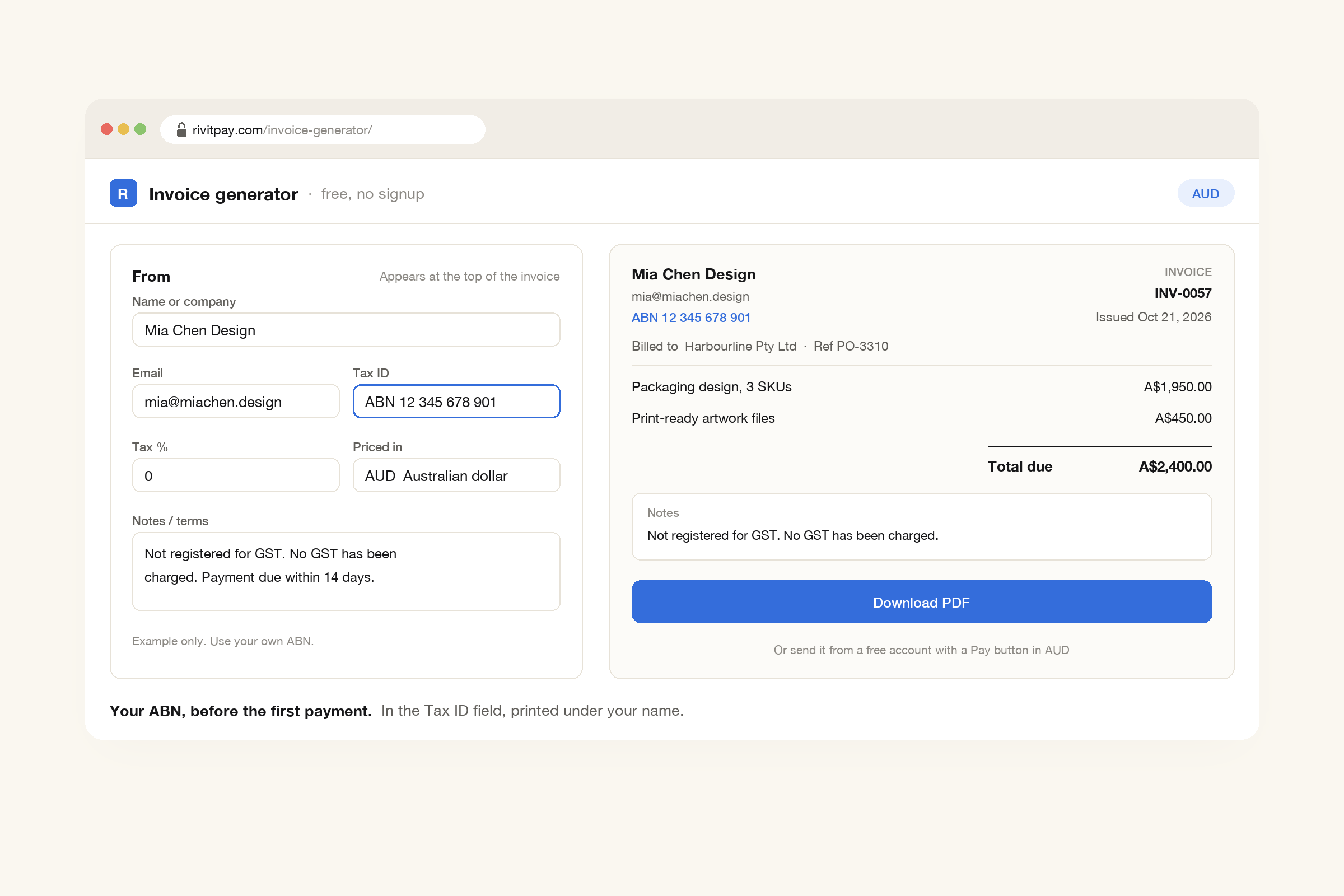
RivitPay's free invoice generator has a Tax ID field that prints under your name at the top of the invoice, so "ABN 12 345 678 901" goes exactly where an accounts team looks for it. Price the invoice in Australian dollars (it's one of 45 currencies), leave Tax % at zero, and put "Not registered for GST. No GST has been charged." in the notes. Your client's PO number has its own reference field too. There's no signup, and nothing you type is uploaded. In a free account, invoices go out by email with the PDF attached and a Pay button, so your client can pay by card or bank, into your own Stripe account. You can see when the invoice was opened, and automatic reminders in your own words stop the moment it's paid.
Before the first invoice goes out
Register the ABN, then check it's on the invoice template before you send anything. It's the cheapest line you'll ever add to a document, and the difference between being paid in full this week and getting nearly half of it back at tax time.
Tax ID under your name, Australian dollars, your own notes, and a Pay button into your own Stripe account. Free until you've collected $5,000.
Make an invoice, free