Tax on your invoices
Paying VAT on invoices nobody's paid yet? Cash accounting and bad debt relief
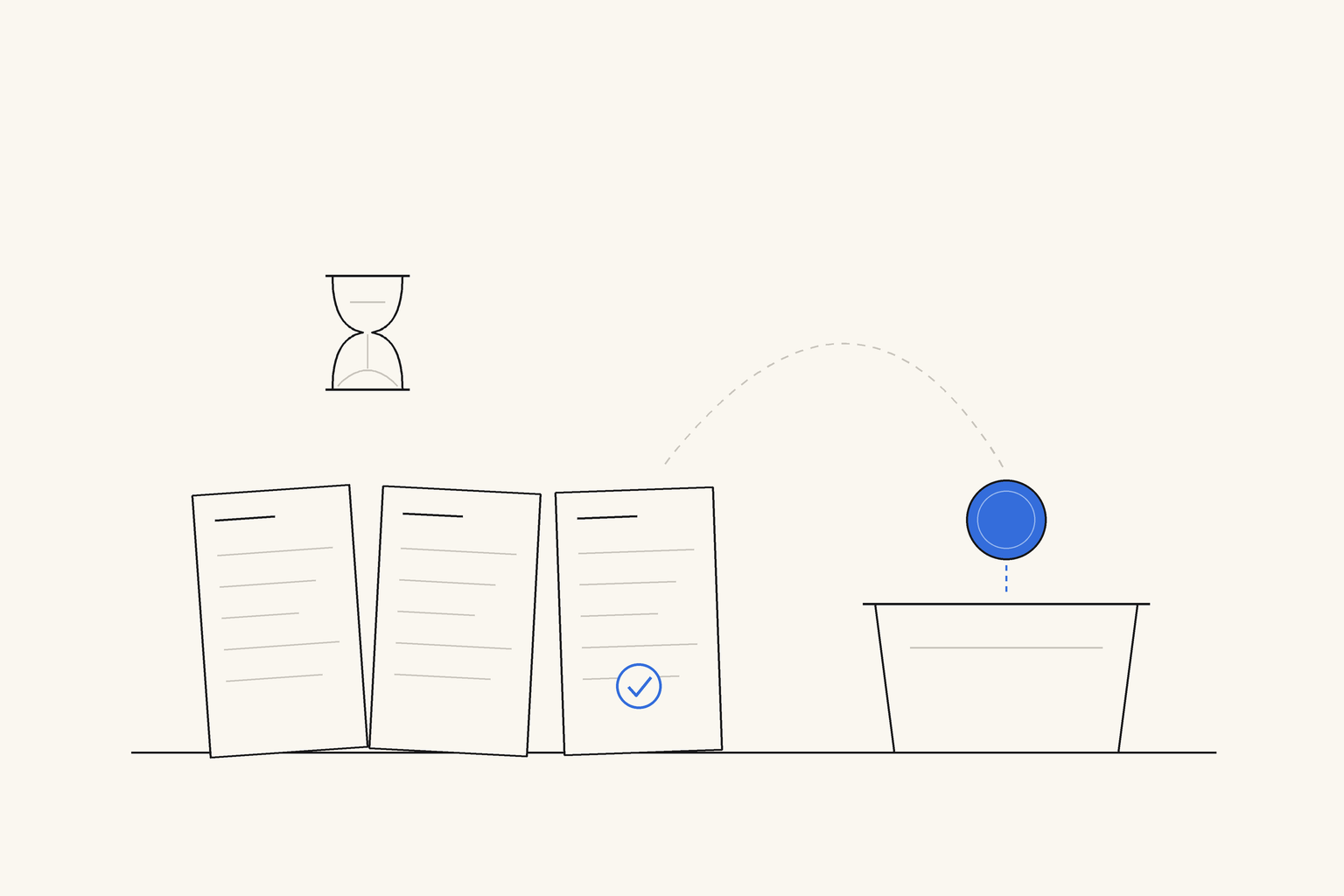
VAT on late invoices is one of the worse bits of being VAT-registered. You send a £3,600 invoice in September, the client sits on it, and your VAT return for the quarter still includes £600 of VAT on money you haven't received. You pay HMRC out of your own account and wait to get it back from the client.
That's the default, but it isn't the only option. Two HMRC rules fix most of it. One stops you paying VAT before the client pays, and the other gets the VAT back when a client never pays at all. Here's how both work, and who can't use them.
The default: VAT is due when you invoice
GOV.UK's Cash Accounting Scheme guide puts the normal rule in one line: you report your sales and purchase invoices "and pay any money to HMRC even if the invoices have not been paid."
For a freelancer that's a real gap. Xero's UK Small Business Insights, published on 30 July 2026, found that small businesses waited an average of 29.1 days to be paid in the June quarter, against 29.3 days across 2025, and that payments arrived 8.3 days late on average. Invoice in the last few weeks of a VAT quarter on 30-day terms, and you'll often file the return before the money arrives. One slow client can push that out by a whole quarter.
The fix: the Cash Accounting Scheme
With cash accounting, GOV.UK says, you "pay VAT on your sales when your customers pay you" and "reclaim VAT on your purchases when you have paid your supplier." VAT Notice 731 says it most helps businesses that "give your customers extended credit" or "suffer a lot of bad debts". For a freelancer, that just means clients who pay late.
Joining is easy:
- The turnover test. You can join if you expect your VAT taxable turnover in the next 12 months to be £1.35 million or less. You must leave once it goes over £1.6 million.
- No application. GOV.UK says you don't have to tell HMRC you're using cash accounting. You start at the beginning of a VAT period. Notice 731 is clear that you "cannot retrospectively apply" it, so it won't help with a quarter you've already filed.
- Be up to date. You can't join with VAT returns outstanding, or if you owe HMRC money and haven't agreed how to pay it.
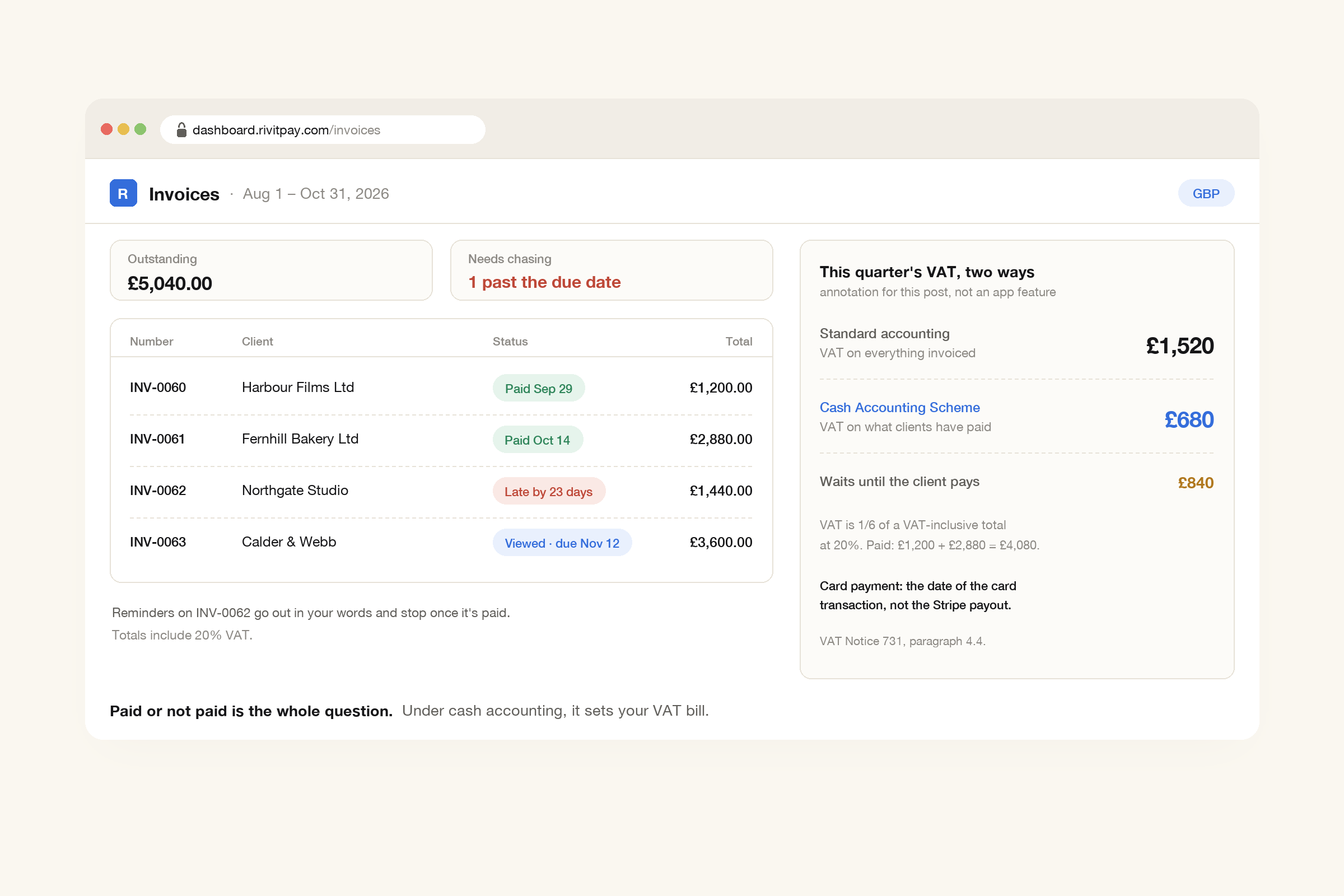
Here's what it does to one quarter. Say you invoiced four clients a total of £9,120 including 20% VAT. At 20%, the VAT is one-sixth of a VAT-inclusive amount, so that's £1,520. By the end of the quarter, two clients have paid £4,080 between them, and two haven't.
- Standard accounting: you account for VAT on everything you invoiced, £1,520.
- Cash accounting: you account for VAT on what you were paid, £680.
- The other £840 goes on the return for whichever quarter those clients actually pay in.
The trade-off is on your costs. Under the scheme you can only reclaim VAT on purchases once you've paid for them. Most freelancers pay their own bills promptly, so that rarely matters.
What counts as "paid", and when
Paragraph 4.4 of Notice 731 sets the payment date by method, and the rules aren't all the obvious ones:
- Bank transfer, standing order or direct debit: "the date your bank account is credited".
- Card: the date the card payment is made. In the notice's words, "not when you actually receive payment from the card provider". A client who pays by card on 30 September counts in that quarter, even if the payout reaches your bank in October.
- Cheque: the date you receive it or the date on it, "whichever is later".
Two more rules matter for freelancers. If a client pays part of an invoice, you account for the same share of the VAT. HMRC's own example: £780 paid against a £1,200 invoice is 65%, so £130 of the £200 VAT. And if a payment arrives with something deducted, Notice 731 says "you must account for VAT on the full value of taxable supplies made by you before such deductions."
You also need records that "clearly cross-refer" each payment to its sales invoice and to the evidence, like your bank statement. Put the invoice number in every payment reference you can.
Who can't use it, or shouldn't
- Flat Rate Scheme users. You can't use both at once. The Flat Rate Scheme "has its own cash-based turnover method" instead.
- Long terms. Invoices with payment terms of 6 months or more are excluded and go through normal accounting.
- Deposits invoiced in advance. A VAT invoice "raised in advance" of the work is excluded too. If you take a deposit, the VAT guide describes the usual route: a pro-forma "clearly marked 'this is not a VAT invoice'", then "a proper VAT invoice" once you're paid or the work is done.
- People who get paid straight away. Notice 731 says the scheme "may not give you any benefit" if you're usually paid at the time of sale, or if you often reclaim more VAT than you pay.
If you leave the scheme, any VAT you haven't yet accounted for falls due "whether your customers have paid you or not". You can usually spread it over 6 months.
When a client never pays: bad debt relief
Under standard accounting, an invoice that never gets paid has already cost you the VAT. VAT Notice 700/18 lets you claim it back if all of these are true:
- You've already accounted for the VAT and paid it to HMRC.
- The debt has been unpaid for 6 months from "the later of the time payment was due and payable and the date of the supply".
- You've written it off in your VAT accounts and moved it to a separate bad debt account.
- You haven't sold or factored it.
You claim it in box 4 of the VAT return covering the date you qualify, and no later than 4 years and 6 months after that same later date. You don't have to tell the client. The notification letter in the notice only applies to supplies made between 1996 and 1997.
A worked example: a £1,440 invoice (£240 VAT) was due on 15 September 2026, and the client paid £600 of it. You can claim on the VAT in the unpaid £840, which is £140, on the return that covers 15 March 2027. If they pay more later, you repay the VAT on that payment in box 1. One thing you can't do: Notice 700/18 says you "may not issue a credit note simply because your customer has not paid you."
On cash accounting you never paid that VAT in the first place, which is why the notice calls bad debt relief "unnecessary" for scheme users.
The rule also works the other way. If you haven't paid a supplier within 6 months of the due date, you have to repay the input VAT you reclaimed on their invoice.
Where RivitPay fits
Cash accounting comes down to one question for each invoice: paid or not, and on what date. The RivitPay dashboard shows what's outstanding in each currency, how many invoices need chasing, and which ones are late, with a "Late by 23 days" style label. A free account lets you email an invoice and see when the client has opened it. Automatic reminders in your own words follow up until it's paid, then stop.
When a client pays through the invoice's Pay button, by card or bank, the money goes straight into your own Stripe account, and the payment is tied to that invoice. The free invoice generator doesn't need a signup. Your VAT number goes in the Tax ID field, Tax % takes the 20%, and the Number field keeps your sequence. If you're sending a deposit request before the work, you can put "This is not a VAT invoice" in Notes.
Pick it before the quarter starts
If late payers are regularly leaving you out of pocket on VAT, cash accounting is the simplest fix HMRC offers. There's no form and no approval. You just have to start at the beginning of a VAT period. If you stay on standard accounting, put a date in your diary six months after each unpaid due date, because that's when the VAT can come back.
Paid, viewed or late at a glance, reminders that stop on payment, and a Pay button for card or bank. Free until you've collected $5,000.
Make an invoice, free