France
Your French invoice footer changed on 1 September. Here's what it needs to say now
If you're a micro-entrepreneur in France, the bottom of your invoice probably says "TVA non applicable, art. 293 B du CGI". Since 1 September 2026, that line has new official wording. You have until the end of 2027 to switch, so there's no rush. But it's a good moment to check the rest of the footer, because the lines most freelancers leave out aren't about VAT at all. They're about late payment.
Here's what French rules require, which lines are easy to forget, and what's coming for freelancers when e-invoicing arrives in September 2027.
Late payment is still common in France
The Banque de France's payment-times observatory published its 2025 annual report in September 2026. Late payments in France were still "légèrement au-dessus de la moyenne européenne" (slightly above the European average), averaging 13.4 days late at the end of 2025. The report estimates that without late payments, SMEs and micro-businesses would have had €13 billion more cash. It also found that the DGCCRF, the regulator that enforces payment terms, carried out checks at 882 establishments in 2025 and found problems at a rate of 54.2%, up from 42.3% in 2024.
You can't make a client pay on time with a footer. But French law gives you penalties and a fixed fee for late payment, and the invoice is where you set them out.
The VAT line has new wording
If you're under the VAT threshold (the franchise en base), your invoice has to say so. The official guide, Tout savoir sur la facturation, explains the change:
- From 1 September 2026, "TVA non applicable, art. 293 B du code général des impôts (CGI)" is replaced by "TVA non applicable, art. L. 223 et s. du code des impositions sur les biens et services (CIBS)". The VAT rules have moved into a new code, and the article number changed with them.
- There's a tolerance period "jusqu'au 31 décembre 2027" (until 31 December 2027), during which the old 293 B wording is still accepted.
The guide recommends updating your invoice templates as soon as you can. It takes one edit.
The thresholds themselves haven't changed. According to service-public's page on the franchise en base, for services the 2026 limits are still €37,500 for the previous year and €41,250 for the current year, and the plan to bring in a single €25,000 threshold "a été abandonnée" (has been dropped).
The payment lines most people leave out
Service-public's list of compulsory invoice mentions applies whether your client is a business, a private person or a public body. Most of it is what you'd expect: your name followed by "Entrepreneur individuel" or "EI", your address and SIREN, the client's name and address, a unique invoice number in an unbroken sequence, the issue date, the date the work was done, a description, quantities and prices before tax, and the total. If the client gave you a purchase order number, that goes on too. Then come the three payment lines:
- The payment date, plus your terms for paying early. If you don't offer a discount, the guide says to write "Escompte pour paiement anticipé : néant" (no early-payment discount).
- The late-payment penalty rate, which applies "sans qu'un rappel soit nécessaire" (without any reminder being needed).
- The €40 fixed recovery fee, for late payment by a business client.
The page on payment terms between businesses gives the details. The penalty rate can't be lower than three times the legal interest rate, "ce qui correspond à 8,25 %". The Code de commerce recommends the European Central Bank's refinancing rate plus 10 points, using the rate in force on 1 January for the first half of the year and on 1 July for the second. That gives 12.40% for the second half of 2026. You can print a figure (at least 8.25%) or the formula itself, "taux BCE + 10 points". If you print a figure, check it each January and July.
The €40 applies once per late invoice, not per day. It's due even if the client pays part of the invoice, and there's no VAT on it. If chasing costs you more than €40, you can ask for more with receipts, but that extra claim shouldn't be written on the invoice.
On a €2,400 invoice paid 30 days late in the second half of 2026, 12.40% a year is about €24.46, plus the €40. At the 8.25% minimum, it's about €16.27. These aren't big sums, but a client who sees them in your terms is more likely to pay on time.
Payment terms have limits too
The same page sets the default. Without an agreement, payment is due "30 jours à partir de la réception de la marchandise ou de la réalisation de la prestation". You and a business client can agree something different, but no longer than 60 days from the invoice date, or 45 days end of month if your contract says so. Service-public gives an example of how much the method matters. On an invoice issued on 1 August 2026 with 45 days end of month, one method gives a deadline of 15 October and the other gives 30 September. If a client's purchase order asks for 90 days, that's above the limit.
What leaving lines out can cost
The invoicing guide says "Une amende de 15 € est appliquée sur chaque omission ou inexactitude" (a €15 fine for each missing or wrong mention). The total for one invoice "ne peut pas dépasser 25 % du montant de la facture" (can't be more than 25% of the invoice). Separately, a sole trader who doesn't state the late-payment penalties and the €40 fee in their terms of sale risks an administrative fine of up to €75,000, and a company up to €2 million. Those are maximums, but the 2025 check figures show the DGCCRF does look.
Then there's e-invoicing
France's e-invoicing reform has started. Here's where freelancers stand, according to the invoicing guide:
- Since 1 September 2026, every business has to be able to receive e-invoices. That includes micro-entrepreneurs.
- From 1 September 2027, SMEs and micro-entreprises must issue e-invoices to other businesses established in France, through a "plateforme agréée" (an approved platform). The rule covers businesses that are "assujetties à la TVA", and the guide says that includes those under the franchise en base, with the example "un micro-entrepreneur facture une agence de communication française".
- From the same date, four more mentions are added for small businesses, including the client's SIREN and whether you're supplying goods, services or both.
- Invoices to private individuals and to businesses outside France don't have to be e-invoices. The guide's example is "une entreprise française facture une entreprise allemande".
Where RivitPay fits
To be clear about what RivitPay is: the free invoice generator, with no signup, makes a PDF and a share link. It isn't a plateforme agréée. Until September 2027, that works for all your clients. After that, you'll need an approved platform for invoices to French businesses, but PDFs still work for private clients and clients abroad.
Here's how the French mentions fit the generator. Put your name followed by "EI" in the Name or company field, and your SIREN in the Tax ID field. Use the Number field for your sequence (the invoice number generator helps keep it unbroken), and set the Issued and Due dates. If the client gave you a purchase order number, put it in Reference / PO. Add the month the work was done to the line description, and set Tax % to 0. Then the whole footer goes in Notes / terms: the CIBS line, "Escompte pour paiement anticipé : néant", your penalty rate and the €40 fee. Your IBAN and BIC go in the Payment section, so the client can pay by bank transfer.
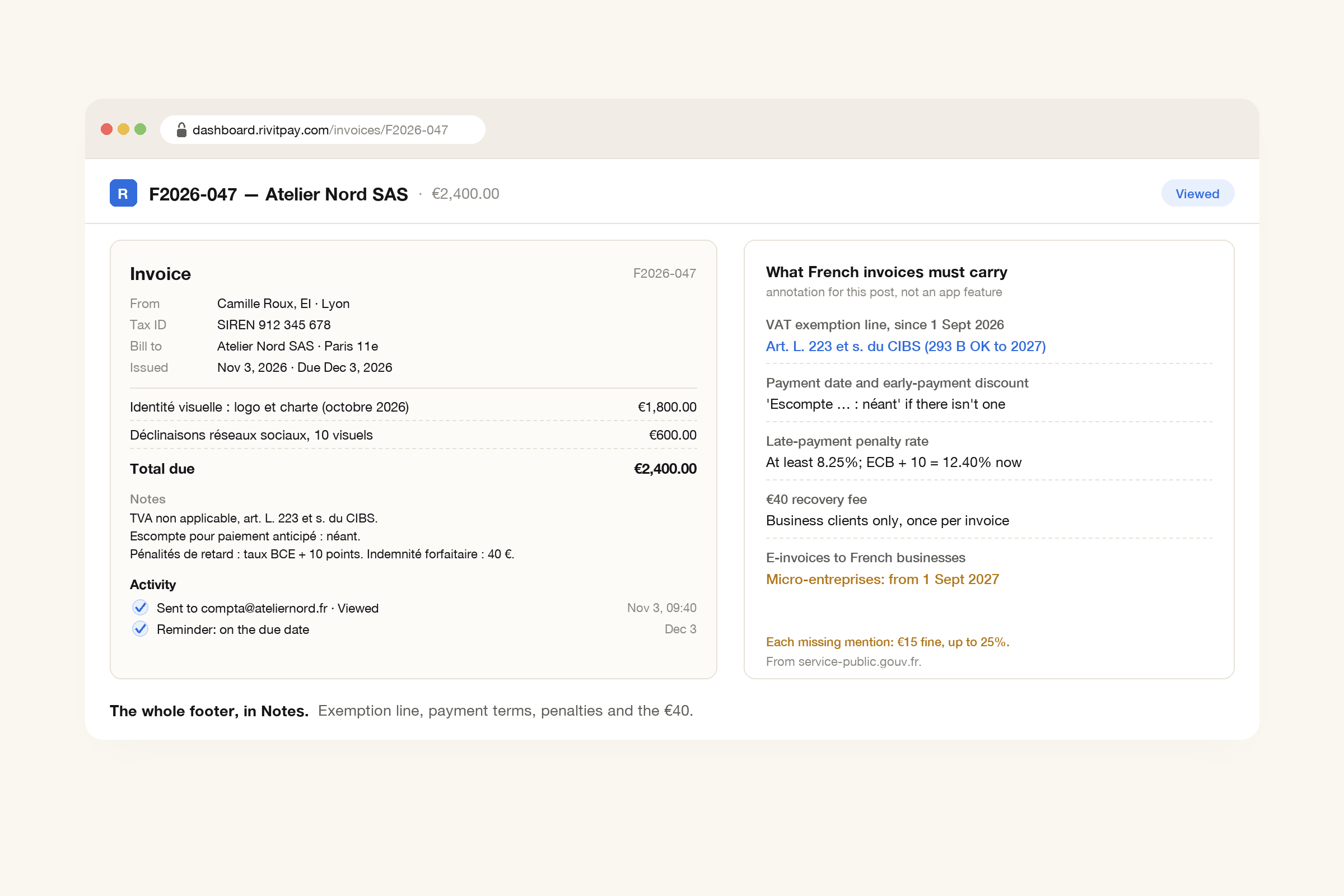
With a free account, you can email the invoice, see when the client opens it, and set automatic reminders in your own words that stop once it's paid. Your reminder can mention the penalties already set out in your terms. Clients can also pay by card through the Pay button, straight into your own Stripe account.
The short version
Swap "art. 293 B du CGI" for "art. L. 223 et s. du CIBS" whenever you next update your template. While you're there, make sure the footer has a payment date, "Escompte pour paiement anticipé : néant", a penalty rate of at least 8.25% and the €40 recovery fee. Each costs a line, and leaving one out can cost €15. Then put September 2027 in your calendar for e-invoicing.
Your SIREN, the CIBS line, your payment terms, euros or any of 45 currencies, and a Pay button for clients who want to pay by card. Invoicing is free.
Make an invoice, free