Tax on your invoices
When a Canadian freelancer has to start charging GST/HST
Your first year freelancing in Canada, nobody mentions sales tax. Then a bigger client signs on, the invoices add up, and one day a client's accounts payable team asks for your GST/HST number. You don't have one. Should you?
The rule is simpler than it sounds, but it has a couple of traps: the threshold isn't measured by your tax year, and the rate on your invoice depends on where your client is, not where you are. Here's how it works, straight from the Canada Revenue Agency's own pages.
Getting paid is slow enough already
Xero tracks invoice payments across Canadian small businesses that use its software. In its latest Small Business Insights (published 30 July 2026), invoices took 29.0 days to be paid in the June quarter, up from 27.1 days in 2025. On average, payments arrived 11.3 days late, against 10.5 days in 2025. Ontario businesses waited 30.0 days, and the Maritime provinces 31.8.
That's an average across all kinds of small businesses, not just freelancers. But it's a reminder that you don't want an invoice bounced back for a missing tax number on top of that. Once you're registered, your client will usually want to claim back the GST/HST you charge, and they can only do that if your invoice shows the right details.
The $30,000 line, measured over four quarters
You don't have to register while you're a "small supplier". The CRA's registration page says you're a small supplier if you "do not exceed the $30,000 threshold over four consecutive calendar quarters". Calendar quarters start on 1 January, April, July and October, so this is a rolling window, not your tax year.
There are two ways to go over it, and they have different deadlines:
- Over $30,000 in a single quarter. You stop being a small supplier immediately and "have to charge GST/HST on the supply that made you exceed $30,000". Your registration date is no later than the day of that sale. One big project can do this.
- Over $30,000 across four quarters, but not in one. You stop being a small supplier "at the end of the month following the quarter" in which you went over, and you have to charge tax from your first sale after that.
You can also register voluntarily before you reach the threshold. Some freelancers do, because business clients are used to paying GST/HST and can usually claim it back, and registering lets you claim back the tax on your own business costs. Since 3 November 2025, new registrations have to be done online through Business Registration Online, with a few exceptions. Your GST/HST account is your 9-digit business number plus a program identifier, which the CRA writes as "123456789 RT0001".
Which rate goes on the invoice
GST is 5% everywhere. Five provinces combine it with their provincial tax into a single HST. From the CRA's rates page:
- 5% GST: Alberta, British Columbia, Manitoba, Quebec, Saskatchewan and the three territories.
- 13% HST: Ontario.
- 14% HST: Nova Scotia, down from 15% on 1 April 2025.
- 15% HST: New Brunswick, Newfoundland and Labrador, and Prince Edward Island.
For most services, the rate depends on your client's address, not yours. The CRA's place of supply page says the place of supply is "the province of the recipient's address if the supplier obtains that address in the normal course of business." Its own example: a Quebec supplier designs a website for an Ontario company, so HST applies at the Ontario rate. A designer in Calgary billing a client in Halifax charges 14%, and the same designer billing a client in Edmonton charges 5%.
Provincial sales taxes in British Columbia, Manitoba, Saskatchewan and Quebec are separate systems with their own rules. They're outside the scope of this post.
What the invoice has to show
Your client claims back the GST/HST you charge as an input tax credit, and the CRA lists what their records must show. The input tax credit page sets out three tiers by the size of the sale:
- Under $100: your business or trading name, the invoice date and the total amount.
- $100 to $499.99: all of that, plus the GST/HST charged (or a note that the total includes it at the applicable rate) and your GST/HST registration number.
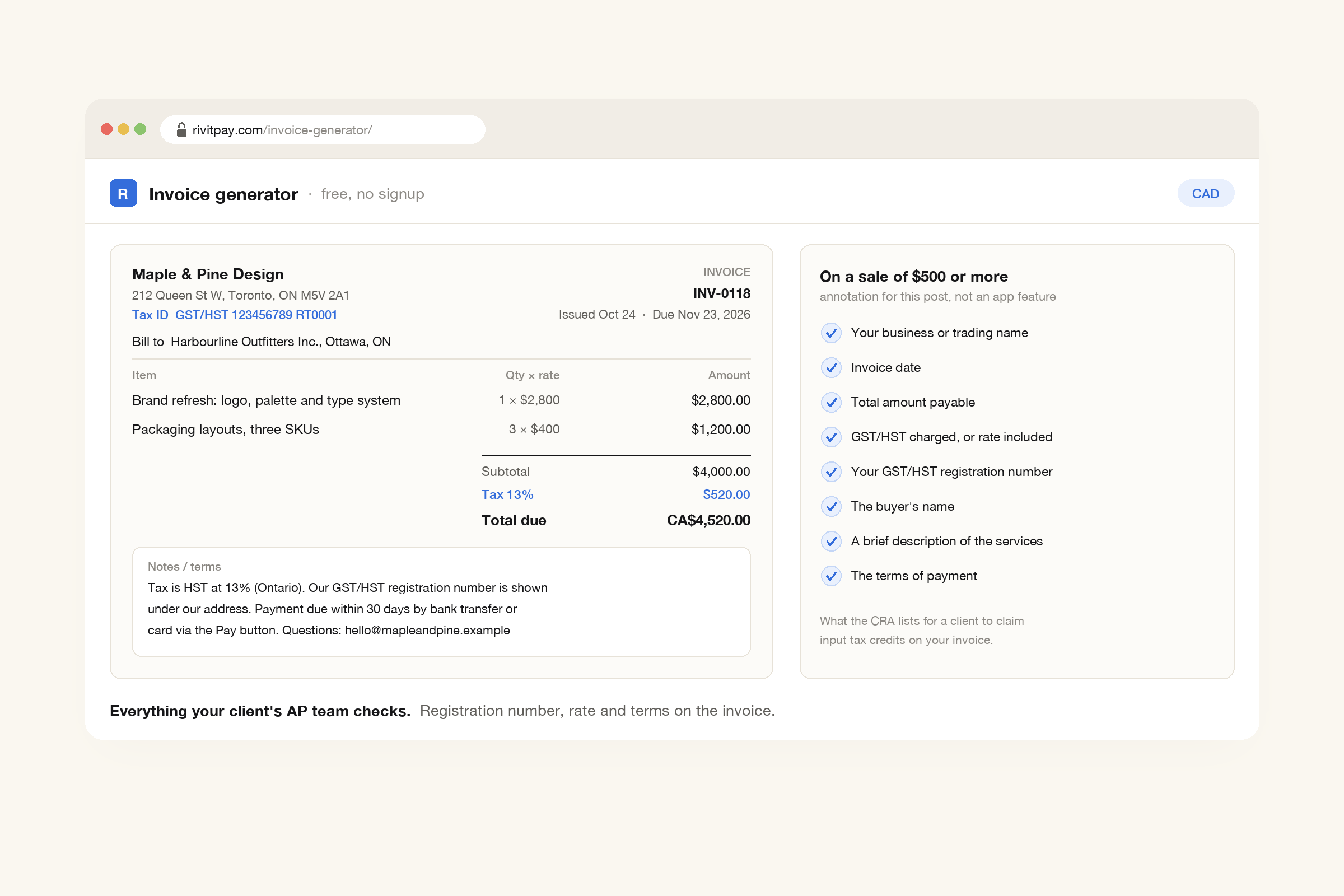
- $500 or more: all of that, plus the client's name, a brief description of the services and the terms of payment.
Most freelance invoices are over $500, so in practice you need all of it. The one people forget is the registration number. Without it, a client can't support a claim, and a careful AP team will send the invoice back.
Clients outside Canada
Work for foreign clients doesn't always carry GST/HST. The CRA's imports and exports page says that certain services provided to a non-resident, "but not to an individual while the individual is in Canada", may be zero-rated, meaning taxed at 0%. Its list includes "certain advisory, professional, or consulting services" and services "provided to a non-resident person by electronic means". Services performed totally outside Canada aren't taxed at all.
The list has conditions, so check it against your actual work before you put 0% on an invoice.
The quick method can leave you ahead
Once registered, a lot of freelancers can choose the quick method. The CRA's guide RC4058 allows it if you have a permanent establishment in Canada and your taxable sales, including the tax and those of any associated businesses, are no more than $400,000 over four fiscal quarters. You still charge your clients the full rate, but you send the CRA a fixed percentage of your tax-included sales instead of working out the tax line by line. For a service business based in Ontario charging 13% HST, that remittance rate is 8.8%. For one based in a GST-only province charging 5%, it's 3.6%. You also get a 1% credit on the first $30,000 of eligible sales each year.
Say you're in Toronto and bill $40,000 of design work to Ontario clients in a year. You charge $5,200 of HST, so your sales including tax are $45,200. Under the quick method you remit 8.8% of that, $3,977.60, minus the $300 credit: $3,677.60. The other $1,522.40 stays with you. The catch: you can't claim input tax credits on your operating expenses. If your business costs are high, the regular method may work out better, so run both before you choose.
Where RivitPay fits
The free invoice generator covers the CRA's list for a $500-plus sale, with no signup. Put your full GST/HST number in the Tax ID field, and it prints under your address. Set the currency to CAD (it's one of 45), describe each piece of work with a quantity and rate, and enter the rate in Tax %. The invoice shows the tax amount on its own line, and your due date and terms print on the PDF.
With a free account, you can email the invoice, see when it's been opened, and set automatic reminders in your own words that stop the moment it's paid. The Pay button lets clients pay by card or bank straight into your own Stripe account. There's no RivitPay fee until you've collected $5,000 through it.
Know which side of the line you're on
Add up your last four calendar quarters now, and again at the end of each quarter. If you're getting close to $30,000, or one project could push you over it, register before you send that invoice. Then put your number, your client's provincial rate and your terms on every invoice, so your client's AP team has nothing to send back.
Your registration number, the right rate, CAD and payment terms on a clean PDF. Free until you've collected $5,000.
Make an invoice, free