Tax
£90,000 and a 30-day look-ahead: when UK freelancers have to start charging VAT
Most UK freelancers know the VAT number: £90,000. What catches people out is how it's counted. It isn't your tax year, it isn't what you've been paid, and one big contract can put you over it before you've earned a penny of it. And once you're over, every invoice you send has to change.
Here's how the threshold actually works, what it means for overseas clients, what a VAT invoice has to show, and why the Flat Rate Scheme is worth much less to most freelancers than it used to be.
Two tests, checked all year
HMRC's registration guide says you must register if either of these is true:
- Looking back. "Your total taxable turnover for the last 12 months goes over £90,000." That's any rolling 12 months, checked at the end of each month, not April to April. You then have to register "within 30 days of the end of the month when you went over the threshold", and you're registered from "the first day of the second month after you go over".
- Looking ahead. "You expect your taxable turnover to go over £90,000 in the next 30 days" alone. That's the one that catches freelancers. Sign a single project worth more than £90,000 that you'll bill within a month, and you have to register by the end of that 30-day period, effective from the date you realised, not the date you invoice.
A worked example: you're a designer, and your invoices for the 12 months to the end of June add up to £91,500. You must register by 30 July, and you're VAT-registered from 1 August. Anything you invoice from 1 August needs VAT on it.
The £90,000 figure has applied since 1 April 2024, when it rose from £85,000. You may deregister if your taxable turnover drops below £88,000.
Being late costs you, not your client
If you miss the date, GOV.UK is blunt: "you must pay VAT on any sales you've made since the date you should have registered", and you "might need to pay a penalty". Your clients already paid those invoices without VAT. Unless they agree to pay it on top, the VAT comes out of the fees you've already collected. That's the real reason to keep a running 12-month total rather than finding out at year end.
Your overseas business clients probably don't count
"Taxable turnover" has a specific meaning. HMRC's VAT Notice 700/1 defines it as "the total value of all the taxable supplies (including the zero-rated ones) which you make in the UK or Isle of Man."
For most services, the place-of-supply rules say that if your client is a business, "the place of supply is the place where the customer belongs." So design, writing or consulting for a company in the US or Germany is generally supplied there, not in the UK. That isn't a UK supply, so it doesn't count toward your £90,000. A freelancer who bills £120,000 a year, mostly to American companies, may never have to register. (If all your work is for clients abroad, Notice 700/1 still lets you register voluntarily, as long as you buy taxable supplies from UK VAT-registered businesses and could reclaim the VAT on them.)
The general rule has exceptions: work related to land and property, event admission, and services to individuals rather than businesses all follow different rules. If your client list mixes UK and overseas clients, count only the UK side, and check the exceptions before you rely on it.
The numbers behind it
HMRC's annual VAT statistics for 2024 to 2025 count a VAT population of 2,330,400 traders. Of those, 683,700 reported annual taxable turnover between £1 and the threshold, so plenty of businesses are registered while turning over less than £90,000. Registering below the line is allowed and sometimes worth it, especially if your clients are VAT-registered businesses that reclaim it anyway.
What changes on every invoice
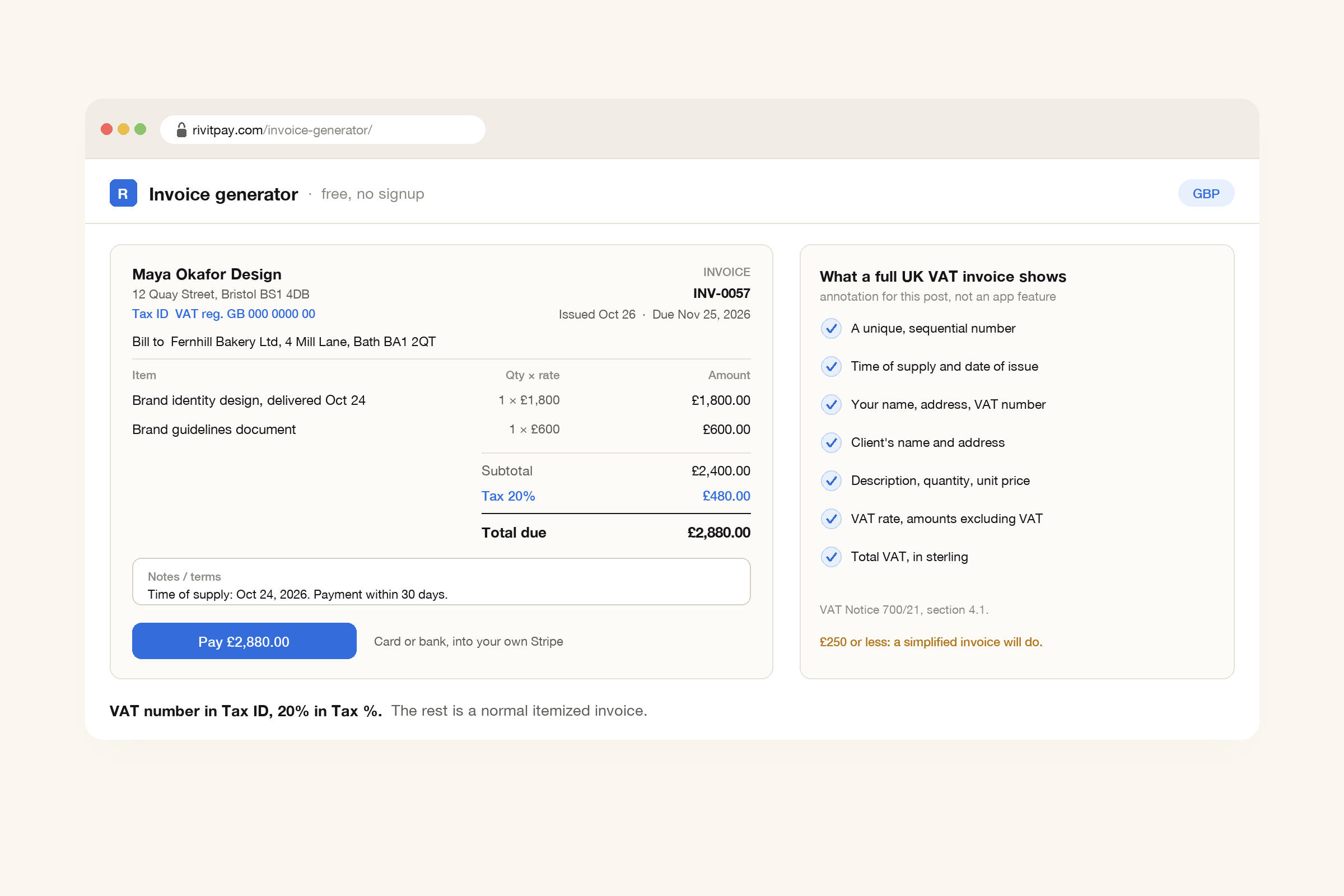
Once you're registered, VAT Notice 700/21 lists what a full VAT invoice must show:
- a sequential number "based on one or more series which uniquely identifies the document"
- the time of supply (tax point), and the date of issue if that's different
- your name, address and VAT registration number
- your client's name and address
- a description of the services, the quantity or extent of the work, and the unit price
- the VAT rate and the amount payable excluding VAT for each line, and the total excluding VAT
- the total VAT, "expressed in sterling", even if the invoice itself is in dollars or euros
You "normally" have to issue it "within 30 days of the date you make the supply". If an invoice is £250 or less including VAT, you can use a shorter simplified invoice instead. The standard rate is 20%, and VAT-registered businesses now keep their records and file returns through Making Tax Digital software.
The price is the other change. A VAT-registered business client reclaims the 20%, so a £1,000 invoice becoming £1,200 makes no difference to them. A sole trader who isn't registered, a charity or a private individual pays the extra £200 for real. If a lot of your clients are like that, decide before you register whether you'll raise your quote or absorb part of the VAT.
The Flat Rate Scheme, and the 16.5% catch
The Flat Rate Scheme is open if your VAT turnover is £150,000 or less. You still charge clients 20%, but you pay HMRC a fixed percentage of your VAT-inclusive turnover and keep the difference. You can't reclaim VAT on purchases, except some capital assets over £2,000. HMRC's own example: a photographer on the 11% rate bills £1,000 plus VAT, £1,200 in total, and pays 11% of £1,200, which is £132.
The catch is the limited cost business rule. If you spend less than 2% of your turnover on goods, or less than £1,000 a year, you pay 16.5% whatever your trade. Most freelancers sell time, not things, so many of them fall into it. Here's the same invoice at 16.5%:
- You bill £1,000 plus £200 VAT: £1,200
- You pay HMRC 16.5% of £1,200: £198
- You keep: £2
Under the normal rules you'd pay over the £200 and reclaim VAT on your costs. So for a limited cost freelancer, the flat rate leaves you about £2 per £1,000 better off before your costs, and loses you all reclaimable VAT on what you buy. The first-year 1% discount makes it £14. HMRC brought the rate in on 1 April 2017 for "businesses with limited costs, such as many labour only businesses". HMRC's statistics don't say why people leave the scheme, but the numbers have fallen a long way: 411,200 traders used it in 2015 to 2016, and 176,100 in 2024 to 2025, out of 1,175,500 eligible.
If you're not a limited cost business, the scheme can still be worth it. Do the sum with your own trade rate and your actual spending on goods before you apply.
Where RivitPay fits
The free invoice generator, with no signup, covers what Notice 700/21 asks for. Put your VAT number in the Tax ID field under your details and it prints on the invoice. Set Tax % to 20 and the invoice shows a subtotal, a "Tax 20%" line and the total. Line items have a description, quantity and rate. The Number field takes your sequence, and the free invoice number generator helps you keep it unbroken. Price it in pounds or any of 45 currencies. For an overseas business client, set Tax % to 0 and use Notes to say the service is outside the scope of UK VAT, if your accountant advises that wording.
With a free account, you can email the invoice, see when it's been opened, and let UK clients pay by card or bank through the Pay button, straight into your own Stripe account. Automatic reminders in your own words follow up until it's paid and then stop.
Keep a running total
The VAT threshold isn't a once-a-year check. Add up your last 12 months of UK invoices at the end of every month, look ahead whenever you sign something big, and leave overseas business clients out of the total. If you're getting close, decide how you'll price VAT before your registration date arrives.
Your VAT number, a numbered sequence, a 20% tax line and a Pay button for card or bank. Free until you've collected $5,000.
Make an invoice, free