When a client goes under
Your client filed for bankruptcy. Here's what happens to your invoice.
The envelope has a court's name on it, and the first paragraph says your client has filed a case under chapter 7 of the Bankruptcy Code. You did $6,400 of work for them in August. The invoice is 40 days overdue. You'd been about to send a firmer reminder.
Don't send it. Bankruptcy changes the rules for chasing an unpaid invoice the moment the case is filed, and the next few weeks decide whether you get anything back. Here's what happens, in the order you'll run into it.
It's happening more than it was
According to the federal judiciary's latest figures, released July 28, 2026, bankruptcy filings rose 12.2% to 608,511 in the year to June 30, 2026. Business filings rose faster, up 16.9%, from 23,043 to 26,941.
To keep that in proportion: filings have risen every quarter since a low of 380,634 in June 2022, but they're still far below the peak of nearly 1.6 million in September 2010. Most clients are not about to go bust. But if you've got a client in a squeezed industry who has started paying slowly, it's worth knowing what happens if they do.
Step one: stop chasing
Filing a bankruptcy case triggers what's called the automatic stay. Under 11 U.S.C. § 362(a)(6), it stops "any act to collect, assess, or recover a claim against the debtor that arose before the commencement of the case". The court's own notice to creditors, Official Form 309C, puts it plainly: "Creditors cannot demand repayment from debtors by mail, phone, or otherwise. Creditors who violate the stay can be required to pay actual and punitive damages and attorney's fees."
That covers the polite stuff too. Your scheduled reminders, a "just following up" email, a demand letter, a small claims case you'd been drafting. All of it stops for the invoices you sent before the filing date. If you use automatic reminders anywhere, turn them off for that client the day you hear.
Step two: find out what kind of case it is
The notice tells you the chapter, the court and the case number. The details of the case itself are on PACER, the federal courts' records system. It costs $0.10 a page, capped at $3 per document, and fees are waived if you spend $30 or less in a quarter. For one case, you'll almost certainly pay nothing. Search by case number, not the client's name.
- Chapter 7 means the business is being wound up. A trustee sells whatever it owns and pays creditors in a set order. Freelancers owed for past work are usually ordinary unsecured creditors, which is near the back of the line.
- Chapter 11 means the business plans to keep operating and restructure its debts. Your old invoices become a claim in that process. The client may still want you to keep working.
Step three: file a claim, if the notice tells you to
To share in whatever gets paid out, a creditor normally files a proof of claim, Official Form 410. Its instructions tell you to "attach redacted copies of any documents that show that the debt exists". For a freelancer, that's your invoices and whatever shows the client agreed to the work. Don't send originals. The instructions warn they "may be destroyed after scanning".
The deadline depends on the chapter and what the notice says:
- Chapter 7 with no assets. If your notice is the "No Proof of Claim Deadline" version, it says: "No property appears to be available to pay creditors. Therefore, please do not file a proof of claim now." If assets turn up, the clerk sends another notice with a deadline. Keep the paperwork ready, and don't file until you're told to.
- Chapter 7 with assets. Under Bankruptcy Rule 3002(c), a claim in a voluntary case is on time if it's filed within 70 days of the filing.
- Chapter 11. Under Rule 3003, the court sets the deadline. If the debtor's own list of debts shows your claim at the right amount, and not marked as disputed, you may not need to file at all. If it's missing, wrong or marked "disputed", you have to file before the deadline or you won't be paid on it.
Claim the amount you're actually owed and nothing more. The same instructions note that a fraudulent claim can mean a fine of up to $500,000, up to five years in prison, or both.
The part nobody expects: payments you've already received
This is the surprise. Under 11 U.S.C. § 547, the trustee can sometimes claw back payments the client made to you in the 90 days before it filed, if they were for an existing debt, the client was insolvent at the time, and the payment left you better off than other creditors. That's called a preference. The idea is that creditors who happened to get paid just before the collapse shouldn't jump the line.
Two of the exceptions matter most for freelancers:
- The ordinary course of business. Payments made in the usual way, on the usual terms, are protected under § 547(c)(2). If the client always paid your invoices in about 30 days and kept doing so, that helps. If they were months behind and you pushed them into paying in one go just before they filed, that looks much less ordinary.
- A small-amount floor. When the debtor is a business, the trustee can't recover transfers worth less than $8,575 in total. That's the § 547(c)(9) amount after the Judicial Conference's inflation adjustment that took effect April 1, 2025.
There are other defenses too, but those two cover most freelance situations. If a demand letter from a trustee ever arrives, it's worth paying a bankruptcy lawyer for an hour before you reply.
If they want you to keep working
In a chapter 11 case, a client may ask you to carry on. Work done after the filing is treated differently from your old invoices. The Form 410 instructions define an administrative expense as one that "arises after a bankruptcy case is filed in connection with operating" the business, and § 507 puts those near the front of the line for payment, ahead of ordinary unsecured claims like your old invoices.
Near the front still isn't guaranteed. The safest arrangement is to be paid as you go. Bill new work on new invoices, dated after the filing, and ask for a deposit or shorter terms. Don't put old and new work on the same invoice.
Where RivitPay fits
RivitPay can't make a bankrupt client pay. What it gives you is the paperwork you'll need, already in order. Every invoice records when you sent it, when the client opened it and when it was paid. That's your evidence for a proof of claim, and it's the pattern that shows whether earlier payments were made in the ordinary course.
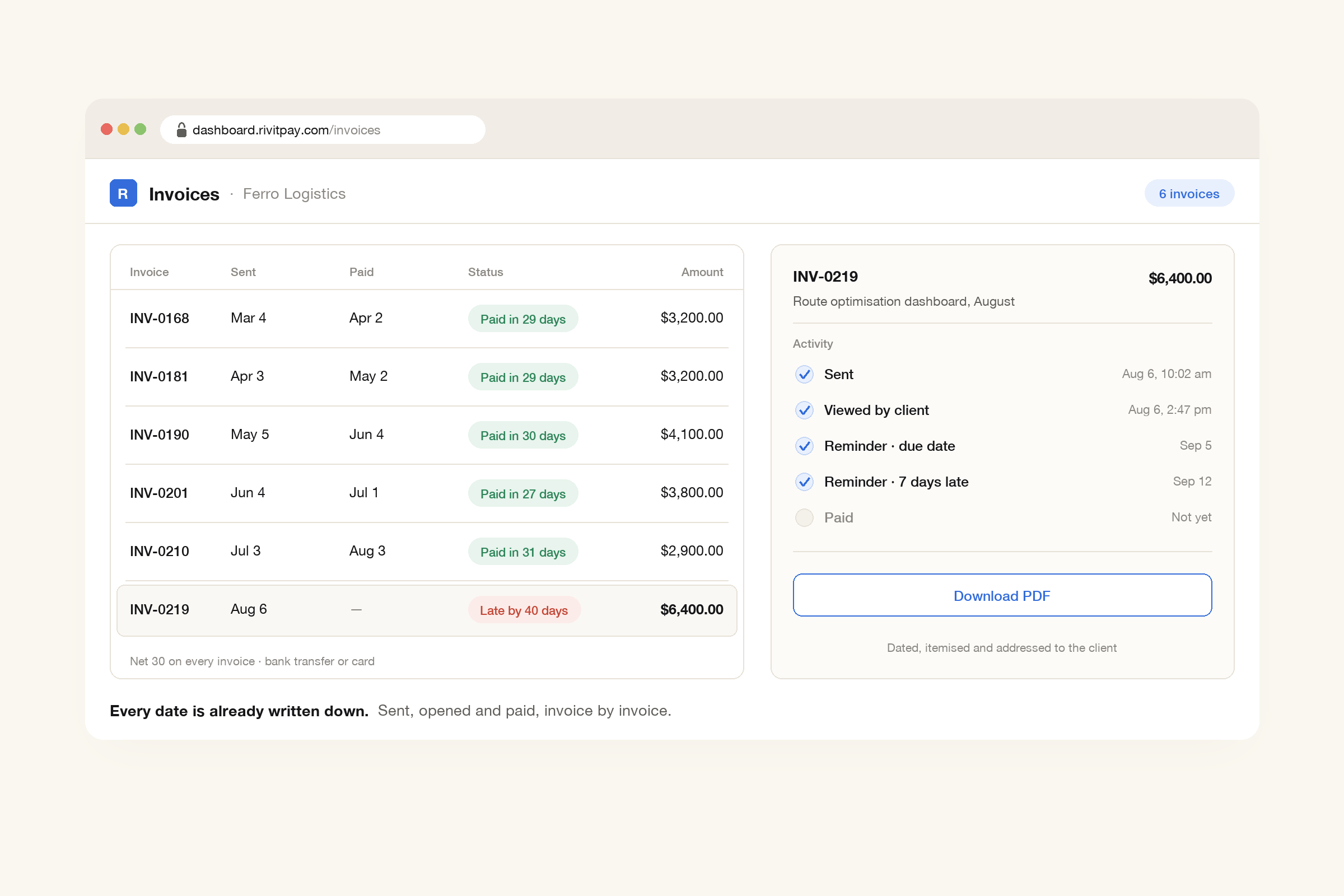
Every invoice downloads as a PDF to attach to a claim. Automatic reminders go out on the schedule you set, in your own words, and stop when the invoice is paid. RivitPay doesn't know when a client files, though, so if one does, take the reminders off their invoices yourself. For new work after a filing, a free account adds a Pay button, so the client can pay each invoice by card or bank straight into your own Stripe account, and you aren't waiting on their accounts payable. Invoicing is free, and there's no RivitPay fee until you've collected $5,000 through the Pay button.
The record matters more than the reminder
Most freelancers find out about a client's bankruptcy from a court notice and then spend a week assembling emails, invoice PDFs and bank statements to work out what they're owed. When every invoice already has its dates on it, that week becomes an afternoon. You may not get every dollar back. You can make sure the reason isn't missing paperwork.
Invoices that record sent, opened and paid, download as PDFs, and come with reminders in your own words. Free until you've collected $5,000.
Make an invoice, free