Tax
Your German client wants an e-invoice: when a PDF stops counting, and who's exempt
If you invoice German businesses, you've probably had the email already: the client's accounts team is "switching to e-invoicing", and could you send XRechnung or ZUGFeRD from now on? Most freelancers have never heard of either. It sounds like your PDF is about to get you paid late.
For most freelancers, it isn't yet. Germany's e-invoice mandate is real, but it comes in stages. Two big groups are exempt for good, and for many of the rest the PDF keeps working until the end of 2027. Here's what the law actually says, with the dates that matter and the one detail about December invoices that's easy to miss.
What counts as an "e-invoice" now
Since 1 January 2025, § 14 of the German VAT Act (UStG) splits invoices in two. An elektronische Rechnung is an invoice in a structured electronic format that allows electronic processing, and it has to follow the European e-invoicing standard (EN 16931) or a format that can be converted to it. Everything else, including a PDF attached to an email, is a sonstige Rechnung, an "other invoice". The same section says sending an other invoice electronically needs the recipient's agreement.
The chamber of commerce in Cologne summarised the finance ministry's October 2025 guidance in one line: "Ein einfaches PDF-Dokument, das per E-Mail versendet wird, erfüllt diese Voraussetzung nicht mehr." A plain PDF sent by email no longer meets the requirement. The formats that do are XRechnung, or ZUGFeRD 2.x except its MINIMUM and BASIC-WL profiles. A hybrid, a PDF with the structured XML data inside it, also works, but the XML part is the one that counts.
The mandate in § 14(2) covers one situation: an invoice to another business for its business, where you and your client are both established in Germany. A client in the Netherlands or the US isn't covered. Neither is a private individual.
The dates, from the transition rule
The timetable is in § 27(38) UStG. For a German freelancer invoicing German businesses:
- Work done in 2025 and 2026: you can still send a paper invoice, or a PDF if your client agrees, as long as you send it by 31 December 2026.
- Work done in 2027: the same, sent by 31 December 2027, but only if your total turnover in 2026 was no more than €800,000. Above that, you have to send e-invoices from 1 January 2027.
- Work done from 2028: e-invoices for everyone in scope, unless one of the exemptions below applies.
Here's the detail that's easy to miss. The cut-off is about when the invoice is sent, not just when the work was done. Say you're a developer in Berlin who charges VAT and turned over €90,000 in 2026, and you finish a project for a Munich agency on 18 December 2027. If you invoice it on 5 January 2028, the transition rule no longer covers that invoice, so it has to be an e-invoice. Send it before New Year and a PDF is still fine. For the rare freelancer over €800,000, the same thing happens a year earlier, with December 2026 work.
Receiving is a separate rule, and it applies already. The same Cologne chamber note says that since 1 January 2025 every business in Germany must be able to receive and process e-invoices. Your software subscription or coworking space can send you one without asking first, so make sure you can open the XML, not just the email.
Two groups are exempt for good
Small business owners under § 19. Since 2025, the Kleinunternehmer rule means your sales are VAT-exempt if your total turnover was no more than €25,000 last calendar year and doesn't go over €100,000 this year. Two details matter for freelancers. First, turnover is counted from the money you've actually received (vereinnahmte Entgelte), so an invoice your client pays in January counts toward next year. Second, the €100,000 test applies during the current year. If a big contract takes you past it, you don't wait until January to start charging VAT. Ask your Steuerberater which invoice the change starts on.
For invoices under § 19, § 34a of the VAT regulations (UStDV) sets a short list of what they must show: your and your client's full name and address, your tax number (Steuernummer) or VAT ID, the date, what you did, the price as one amount, and a note that the small-business exemption under § 19 applies. It ends with the line that matters here: such an invoice can "immer als sonstige Rechnung" be sent, always as an other invoice. A PDF, permanently.
Small invoices. § 33 UStDV gives the same permanent exception to invoices with a total of no more than €250. That probably won't cover your project invoices, but it covers the odd small job.
How many people the exemption covers
Germany's statistics office published its latest VAT figures on 20 October. In the annual-return statistics for 2022, it counted almost 7.3 million businesses liable for VAT. Almost 3.60 million of them, 49.40%, had turnover of up to €22,000, which is below today's €25,000 limit. And 68.27% were natural persons or sole proprietorships. Those are 2022 figures, and not everyone under the limit uses the § 19 rule. Still, it suggests that a lot of German businesses, many of them one-person operations, could keep sending PDFs indefinitely.
If you're not exempt
If you charge VAT and invoice German businesses, you have until the end of 2027 at the latest to get set up, as long as you're under €800,000. Until then, nothing stops a client asking for XRechnung early, but the law doesn't require it. Throughout the transition, though, a PDF by email only works if your client agrees to it, so if a client says no to PDFs, that's their right. Agree on the format before the first invoice, not when it's already overdue. From 2028 you'll need software that produces EN 16931 invoices for those clients.
None of this changes the rest of § 14(4). A full invoice still needs a unique, sequential invoice number, the date of the work, the net amount, the VAT rate and amount (or a note on why there's no VAT), plus your tax number or VAT ID.
Where RivitPay fits
To be clear about what RivitPay is: the free invoice generator, with no signup, makes a PDF and a share link. It doesn't make XRechnung or ZUGFeRD files. That makes it a good fit for the invoices the mandate doesn't touch, and for the next 14 months for most of the rest.
- Kleinunternehmer: put your Steuernummer in the Tax ID field, set Tax % to 0, and add the § 19 note in Notes, for example "Umsatzsteuerfrei gemäß § 19 Abs. 1 UStG (Kleinunternehmerregelung)", in whatever wording your Steuerberater prefers.
- Clients outside Germany, and private clients: the mandate doesn't apply. Price it in euros or any of 45 currencies, and the Pay button lets them pay by card or bank, straight into your own Stripe account.
- German business clients, through 2027: a PDF still works if they agree. Use the Number field for your sequence, and the free invoice number generator helps you keep it unbroken.
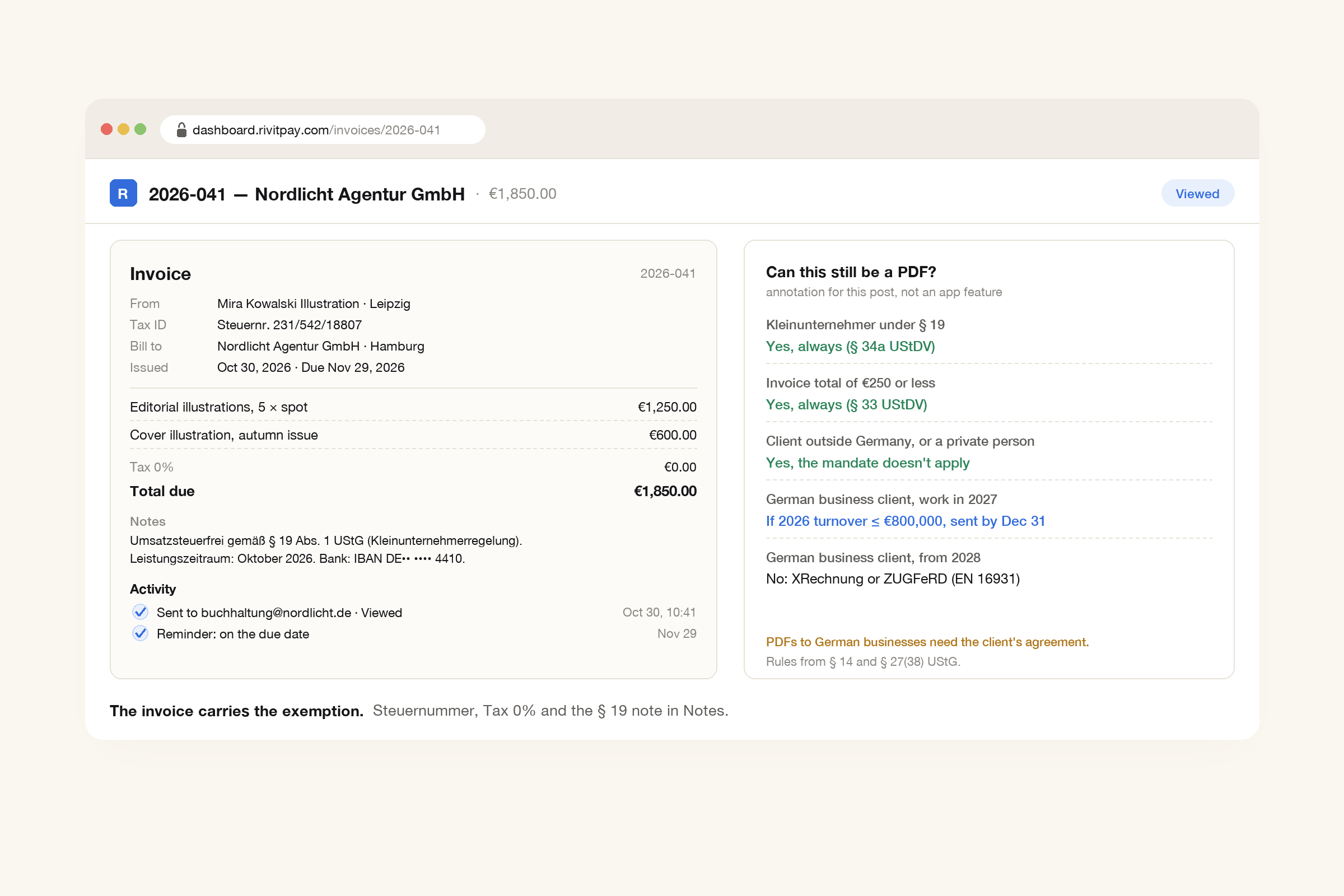
With a free account, you can email the invoice, see when it's been opened, and set automatic reminders in your own words that stop once it's paid. That part matters whatever format the invoice is in: an e-invoice gets processed faster, but it doesn't make anyone pay on time.
The short version
Under § 19, or invoicing clients outside Germany? Keep sending PDFs. Invoicing German businesses and charging VAT? PDFs work until the end of 2027 if you stayed under €800,000 in 2026 and your client agrees. Send your December 2027 invoices before New Year, and be on e-invoices for anything after that.
Your Steuernummer, the § 19 note, euros or any of 45 currencies, and a Pay button for clients who want to pay by card. Free until you've collected $5,000.
Make an invoice, free