After you get paid
Your invoices aren't your income (not to a lender)
You found the apartment, or the house. The application asks for your last two pay stubs. You don't have pay stubs. You have a year of invoices, most of them paid, and a bank account that goes up in lumps.
So you send the invoices, and they don't land the way you expect. To a landlord, a pile of invoices is a list of things you asked people to pay. To a mortgage lender, it's barely evidence at all. What they want is something else, and it's worth knowing what before you're filling in the form with a deadline.
Why it's harder when you're paid by invoice
It isn't just paperwork. The Federal Reserve's latest survey of household finances, covering 2025, found that 22% of self-employed adults struggled to pay their bills in the previous 12 months because their income varied, compared with 10% of people who worked for someone else. And in a footnote: "after controlling for income, self-employed adults still were more likely to experience hardships due to income variability."
That's exactly what a lender or landlord is trying to price. They aren't asking whether you earned money last month. They're asking whether you'll earn it next month, and a salary answers that question in a way a busy October doesn't.
What a mortgage lender actually counts
Lenders that sell their loans to Fannie Mae have to follow its Selling Guide, which makes it a good public map of what a mortgage lender will ask for. A few lines from it do most of the work:
- You're self-employed if you own 25% or more of the business. A sole proprietor owns all of it.
- Two years is the default. Lenders generally get "a two-year history of the borrower's prior earnings" to show the income is likely to continue.
- One year can be enough, with conditions. Less than two years of self-employment can still count if your latest signed tax returns show "a full year (12 months) of self-employment income from the current business," and you can show earlier income at the same level or higher in the same kind of work. A designer who went freelance after five years at an agency is the case this is written for.
- The evidence is your tax returns. Signed federal returns for the last two years with every schedule attached, or IRS transcripts of them.
Federal rules point the same way. Under the CFPB's ability-to-repay rule, a lender has to verify your income "using third-party records that provide reasonably reliable evidence." The examples it lists are tax returns, an IRS tax-return transcript, W-2s, payroll statements and "financial institution records". Invoices aren't on the list. You wrote them, so they don't count as third-party evidence.
The number they use is after your write-offs
This is the part that catches people. For a sole proprietor, Fannie Mae's guide says income "is calculated on IRS Form 1040, Schedule C". That means your net profit after expenses, not what you invoiced.
The lender then adjusts it, but only a little. The Schedule C section lists a few deductions that get added back because they aren't cash leaving your account: "depreciation, depletion, business use of a home, amortization, and casualty losses." Everything else you deducted stays deducted. And anything the lender decides was a one-off "must be deducted in the cash flow analysis."
So a freelancer who invoiced $110,000, collected $104,000 and wrote off $38,000 of software, travel and equipment has, as far as the lender is concerned, something close to $66,000 of income, plus whatever home-office and depreciation they get back. The write-offs that helped in April are working against you here. If you're planning to buy a home in the next couple of years, that's a conversation to have with whoever does your taxes before you file, not after.
The year-to-date gap
Tax returns describe last year. If you apply in the summer, your strongest recent months are on no tax return at all. Fannie Mae's profit and loss section says "a year-to-date profit and loss statement is not required for most businesses." But if your application is "dated more than 120 days after the end of the business's tax year" (for most freelancers, that's from about May), the lender can ask for one. It can be "audited or unaudited", which in practice means one you put together yourself.
A year-to-date P&L for a freelancer is mostly two lists: what clients paid you, and what you spent. The first one is where your invoices finally earn their keep. Not as proof on their own, but as the itemised record that makes the P&L add up and matches the deposits on your bank statements.
Renting is looser, and less predictable
Landlords don't have a rulebook like Fannie Mae's. Each one sets its own bar, and many ask for income at some multiple of the rent. The CFPB notes that a tenant screening report can include employment verification, which is awkward when you're your own employer.
What tends to work is a small, tidy packet:
- Last year's tax return, or the 1040 and Schedule C pages if you'd rather not hand over the whole thing.
- Three to six months of bank statements showing deposits that line up with your paid invoices.
- A signed income statement: what you do, how long you've done it, your average monthly income over the last 12 months.
- A letter from a regular client, if one will sign it. It carries more weight because it comes from someone else.
Use a twelve-month average and round down. If your last three months were your best ever, the landlord will see that in the bank statements anyway. If the statement and the deposits don't match, you've lost more credibility than the higher number was worth.
Where RivitPay fits
We built a free proof of income letter generator for the two letters above: a self-employment income statement you sign yourself, or a verification letter for a client to sign. You fill in what you do, how long you've done it and your average monthly income, and print it or save it as a PDF. It runs in your browser and nothing you type is uploaded or saved.
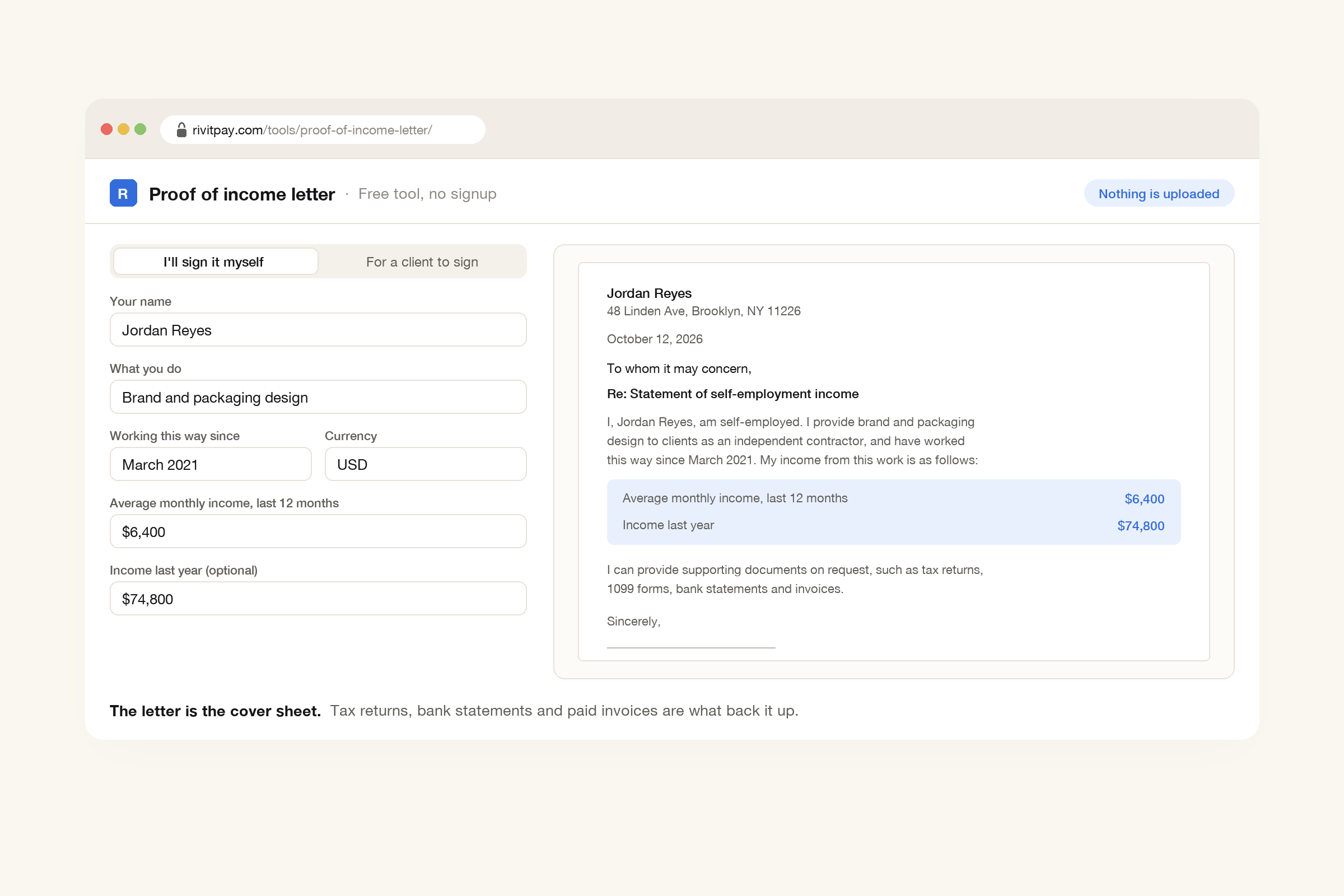
The number on that letter has to come from somewhere, and that's where a free RivitPay account helps. It keeps every invoice you send and marks it paid when the money arrives, so the last twelve months of income is a total you can look up rather than reconstruct. Card payments through the Pay button settle to your own Stripe account, and RivitPay never holds the money. When a lender asks for a year-to-date P&L, the income half is already written down.
Start the paper trail before the application
The time to sort this out is a year before you need the apartment or the mortgage, not the week the application is due. File a tax return that reflects the income you want to be judged on. Keep your invoices and your deposits telling the same story. When someone asks for proof, you'll be handing over a short packet rather than a long explanation.
A free proof of income letter, plus invoices that track what's been paid and settle card payments to your own Stripe account. Free until you've collected $5,000.
Write my letter, free