Getting paid by government
A federal agency can pay you by card, and owes interest if it's late
Someone at a federal agency liked your work. Maybe it's a two-day workshop for a program office, a set of illustrations for a report, or a site audit. They email to ask two things you've never been asked before: "Can we put it on the card?" and "Are you registered in SAM?"
Government clients feel bureaucratic, and they are. But the rules for how an agency pays you are public, written down, and in a couple of places more generous than most private clients. Which rules apply depends mostly on one number.
The number that decides it: $15,000
The Federal Acquisition Regulation defines the micro-purchase threshold as $15,000. At or under it, an agency can buy with simplified procedures, and the FAR is clear about how it should pay: "The Governmentwide commercial purchase card shall be the preferred method to purchase and to pay for micro-purchases" (FAR 13.201(b)).
There are exceptions. For services covered by the Service Contract Labor Standards the threshold is $2,500, and for construction it's $2,000. But for a lot of freelance work under $15,000, the "card" is a government purchase card, and the agency would rather use it than set up a contract.
Those cards carry a lot of spending. GSA's SmartPay program statistics for fiscal year 2025 show $39.4 billion in total spend across its purchase, travel and fleet cards, at an average of $480 a transaction.
Path one: the card
If you already take Visa or Mastercard, GSA's merchant page says you're "already set up to accept GSA SmartPay cards/accounts." Three details are worth knowing before you send the payment link:
- You may not need SAM. Registration in the System for Award Management is normally required, but FAR 4.1102(a)(1) exempts purchases under the micro-purchase threshold that use the purchase card "as both the purchasing and payment mechanism." If the card is only the payment method on a contract, the exemption doesn't apply.
- Don't add sales tax. GSA's guide to recognizing its cards says "All GSA SmartPay Purchase cards/accounts are CBAs and should be exempt from state sales tax." A CBA is a centrally billed account, so the agency pays the card bill, not the employee. Purchase cards use prefixes such as 5565 and 5568 (Mastercard) or 4614 and 4716 (Visa).
- Your normal card fees apply. Same page: "The transaction fees negotiated with the bank to accept cards from the private sector will also apply to government purchases." No special government rate, but no extra charge either.
One more thing to ask. GSA's FAQ says payments made through third-party payment platforms (it names PayPal) "are considered to be high-risk transactions." It adds that there's no governmentwide policy, and some agencies restrict them completely while others allow them when there's no other way to pay. Online card payments for small businesses often run through platforms like these, so ask the cardholder whether an online payment link is fine before you send one. It saves an awkward decline.
Path two: the contract and the "proper invoice"
Above the threshold, or whenever the agency issues a contract or order, you invoice the old-fashioned way. Many agencies take invoices through the Invoice Processing Platform, which lists more than 220 federal agencies and charges nothing to agencies or vendors. The details live in the Prompt Payment clause, FAR 52.232-25. It lists what a "proper invoice" must include:
- your name and address, and the invoice date and number
- the contract number or other authorization, including the order number and line item number
- a description, quantity, unit of measure, unit price and extended price for what you delivered
- shipping and payment terms, including any discount for paying early
- the name and address payment goes to, which must match the contract
- a person to contact if the invoice is defective: name, title, phone and mailing address
- your TIN and bank details, but only where the contract asks for them on the invoice. Otherwise your bank details have to be on file, usually through SAM.
- anything else the contract itself asks for
If something's missing, the billing office has to send the invoice back "within 7 days after receipt" with the reasons. That's where a lot of government payments really go wrong. A missing line item number doesn't make the payment late. It means the payment clock never started.
The 30-day clock, and the interest you don't have to ask for
Under the clause, payment is due on the later of the 30th day after the billing office receives a proper invoice and the 30th day after the government accepts the work. Miss that, and the agency owes interest. The Prompt Payment regulations in 5 CFR 1315.10 say late-payment interest "shall be paid without regard to whether the vendor has requested payment," with a notice showing the amount, the days late and the rate. It's calculated on a 360-day year, and amounts under $1.00 aren't paid.
The rate is set by the Treasury every six months. For 1 July to 31 December 2026, it's 4.75%. On a $12,000 invoice paid 20 days late:
- $12,000 × 4.75% = $570 a year
- $570 × 20 ÷ 360 = $31.67 in interest
It's not a lot, and it won't arrive any faster than the payment does. But it shows the system takes its own deadline seriously. Compare that with a private client, where you'd have to find a law and ask for it yourself. The thing to protect is the proper invoice, because nothing counts until it's received.
Where RivitPay fits
For the card path, the invoice is the payment link. In a free account, the agency contact gets your invoice by email with the PDF attached and a Pay button, and the cardholder pays by card into your own Stripe account. You can see when they opened it, and automatic reminders in your own words stop the moment it's paid. Leave the Tax % at zero for a purchase card.
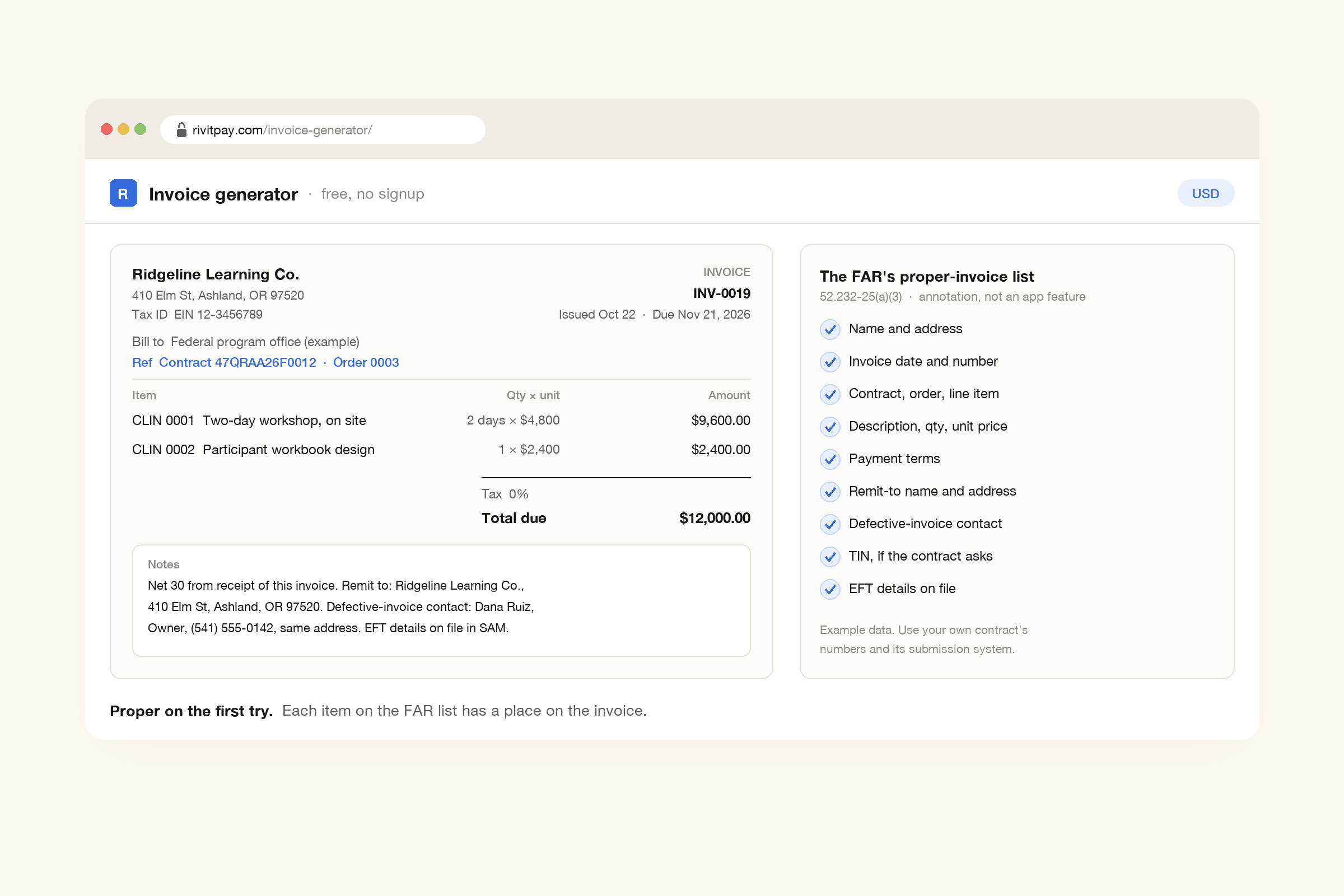
For the contract path, the free invoice generator covers most of the list without a signup. Your name and address and tax ID go in From. The contract and order number go in Reference / PO. Line items take a quantity and a unit price. There's an invoice number, issue date and due date, and Notes can carry the remit-to address and the person to call about a defective invoice. Download the PDF and upload it wherever the contract tells you to submit invoices.
Small government work is easier than it looks
Under $15,000, a federal client is often just a person with a card who'd like to pay you without paperwork. Above it, you're paid on a 30-day clock that runs from a "proper" invoice and pays interest automatically when it's missed. Either way, the invoice does the work. Get the contract number, the line items and the contact details right the first time, and the clock starts when you send it.
Contract and order numbers in the reference, line items with unit prices, and a Pay button for purchase cards where the agency allows it. Free until you've collected $5,000.
Make an invoice, free