Tax
Billing a business in another EU country? Your invoice needs two VAT numbers and two words
You're a freelance developer in Lisbon. A Berlin agency books you for a month and you send a €4,000 invoice, laid out exactly like the ones you send Portuguese clients. Two weeks later their accounts team sends it back: no VAT number for them, VAT charged that shouldn't be there, and nothing saying who pays the tax. Fix it and resend. Your 30 days start again.
This happens a lot, and it isn't the client being difficult. When you sell services to a business in another EU country, the VAT rules flip round, and an invoice that's fine at home is wrong across the border. The good news is that the fix is short: two VAT numbers, two words, and a deadline. Here's what the VAT Directive actually says.
Why the VAT disappears from your invoice
For most services between businesses, Article 44 of the VAT Directive says the place of supply is "the place where that person has established his business", meaning your client. So the tax belongs to Germany, not Portugal. Then Article 196 makes the client pay it: VAT "shall be payable by any taxable person … to whom the services referred to in Article 44 are supplied, if the services are supplied by a taxable person not established within the territory of the Member State."
The EU's own Your Europe guide puts it plainly: in that case "the VAT will not appear on your invoice. This does not mean the service is not subject to VAT, just that the VAT would be accounted for and paid directly by your business partner in the other EU country." That's the reverse charge. Your client declares German VAT on your fee as if they'd supplied the service themselves and, as the cross-border page puts it, "can usually deduct this amount later on when you make your VAT declaration".
Two exceptions to keep in mind. This is about business clients. A private person in another country is usually charged your home VAT, per Your Europe's cross-border page, which also warns that "there are several important exceptions to the rules", for things like events and work connected to property. If your work is one of those, check before you invoice.
Check the client's VAT number first
How do you know the client is a business? The EU's implementing regulation gives you the test. Under Article 18 of Regulation 282/2011, you can treat a client in the EU as a taxable person "where the customer has communicated his individual VAT identification number to him, and the supplier obtains confirmation of the validity of that identification number and of the associated name and address." The flip side is in the same article: a client who hasn't given you a VAT number can be treated as a private customer.
The check is the free VIES tool. One thing trips people up, according to the Your Europe VIES page. A number can be perfectly real at home and still come back invalid, because it "has not been activated for intra-EU transactions", and "some EU countries require a separate registration for intra-EU transactions." If that happens, the client needs to sort it with their own tax office before you leave the VAT off. The same page recommends that "you keep track of your validation in case of tax control", so save the confirmation with the invoice.
What the invoice has to show
Article 226 is the EU-wide checklist. For a reverse-charge invoice, the lines that matter most are:
- Your VAT number, and your client's VAT number, the one "under which the customer received a supply … in respect of which he is liable for payment of VAT". This is the line a home-country invoice usually doesn't have.
- The words "Reverse charge". Point 11a: "where the customer is liable for the payment of the VAT, the mention 'Reverse charge'".
- A sequential invoice number "which uniquely identifies the invoice", the date of issue, and both full names and addresses.
- What you did and when: "the extent and nature of the services rendered", plus the date the work was done or finished if it's different from the invoice date.
- The net amount, with no VAT added on top.
The deadline nobody mentions
At home, your country may let you invoice whenever suits you. Cross-border, there's a fixed date. Article 222 says that for services where the client pays the VAT under Article 196, "an invoice shall be issued no later than on the fifteenth day of the month following that in which the chargeable event occurs." In plain terms: finish the Berlin project on 28 October, and the invoice is due out by 15 November.
That deadline happens to suit you anyway. Every week an invoice sits in drafts is a week added to the wait for your money.
You may need a VAT number even if you never charge VAT
This is the part that catches small freelancers. Lots of EU countries let you stay out of VAT below a turnover threshold, so you've never had a VAT number. But Article 214(1)(e) requires an individual VAT number for "every taxable person, established within their respective territory, who supplies services within the territory of another Member State for which VAT is payable solely by the recipient pursuant to Article 196." Your first reverse-charge client can be the reason you need one.
With it comes a short report. Article 262 requires a recapitulative statement listing the business clients in other countries you supplied reverse-charge services to. Article 263 sets it per calendar month, though countries "may allow" a quarterly statement for services, due within a month of the quarter ending. It's how your tax office matches your sales against your clients' returns, which is why the client's VAT number on your invoice matters so much.
Why tax offices care, and what's coming
The European Commission's VAT gap report estimates that €128 billion of VAT went uncollected in the EU in 2023, 9.5% of what was due, through "non-compliance, insolvency, and administrative errors". Cross-border reverse charge is one of the places that gap is policed, through these numbers and statements.
It's also where the next change lands. The VAT in the Digital Age package, adopted on 11 March 2025, brings in "Digital Reporting Requirements" that "will affect cross-border B2B transactions from 1 July 2030", based on e-invoicing. The Commission says the move "will help reduce VAT fraud by up to €11 billion a year". Since the package came into force on 14 April 2025, countries have also been able to require e-invoices at home, as Germany is doing now.
Where RivitPay fits
You can build a correct reverse-charge invoice in the free invoice generator, with no signup:
- Tax ID: your VAT number, with the country prefix. It prints under your name and address.
- Client address: there's no separate field for the client's VAT number, so add it as the last line of their address, for example "VAT DE123456789".
- Tax %: 0, so no VAT is added.
- Notes / terms: "Reverse charge: VAT to be accounted for by the recipient (Article 196, Directive 2006/112/EC)", or your accountant's preferred wording.
- Number: keep your sequence unbroken. The free invoice number generator helps.
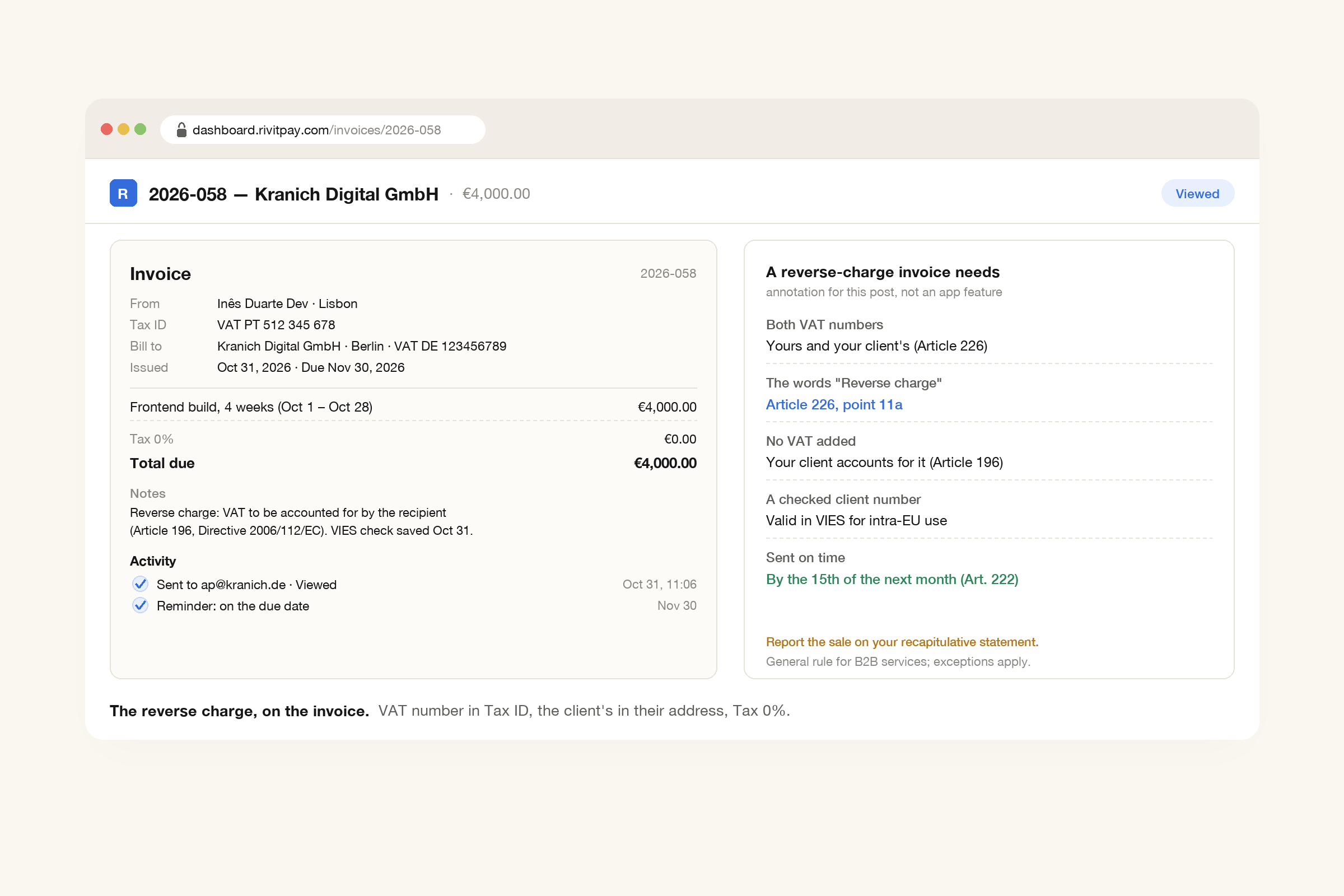
Price it in euros or any of 45 currencies. The Pay button lets the client pay by card or bank, straight into your own Stripe account. With a free account you can email the invoice, see when it's been opened, and set reminders in your own words that stop when it's paid.
The short version
Get the client's VAT number and check it on VIES. Put both VAT numbers on the invoice, no VAT, and the words "Reverse charge". Send it by the 15th of the month after you finish. And if you're a small freelancer without a VAT number, get one before the first cross-border invoice, not after.
Your VAT number, your client's, a reverse charge note and Tax at 0%, in euros or any of 45 currencies. Free until you've collected $5,000.
Make an invoice, free