Getting paid by government
A state agency has a payment deadline too, and owes interest when it misses it
A lot of government work isn't federal. It's a survey analysis for a state health department, photography for a transportation agency, or a training video for a state university. The contract is signed, the work is delivered, and the invoice disappears into a system you can't see.
Yesterday we looked at how federal agencies pay. States have their own rules, usually called prompt payment laws, and the good ones work the same way: a clock starts when a proper invoice arrives, and if the state misses the deadline, it pays interest. Every state writes its own version. Here's how three of the biggest work, and what they have in common.
It happens, and the state pays for it
New York's Comptroller publishes the numbers every year. In its Prompt Payment Interest Report for the fiscal year to 31 March 2026, state agencies paid vendors $4,239,678 in late-payment interest, across 25,200 interest payments. The reasons given include "delays in encumbrance processing, and agency backlog or agency processing delays." The Department of Health alone paid $1,211,445.
So late payment from a state isn't rare. But in states with a prompt payment law, it isn't free for the state either.
Texas: day 30, prime plus one, and no early payments
Under Texas Government Code 2251.021, a payment is overdue on the 31st day after the latest of three dates: when the agency gets the goods, when you finish the service, or when it receives your invoice. The same chapter covers local governments too, though a political subdivision whose governing body meets only once a month or less isn't overdue until the 46th day.
- The rate is prime plus 1%. It's set once a year from the Wall Street Journal prime rate (section 2251.025). The Comptroller's interest calculator shows 7.75% for fiscal 2027, which began on 1 September 2026. A $6,000 payment 30 days late comes to $38.22.
- You don't have to ask. The agency pays interest "at the same time the principal is paid," and it can't require you to request it first (section 2251.026). If it's missing, the Comptroller's payee guide says to claim it from the paying agency "not later than the sixth month" after the late payment arrives.
- Disputes have a deadline too. An agency has to tell you about an error or disputed amount within 21 days of receiving the invoice, with a detailed statement of what's disputed. It can hold back no more than 110% of the disputed amount (section 2251.042).
The twist is a separate payment scheduling law. The same payee guide explains that state agencies "are not allowed to pay vendors before the payments are due" unless the invoice is under $5,000 or there's a business reason, such as a substantial early-payment discount. Payments are scheduled to go out "just before the payment becomes late." So on a large invoice, expect the money around day 30, not before.
New York: 30 days, or 15 for small businesses that invoice electronically
New York's rules are in Article 11-A of the State Finance Law. Under section 179-f, the required payment date is 30 calendar days, excluding legal holidays, from the later of receiving a proper invoice or receiving the goods or services. A "proper invoice" is defined in section 179-e: a written request that sets out "the description, price, and quantity" of what you delivered, with whatever supporting documents the agency reasonably requires.
- 15 days for qualified small businesses. You need a primary place of business in New York, a significant business presence there, independent ownership, no dominance in your field and 200 or fewer employees. You also have to sign up to invoice and be paid electronically, and self-certify in the state's Vendor Self-Service Portal, according to the Comptroller's small-business page. Its guidance to agencies is blunt: an invoice sent "by email, fax, text, SMS" doesn't count as electronic for this purpose.
- The agency has to flag problems fast. It has 15 days (7 for a small business) to tell you about defects in the work or the invoice. If it tells you later, the extra days come off its payment clock.
- The rate is the state's tax overpayment rate. Section 179-g ties interest to the overpayment rate set by the Commissioner of Taxation and Finance. Interest under $10 isn't paid.
Florida: 40 days, then interest, and an ombudsman
Florida's rule is section 215.422 of its statutes. An agency has 20 days after receiving the invoice and approving the work to approve the invoice for payment, and inspection and approval should take no longer than 5 working days unless the contract says otherwise. If the payment hasn't been issued within 40 days, the agency owes interest on top of the invoice.
- The rate changes every quarter. It's the judgment interest rate set by the Chief Financial Officer. For the quarter that began on 1 October 2026, the CFO's memo to agencies sets it at 7.87% a year.
- There's someone to call. The statute creates a vendor ombudsman in the Department of Financial Services to help vendors get paid on time, and requires its phone number to appear on agency purchase orders.
- Paperwork errors reset the clock. If the error is yours, the 40 days restart from your corrected invoice. Not having your federal taxpayer ID paperwork on file with the state counts as your error.
- An early-payment discount gets priority. If your invoice offers a discount for paying in under 30 days, agencies must process it preferentially.
What all three have in common
Every clock starts from a complete invoice, received where the agency says to send it, for work it has accepted. That's the part you control. Before you send one:
- Finish vendor registration first, including your tax ID form. An unregistered vendor can't be paid on time, however good the invoice is.
- Quote the contract and purchase order numbers exactly as they appear on the order.
- Describe the work with quantities and prices that match the contract, and give the date you finished.
- Send it to the designated payment office or system, and keep a record of when it went.
If your state isn't one of these three, ask the agency's accounts payable office which prompt payment rules apply to your contract. Universities, cities and counties often have their own.
Where RivitPay fits
The free invoice generator covers what these laws ask for, with no signup. Your name, address and tax ID go in From, the contract and PO go in Reference / PO, and each line item takes a description, quantity and rate. There's an invoice number, issue date and due date, and Notes can carry the completion date and a contact for questions. Download the PDF and upload it wherever the agency tells you to.
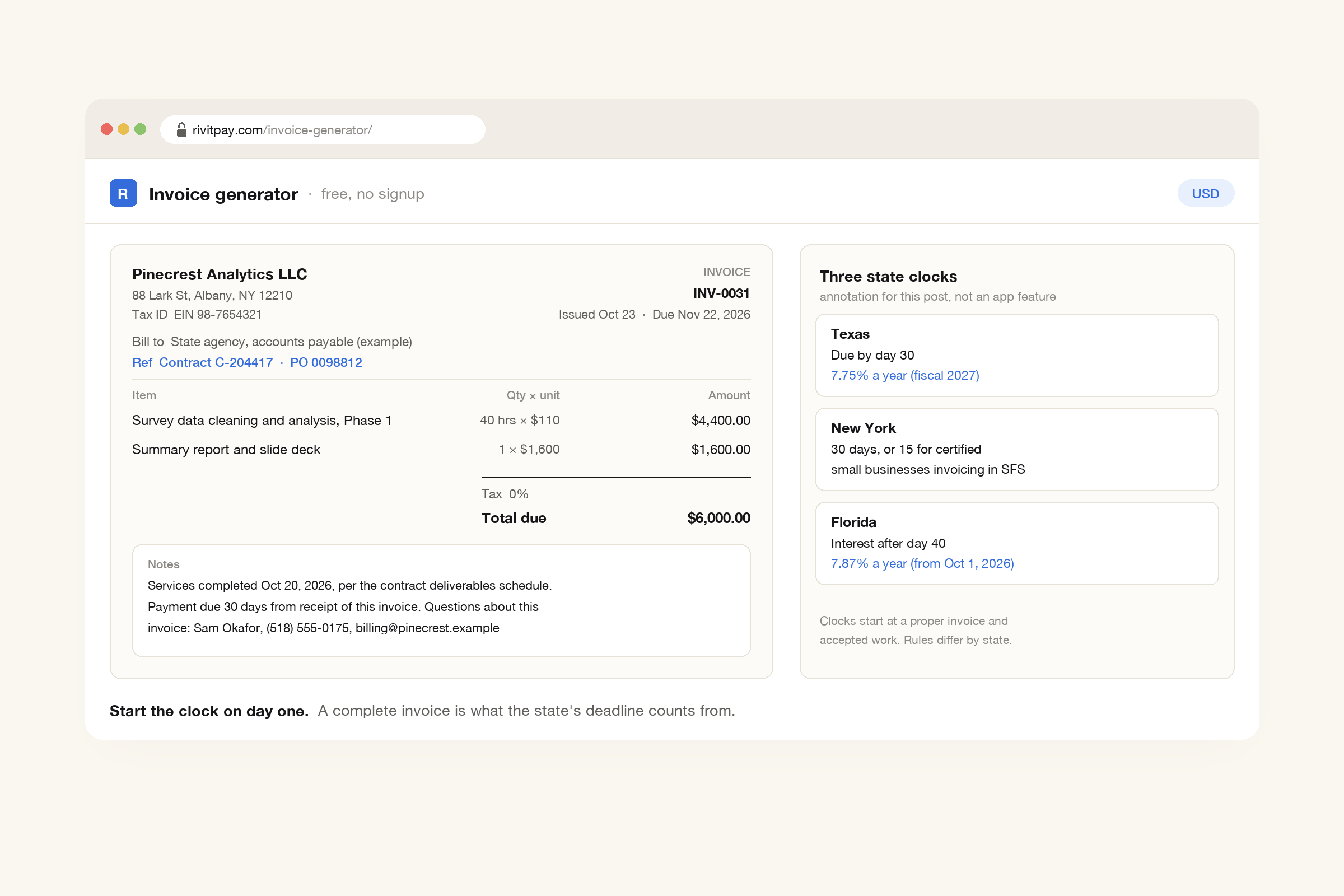
In a free account, you can also email the invoice with the PDF attached, see when it's been opened, and set automatic reminders in your own words that stop the moment it's paid. If the agency pays by card, the Pay button takes card or bank payments into your own Stripe account.
The state is on a clock too
A state client can feel like a black box, but most of the big ones have a written deadline and an interest rate for missing it. Texas pays at day 30, New York at day 30 or 15, Florida pays interest after day 40. In every case, the clock starts with a proper invoice. Make yours complete the first time, and the deadline works for you.
Contract and PO numbers, line items with quantities and rates, your tax ID and a contact for questions. Free until you've collected $5,000.
Make an invoice, free