The paperwork of getting paid
The 1099-K threshold went back up. Your state might disagree.
If you've been freelancing for the last few years, you have lived through one of the strangest games of legislative ping-pong in recent memory. A $600 reporting threshold for payment apps was coming. Then it was delayed. Then it was $5,000. Then $2,500. Then, quite abruptly, it wasn't happening at all.
Here's where it landed, and — more usefully — the part nobody mentions, which is that the federal number was never the only number that applied to you.
What's actually true now
The One, Big, Beautiful Bill retroactively reinstated the reporting threshold that existed before the American Rescue Plan Act of 2021. A third-party payment platform now has to send you a Form 1099-K when the gross amount of your reportable payment transactions exceeds $20,000 and the number of transactions exceeds 200 (IRS, October 2025). Both conditions, not either.
For most solo freelancers, that combination is the whole story: 200 separate transactions is a lot of invoices. Bill six clients a month at healthy rates and you can clear $20,000 comfortably while never coming close to 200 payments. Federally, no form.
Which is exactly where people get into trouble, because "no form" is not the same as "nothing to report" — and because the states never agreed to any of this.
The bars your state actually set
Payment processors don't just file with the IRS; they file with states, and a good number of states set their own, much lower thresholds. Stripe — the processor behind RivitPay's card payments — publishes the state-by-state table it files against, and it's a genuinely uneven landscape:
- Rhode Island: $100. One decent invoice.
- $600 in the District of Columbia, Maryland, Massachusetts, Montana, Vermont and Virginia.
- Illinois: $1,000 and 4 transactions. New Jersey: $1,000. Arkansas: $2,500.
- Plenty of states — California, Georgia, Hawaii, New York and others — simply match the federal figure, and several don't require 1099-K filing at all.
So two freelancers with identical books, one in Providence and one in Sacramento, can have completely different mail arriving in January. The federal headline moved; roughly a dozen state floors didn't move with it. If you read "the threshold is $20,000 now" and concluded no form was coming, your state may be about to correct you.
The part that never changed at all
This is the sentence worth taping to your monitor, and it's the IRS's own: "Whether or not you receive a Form 1099-K, you must still report any income on your tax return" (IRS).
A 1099-K is a report, not a tax. It doesn't create the obligation and it doesn't cap it. Every threshold change over the past four years altered who gets a piece of paper — none of them altered what you owe on the work you did. The freelancers who panicked about the $600 rule and the ones who relaxed when it was repealed were both reacting to the same thing: paperwork visibility, not liability.
The practical consequence is that your records are the real record, and the form is a partial copy of them at best.
Why the form is always an incomplete picture
Two structural gaps are worth understanding before you ever compare a 1099-K to your own numbers.
It only counts one channel. A 1099-K reports what flowed through that specific processor. The client who paid you by bank transfer, the one who sent a check, the one who paid in stablecoins — none of them appear. If you're using the number on the form as your income figure, you're understating, sometimes badly.
It reports gross. The threshold and the reported figure are both the gross amount of reportable transactions. Processing fees, refunds and chargebacks come out afterwards. The number on the form will generally be larger than the money that actually reached you — which is a normal thing that gets reconciled on your return, not an error to be alarmed by.
Both gaps have the same remedy: keep your own list of what you invoiced, what was paid, when, and by which method. That's a habit, not a product — a spreadsheet does it fine. It just happens to be something your invoicing tool should be doing for you anyway:
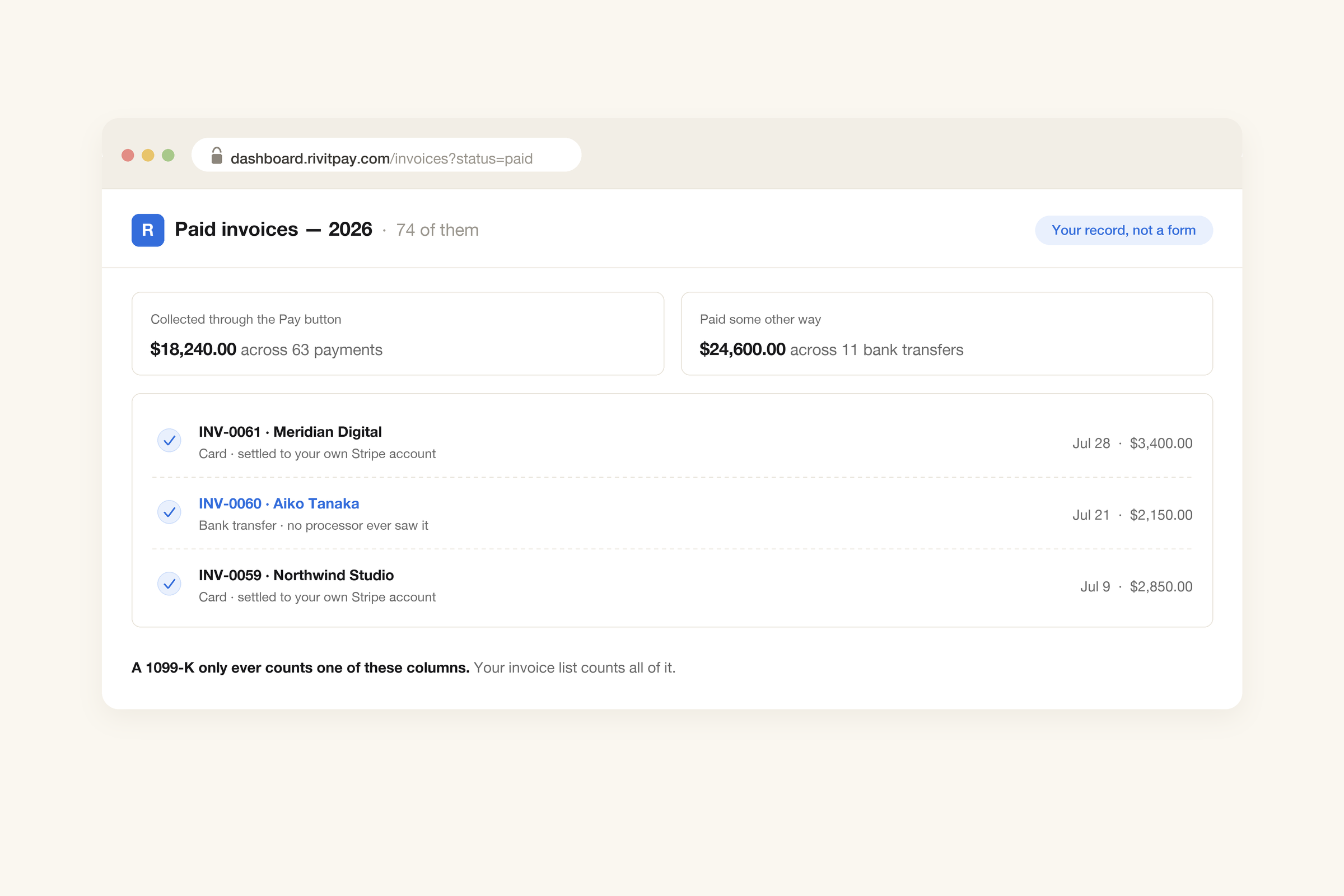
That's the shape of the thing. Card payments through RivitPay settle into your own Stripe account, so they're the ones a 1099-K would eventually describe. Invoices you sent and got paid by bank transfer are tracked as paid all the same — they never touch a processor, they never count toward our free $5,000, and they'd never show up on any form. One list, both columns, which is the view the actual tax return wants.
Stop watching the threshold
The last four years trained a lot of freelancers to track a number that was never really about them. The threshold decides whether a form gets mailed. Your invoices decide what you earned. Only one of those two things is worth checking in on, and it's the one you already control — the same paper trail that backs you up when a client doesn't pay, doing a quieter second job in January.
Every invoice tracked as sent, viewed and paid — by card or any other way. Free until you've collected $5,000.
Make an invoice — free, no signup