After you get paid
The fourth quarter is four months long
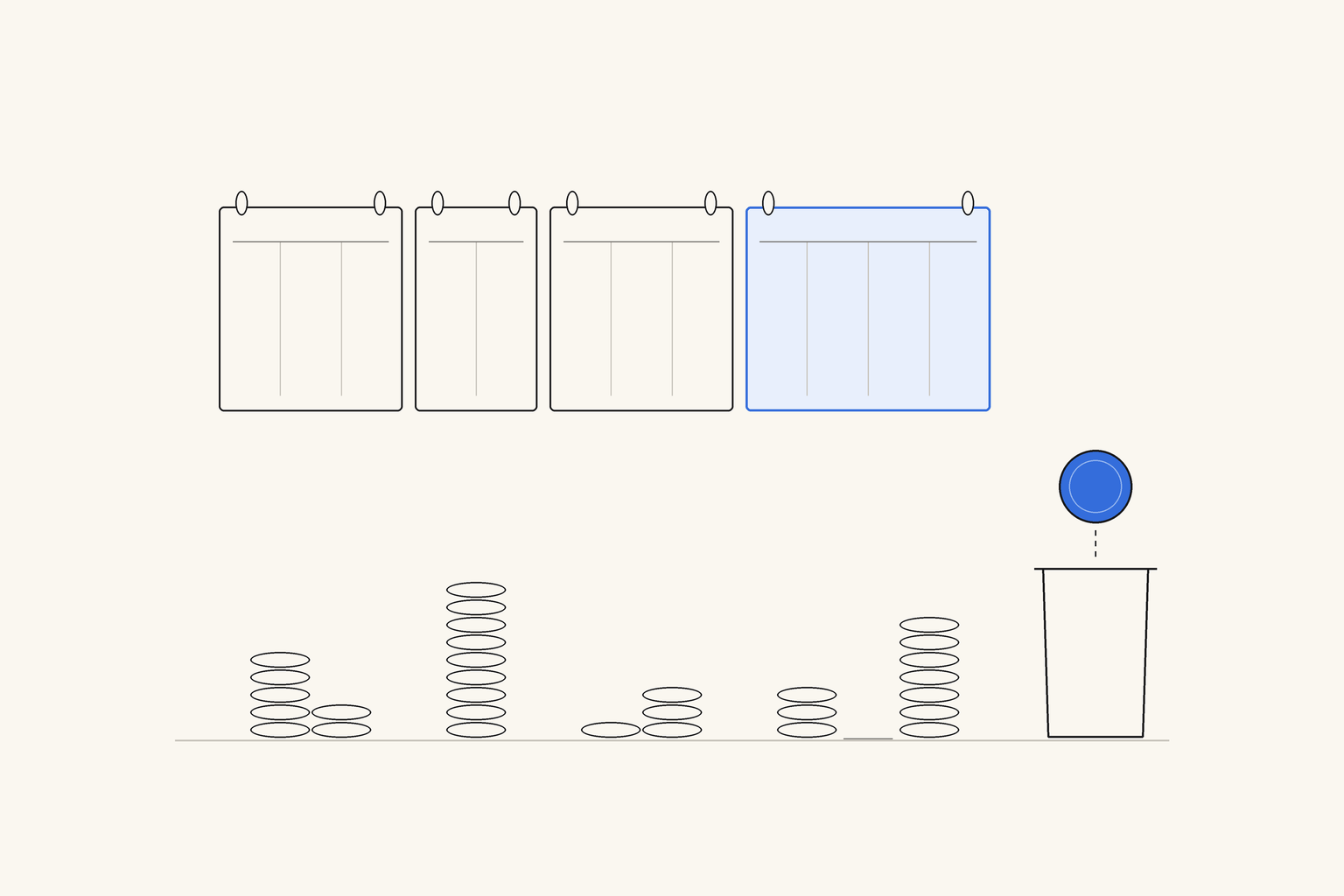
The IRS calls them quarterly estimated payments. They aren't quarters.
Here are the 2026 payment periods, straight from Publication 505:
| Income earned | Length | Payment due |
|---|---|---|
| January 1 – March 31 | 3 months | April 15, 2026 |
| April 1 – May 31 | 2 months | June 15, 2026 |
| June 1 – August 31 | 3 months | September 15, 2026 |
| September 1 – December 31 | 4 months | January 15, 2027 |
Three, two, three, four. We're six weeks into the long one now. Everything you get paid from September 1 to December 31 lands in a single bucket, due in the middle of January, when your December invoices are still trickling in and the holiday quiet has hit everyone's bank balance.
For someone on a salary, none of this matters, because withholding happens automatically. For a freelancer paid in lumps, it's where an annoying, avoidable penalty comes from.
15.7 million penalties in one year
The IRS Data Book shows that in fiscal year 2025 the IRS assessed 15,734,656 estimated tax penalties on individual (and estate and trust) income tax returns, totalling about $12.06 billion. That's nearly four times the number of late-filing penalties on the same returns (4,009,691). In the same year it recorded only 215,192 abatements of the estimated tax penalty.
Two honest qualifiers. That figure covers everyone who files a Form 1040, not just freelancers: retirees, investors and people with side income too. And it works out to an average of roughly $770, which is unpleasant but not ruinous. The penalty is common because the system quietly assumes your income arrives the way a salary does, and freelance income doesn't.
Who has to pay, and why it's bigger than you think
Per the IRS's estimated taxes page, sole proprietors "generally have to make estimated tax payments if they expect to owe tax of $1,000 or more." Clients don't withhold anything from what they pay you, so for most full-time freelancers that's a given.
The number is bigger than people expect because of self-employment tax. The IRS puts it at 15.3%: 12.4% for Social Security and 2.9% for Medicare. That's the employer's half and the employee's half, both paid by you, on top of income tax. It's why "set aside 20%" folk wisdom so often comes up short.
What the penalty actually is
It helps to know what you're avoiding, because it's less dramatic than the word "penalty" suggests. The Form 2210 instructions say it's figured separately for each installment, "for the number of days that each underpayment remains unpaid," at the IRS underpayment rate. For the quarter that started October 1, 2026, that rate is 7% a year, compounded daily (IR-2026-98).
So it behaves like interest on a loan you didn't ask for. A September installment you underpaid keeps accruing until you catch up. If you're behind, pay now rather than waiting for January. And one missed payment isn't a cliff.
The two ways out
Safe harbors. Per IRS Topic 306, you generally avoid the penalty if your withholding and on-time estimated payments cover "at least 90% of the tax for the current year" or "100% of the tax shown on the return for the prior year, whichever is smaller." The prior-year figure becomes 110% if your adjusted gross income was over $150,000 ($75,000 if married filing separately). If your income is growing, paying a quarter of last year's tax each period is the simplest option, because you already know the number.
Annualizing. The default assumption, in the IRS's words, is that you pay "in four equal amounts." If your income arrives unevenly, the annualized income installment method lets you match each payment to what you'd actually earned by then. Its periods are cumulative: January 1 through March 31, through May 31, through August 31, then the full year. Publication 505's example is a repair shop that earns most of its money in summer. A freelancer whose big project paid out in November is the same case. The catch is paperwork: you file Form 2210 with Schedule AI on your return. Tax software does the arithmetic, but it needs to know when you were paid.
Which is where your invoices come in
Most freelancers use the cash method, and Publication 334 is precise about what that means: you "include in your gross income all items of income you actually or constructively receive during your tax year." Constructive receipt is "when an amount is credited to your account or made available to you." And: "Receipt of a valid check by the end of the tax year is constructive receipt of income in that year," even if you don't deposit it until January.
In practice, the date that matters is the day you were paid, not the day you invoiced:
- An invoice sent December 1 and paid January 10 is 2027 income, part of next year's first period.
- An invoice paid December 28 belongs to the January 15 payment, even though the money arrived three days before the year ended.
- A client check that arrives December 30 counts this year, even if it sits on your desk until the 4th.
If you've ever heard of freelancers "pushing invoices into January," that's the mechanism. More usefully, it's why a list of what was paid, and when, is the most important input to everything above.
A system that doesn't depend on remembering in January
The IRS doesn't actually require four payments. You can pay "weekly, bi-weekly, monthly, etc." as long as "you've paid enough in by the end of the quarter." That points to the least painful habit there is:
- When an invoice is paid, move a fixed share of it to a separate tax account. Pick the share from an actual estimate, not folk wisdom.
- Pay the IRS from that account as you go, or at least at each due date. The money is already set aside, so January 15 is a transfer rather than a surprise.
- Check the year-to-date total once a month against the safe harbor you're aiming for.
Where RivitPay fits
A free RivitPay account keeps every invoice you send and marks it paid when the money arrives, so your year-to-date income is one glance away rather than a January reconstruction from bank statements. Card payments through the Pay button settle to your own Stripe account; RivitPay never holds the money.
For the share to set aside, the free quarterly tax calculator works out what to pay each period on your 2026 profit, including self-employment tax, with the due dates and safe harbors next to it:
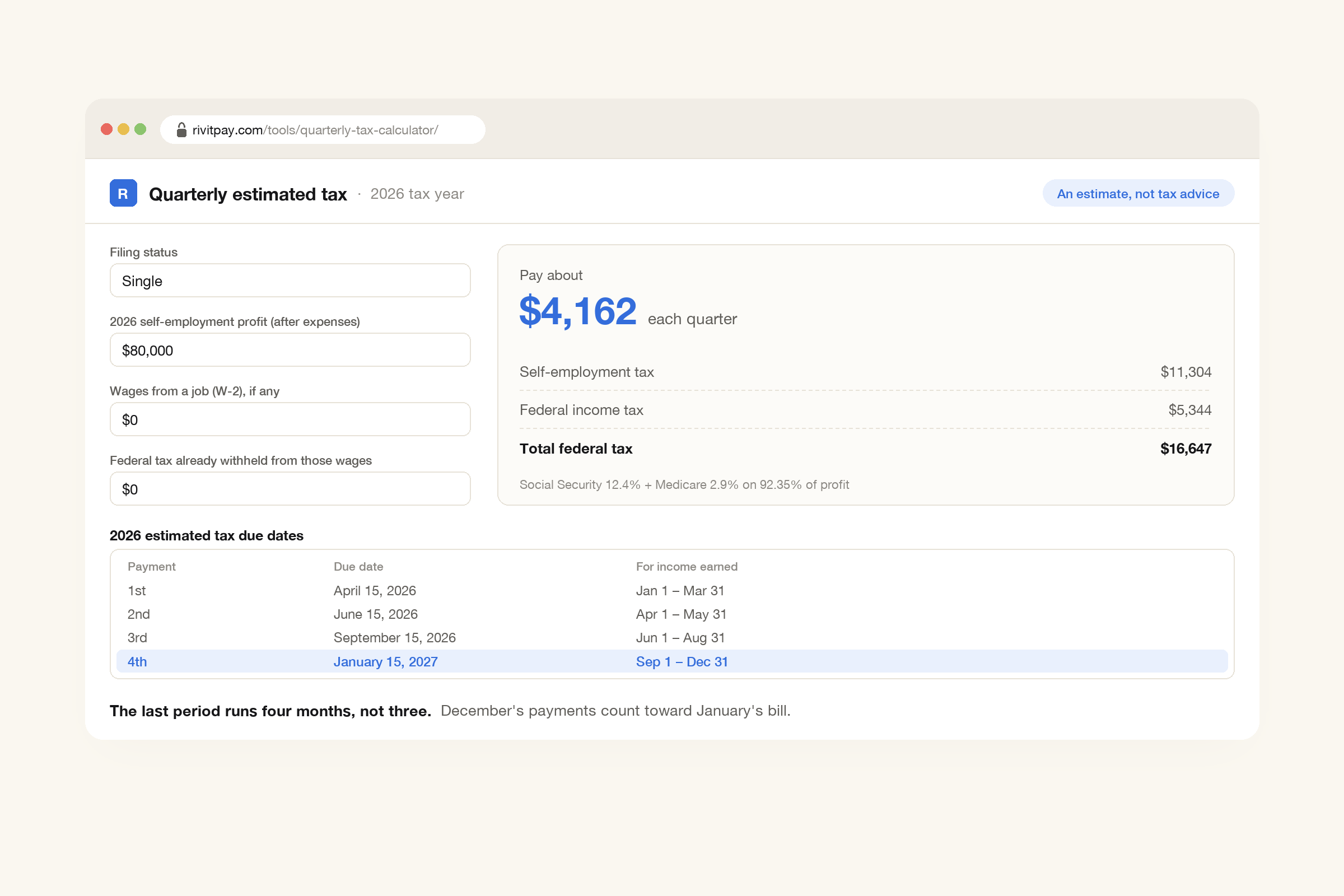
On $80,000 of profit, single, with no other job, it comes to about $4,162 a period, or about $16,647 for the year. That's around 21% of profit before any state tax. If you want the full-year picture, the self-employment tax calculator shows how much to keep back from each payment.
January 15, 2027
That's the date. Everything you're paid from now until the end of December lands in one four-month period with one payment, due when your clients are at their slowest. If you set aside a share every time an invoice is paid, January 15 is just a transfer.
Invoices that track sent, viewed and paid, with card payments settling to your own Stripe account. Free until you've collected $5,000.
Make an invoice — free, no signup