Getting paid, actually
Your client paid on Tuesday. Your bank hasn't noticed yet.
You get the email you've been waiting three weeks for: "Sorry for the delay — paid this morning!" You believe them. You even like them again. Then you open your banking app, and it says exactly what it said yesterday.
Nobody is lying. The client really did pay on Tuesday. The money really isn't there. Those two facts coexist because "paid" isn't one event — it's a chain of them, and only the last link is the one you can spend. Most freelance cash-flow panic lives in the gap between the first link and the last, and almost nobody explains the gap to you before you're standing in it.
Three different days, all called "paid"
Whatever rail the money travels on, the same three moments happen in order:
- The client parts with it. They press Pay, sign the wire, or drop the envelope in a postbox. This is the day they'll tell you about, and the day they'll consider the matter closed.
- It settles somewhere. The card is captured, the ACH batch clears, the check is deposited and cleared. The money now exists in an account with your name on it — but usually not the account your rent comes out of.
- Your bank posts it. The payout arrives, the hold lifts, the balance changes. This is the only one that pays your rent.
The distance between day one and day three is entirely determined by a decision you didn't make: how your client chose to pay.
What each rail actually costs you in days
Card. Fastest at the front, slower at the back. The charge is captured within seconds, but the payout to your bank runs on the processor's schedule — Stripe's standard settlement timing for US accounts is two business days from capture, and your very first payout typically lands 7–14 days after your first payment while the account is being established (Stripe payouts documentation). A Friday-afternoon payment is a Tuesday-morning balance. That's not a delay anyone is inflicting on you; it's how card money works everywhere.
Bank transfer. Domestic ACH is typically a day or two, wires are usually same-day but expensive enough that clients avoid them, and cross-border transfers add correspondent-bank hops and an FX conversion on top — the whole reason an international invoice feels slower than it should.
Checks, still. The one that surprises people: paper hasn't gone away. In the 2025 AFP Digital Payments Survey, which drew on responses from 223 financial professionals, checks still accounted for 26% of B2B payments — down from 33% in 2022, but a quarter of all business payments is not a rounding error. A check adds printing, an approval signature, postal transit, a trip to deposit it, and a bank hold before you see a cent. Getting "paid" by check on Tuesday can easily mean spendable money the following week.
Instant rails, arriving but not yet everywhere. The Federal Reserve's FedNow Service settled 4,997,811 payments worth $274.7 billion in the second quarter of 2026, up from 1,310,017 payments in the first quarter of 2025 (Federal Reserve Financial Services). That's real growth from a small base — and it is genuinely the future. It is also almost certainly not how your client's accounts-payable department is set up to pay you this month.
The practical version
Quote the third date, not the first. When you're deciding whether you can cover a bill, the number that matters is when your bank posts it, not when the client felt generous. Add the rail's lag to the promise date and plan against that.
Tell clients which rail you'd prefer, before the invoice. "Card or bank transfer through the link" is a sentence that quietly deletes a week of postal float. Most clients genuinely don't care how they pay; they just do whatever their finance process defaults to. Ask, and the default often changes.
Stop treating the lag as chasing. There's a real difference between a payment in transit and a payment that hasn't started. Sending a "just following up!" email on day two of a two-day payout makes you look like you're not tracking your own books. Knowing which one you're in is the entire skill.
What we do about it, and what we can't
RivitPay's card payments are direct charges: your client pays, the money lands in your own Stripe account, and it settles to your bank on Stripe's schedule. We never hold, route, or touch it — there is no RivitPay float, no platform balance, no payout button on our side to wait for. That removes one link from the chain that a lot of marketplaces and payment tools add. Meanwhile the invoice itself records every step it can see, so you can tell a client the honest date instead of guessing:
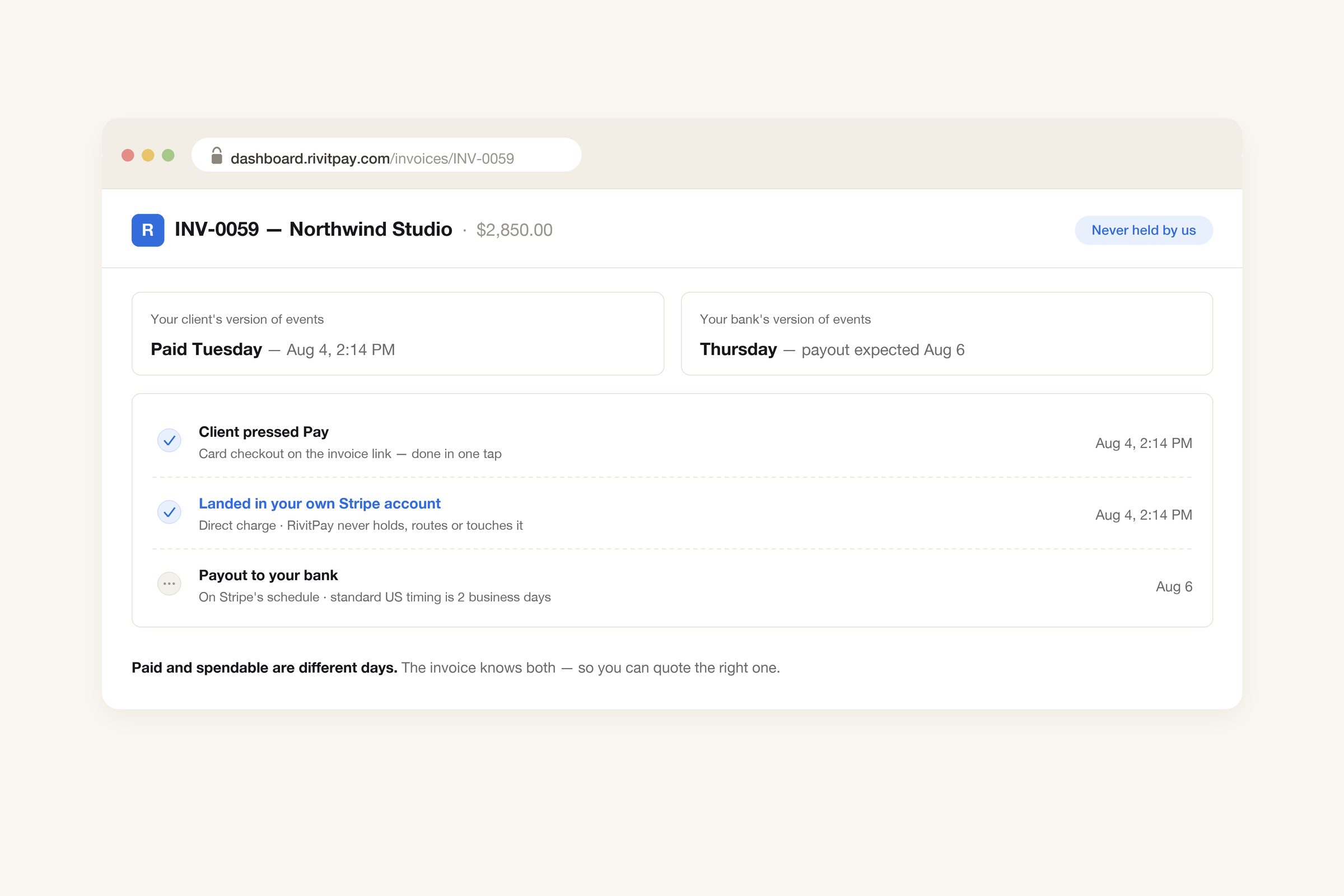
What we can't do is bend banking. Nobody can make a two-day payout arrive in one, and anybody who claims otherwise is either charging you for an advance or quietly holding your money to do it. The most useful thing an invoicing tool can offer here isn't speed — it's an accurate answer to "when, exactly?"
Two other honest levers exist. The payment terms you set govern day one, which is the biggest number in the whole chain by a mile — a client who pays 12 days late costs you far more than any settlement window. And if a client is willing, our crypto mode settles stablecoins wallet-to-wallet in seconds to minutes, skipping the payout step entirely. That's a genuinely different rail, with its own tradeoffs: your client needs a wallet, you're responsible for the address, and an on-chain payment can't be reversed if something goes wrong.
The gap is normal. Not knowing about it isn't.
Freelance cash flow doesn't usually break because of one catastrophic non-payment. It breaks because of a handful of invoices that were all "paid" on days that turned out to mean something other than what you assumed. The fix is unglamorous: know which rail each client uses, add the lag, and promise yourself the date your bank will agree with.
Card payments that settle straight to your own account, with the whole chain on the record. Free until you've collected $5,000.
Make an invoice — free, no signup