Getting paid, legally
The UK's 60-day payment cap just cleared the Lords
A big client sends over a purchase order for a £6,000 project. Your quote said 30 days. The PO says 90. Somewhere in their supplier terms there's also a line saying disputes "pause" payment, and another saying late-payment interest doesn't apply. You sign it anyway, because the alternative is not getting the work.
Almost all of that is on its way out. On 20 October the House of Lords passed the Commercial Payments Bill, and it's now waiting for its second reading in the Commons. It isn't law yet. But the text that left the Lords is specific enough to read closely, and a few parts matter far more to a one-person business than the headline cap does.
Why the government is bothering
The Department for Business and Trade's own research explains the problem in one line. In a 2024 survey of 300 businesses, only 19% of micro businesses said they pursue late payments formally, by charging interest or recovery costs. For large businesses it was 42%. Among businesses that don't, the most common reason was not wanting to damage the customer relationship. That was 33% overall, and 44% among micro businesses. One micro business put it plainly: if they took a large customer to small claims, "they will strike me off."
The government's final impact assessment for the bill shows who the late payers are. Using Experian data from February 2024, it found that only 33% of large businesses pay their suppliers on time, against 65% to 68% of micro and small businesses. Large firms are 0.3% of UK businesses but take 51% of turnover. By the assessment's own illustrative estimate, they account for about 65% of invoices paid late. And in 2024, 7% of invoices paid by large businesses took 61 days or more.
The same document quotes a four-person supplier that will sound familiar to most freelancers: "All our quotations say 30 days but they're ignored. Every purchase order comes in with 45 days, or more usually 60 or 90 days."
The cap: 60 days, or 30 for the public sector
The core of the bill is a new section 2B in the 1998 late payment law. In the text as amended on report, which went through third reading with no further amendments, a business-to-business contract must make each payment due within a set period. The longest period allowed is 60 days, or 30 days if the client is a public authority. Any term that tries to go longer is void.
The part most people will miss is what replaces the void term. It isn't 60 days. If a contract has no payment terms, or its terms are void, the bill implies a term that payment is due 30 days after the later of the day you deliver the work and the day the client has your invoice. So under the new rules, that 90-day PO wouldn't become 60. It would become 30.
Two more details are worth knowing:
- Acceptance periods are capped too. If payment is tied to the client "accepting" or "verifying" the work, the bill treats that as done 30 days after you deliver. A longer acceptance period only survives if it's fair and reasonable, and the client has to prove that.
- You can't be made to sign it away. A side agreement or settlement in which you waive your right to be paid on time is void as far as it changes the payment date.
Deposits aren't affected. The cap applies to payments of the contract price that aren't advance payments, so asking for 50% up front stays a perfectly good idea.
The exemptions mostly don't point at you
There are exemptions, but look at who they're for. A contract can opt out of the cap only if it's in writing, says which exemption applies, and fits one of the bill's descriptions. Those descriptions are a smaller client buying from a bigger supplier (a micro business buying from a small one, say), two large businesses dealing with each other, or a type of contract the government later names in regulations. A freelancer billing a company bigger than they are doesn't fit the first two. The third depends on regulations nobody has seen yet.
The bill also lets the government shorten the limits later. It can cut the 60-day limit by regulation, but never raise it, and it has to consult on doing so within five years of the cap coming into force.
Raise a dispute on day 58, and it costs them
For a freelancer, this is the change worth watching most closely. Every invoice-chaser knows the move: nothing for eight weeks, then, two days before the money is due, an email saying there's "a query on the invoice." The bill adds an implied term to business contracts that puts a price on it.
If a client wants to hold back or delay payment because of a dispute, they have to tell you by the "last dispute day". That's the first day of the eight-day period ending on the due date, which in practice means a week before it's due. They also have to give you enough information to understand what the dispute is about. If they raise it later, or raise it on time but too vaguely, you're entitled to a fixed sum: the higher of £40 or 1% of the contract price. If only part of the price is disputed, it's 1% of that part.
On the £6,000 project, a query that turns up two days before the due date would cost the client £60. That won't change anyone's year. But it changes the habit, and it gives you something specific to say back. A court can reduce or waive the sum if it's fair to, for example where you were in breach yourself. Construction contracts are left out of this rule, and short jobs paid within 14 days of delivery have a slightly different deadline.
Interest you can't sign away
Today, a contract can replace statutory interest with its own remedy for late payment, as long as that remedy is "substantial". That's why so many supplier terms quietly offer something smaller. The bill removes that whole part of the 1998 Act. Under a new section 6A, any term is void if it tries to exclude or vary the right to statutory interest. That includes a lower rate, a later start date, or a rule that interest doesn't run while a dispute is open. (Here's how statutory interest works today and what it comes to.)
The penalty side is aimed at the big payers. The Small Business Commissioner gets powers to investigate poor payment practices and fine larger businesses, capped at 1% of annual turnover. The impact assessment's preferred design would link fines to firms paying more than a quarter of their invoices late, and set them at twice the statutory interest they failed to pay. Those details still have to be set in regulations.
A referee who isn't a court
The bill also gives small businesses, which the Commissioner's law defines as fewer than 50 staff, a way to have a payment dispute with a larger business decided without going to court. The Commissioner, or someone they appoint, adjudicates and gives written reasons. The decision binds both sides unless it's later overturned in court or arbitration. And an amount awarded is recoverable as if a county court had ordered it. A contract can't take away your right to use it. One limit: it applies only to contracts signed after that part of the law comes into force, so a retainer you agreed this year won't qualify unless you sign a new one.
When any of this applies
Not yet, and not soon. Most of the bill comes into force on dates the government sets by regulation, and the impact assessment says the policies are expected to take effect "no earlier than FY2027/28". It also says the maximum payment terms will be phased in, to give businesses time to adjust. The Commons can still amend the text. So for now, the 1998 Act as it stands is the law you're working with. That already gives you statutory interest and a fixed sum for chasing, and you can claim both.
What to do this year anyway
Most of what the bill is trying to force, you can ask for now:
- Put your terms on every invoice. A due date, not just "Net 30", plus the client's PO number so accounts payable can't bounce it.
- Ask for queries early. One line in your terms asking clients to raise any query within seven days of receipt is the same idea as the bill's dispute rule. Clients who read it tend to follow it.
- Mention statutory interest in the terms. It applies whether or not you mention it, but writing it down means nobody's surprised.
- Push back on a 90-day PO before you sign it. "Our standard is 30 days" is easier to say when the government has just said 60 is the maximum.
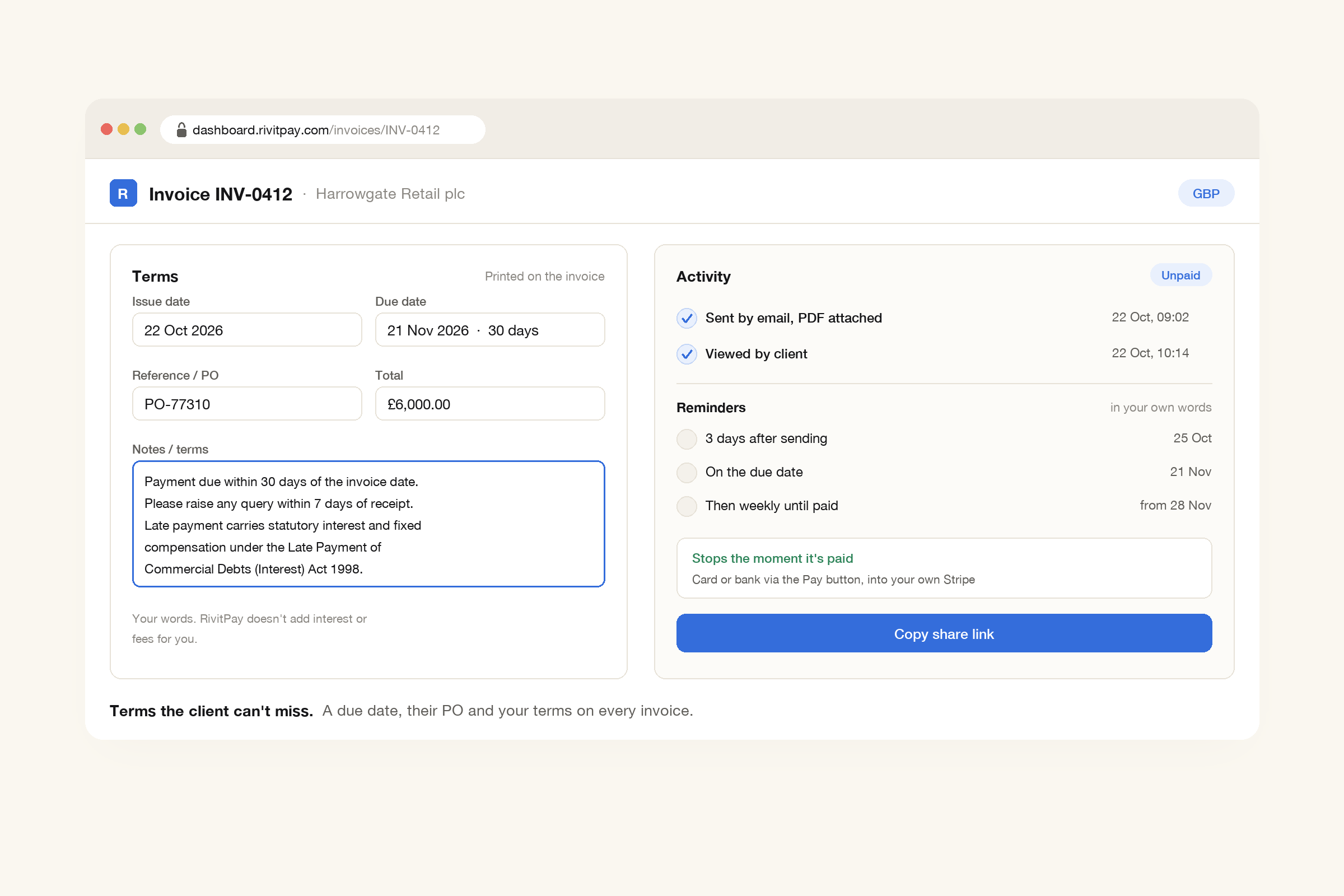
That's the shape of an invoice in RivitPay. The free invoice generator prices it in pounds, prints the client's PO in the Reference field, sets an issue and due date, and carries your terms in Notes, with no signup. A free account sends it by email with the PDF attached. It shows when the client opened it, and runs automatic reminders in your own words. Three days after sending, on the due date, then weekly is a common schedule, and the reminders stop the moment the invoice is paid. Clients can pay by card or bank through the Pay button, straight into your own Stripe account, with no RivitPay fee until you've collected $5,000 through it.
The cap is the headline. The dispute rule is the change.
Most clients already pay within 60 days, at least on paper. The bigger change for a freelancer is what the bill takes away from the client's side of the table: the 90-day PO that's really 30, the last-minute "query", and interest clauses that exist to switch interest off. None of it is law yet. But when it is, the invoice you're already sending, with a clear due date, a PO number and your terms, will be the document it all hangs on.
A due date, the client's PO and your terms on a free invoice in pounds, plus reminders in your own words that stop when it's paid. Free until you've collected $5,000.
Make an invoice, free