Getting paid, legally
Your late invoice is already earning interest (if you're in the UK)
A client in Manchester owes you £2,400. It was due at the end of August. You've sent two polite emails and one slightly less polite one, and you're now drafting a fourth that says "just checking in" for the third time.
Here's what most UK freelancers don't put in that email: since the day after the due date, the law has been adding interest to that invoice at 11.75% a year, plus a fixed £70 on top. You don't need a clause in your contract for it to apply. You don't need a lawyer. You mostly need to know it exists, and to say so before you're angry.
How common this is
The government's own figure, from its March 2026 announcement on late payment, is that it's "a problem costing the UK economy £11 billion every year", and that "some 38 businesses shut their doors every single day because they are not paid on time."
For freelancers specifically, the most recent numbers we could find come from the Scottish Trades Union Congress. Its Freelance and Forgotten survey of 805 creative-industry workers, run between 23 March and 22 April 2025, found that 69% had experienced issues with late payment and 33% had not been paid for freelance work they'd done. Respondents described waits of six, nine, ten and even fifteen months.
That's one sector, in one country, from people who chose to answer a union survey, so read it as a signal rather than a national rate. But anyone who freelances in the UK will recognise it.
The law you already have
The Late Payment of Commercial Debts (Interest) Act 1998 applies to a contract for goods or services "where the purchaser and the supplier are each acting in the course of a business". A sole trader invoicing a company is acting in the course of a business. A sole trader invoicing someone for their wedding photos isn't, because the customer is a consumer, and the Act doesn't cover them.
For business clients, GOV.UK's guidance sets out three things worth knowing:
- When it's late. If you agreed a payment date, it's late the day after. If you didn't, "the law says the payment is late 30 days after" the customer gets the invoice or you deliver the work, whichever is later.
- How long terms can be. Agreed terms "must usually be within 30 days for public authorities or 60 days for business transactions." Longer is allowed only if it's fair to both sides.
- What you can add. Statutory interest, a fixed sum for the cost of chasing, and reasonable recovery costs on top.
The rate: 8% plus the base rate, frozen twice a year
Statutory interest is "8% plus the Bank of England base rate for business to business transactions," per GOV.UK. The base rate you use isn't today's, though. The rate order fixes it twice a year: interest that starts running between 1 July and 31 December uses the base rate in force on 30 June, and interest that starts between 1 January and 30 June uses the rate on 31 December. Scotland's order says the same.
The Bank of England's Bank Rate history shows the last change on 18 December 2025, to 3.75%, and it's still 3.75%. So both reference dates this year landed on 3.75%, and any invoice that went overdue at any point in 2026 is earning 11.75% a year. That rate stays fixed for the life of the debt, even if the Bank moves rates at its next meeting.
The fixed sum on top
Separately from interest, you can charge a one-off amount per late payment for the cost of chasing it. The amounts are set by the late payment legislation:
- Debts up to £999.99: £40
- £1,000 to £9,999.99: £70
- £10,000 or more: £100
"You can only charge the business once for each payment," and you can also claim "reasonable costs each time you try to recover the debt," such as a debt collector's fee.
What it comes to on a real invoice
GOV.UK's method is simple interest worked out by the day: the annual figure divided by 365, times the days late. On the £2,400 invoice from the top, 45 days late:
- £2,400 × 11.75% = £282 a year
- £282 ÷ 365 = about 77p a day
- 45 days late = £34.77 in interest
- Plus the fixed sum for a £1,000–£9,999.99 debt: £70
That's £104.77 you're entitled to ask for. It won't change your year. But the reason to know it isn't the money. "I'm owed £2,504.77 under the Late Payment Act" gets a different response from accounts payable than "just checking in". It's specific, it's in law, and it keeps growing every day the invoice sits there. (If you'd rather not do the arithmetic, our net 30 calculator has a late-fee mode: set it to "% per year" and 11.75. It shows a dollar sign, but the sum works the same in pounds.)
What's about to change
The government wants to go further. The Commercial Payments Bill [HL] was introduced in the House of Lords on 19 May 2026. According to Parliament's own record, it has been through committee and report stage in the Lords, with third reading set for 20 October 2026. It then still has to pass the Commons, so it isn't law yet.
The government's announcement says the changes will include "a new 60-day cap on payment terms on all large firms when paying smaller suppliers" and "a requirement for all commercial contracts to include statutory interest set at 8% above the Bank of England base rate", along with powers for the Small Business Commissioner to adjudicate disputes and fine persistent late payers. Bills change on the way through, so check the final Act rather than this paragraph before relying on any of it.
How to actually use it without burning the client
Statutory interest works best as something you mention calmly and early, not something you spring on a client at day 90:
- Put it on the invoice. One sentence in the terms: late payments carry statutory interest and fixed compensation under the 1998 Act. You don't need it there for the law to apply, but it means nobody can say they're surprised.
- Mention it in the second reminder, not the first. The first is for honest mistakes. The second can say what's now running and how much.
- Offer to waive it. "Pay this week and I'll waive the interest" is a perfectly good use of it. You've shown you know your rights and given them an easy way out.
- Actually claim it if it comes to that. If you end up filing a claim for the money, add the interest and the fixed sum to it. That's what they're for.
Where RivitPay fits
You can price an invoice in pounds in the free invoice generator, add your sort code and account number under Payment, and put your late-payment wording in Notes / terms, where it prints on the PDF and travels with the share link. No signup.
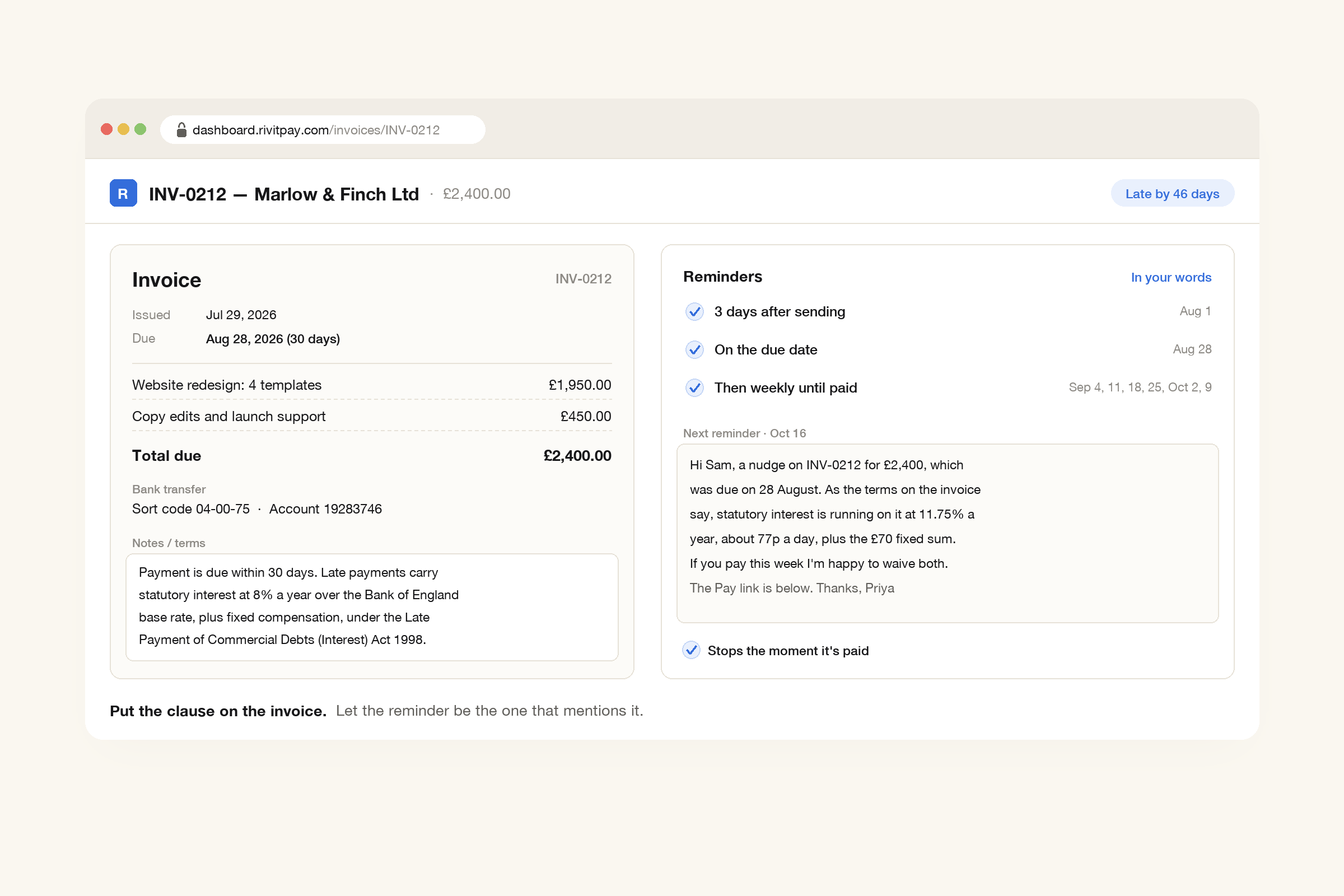
A free account adds the part that does the chasing. You can see when the client has opened the invoice. Automatic reminders go out on a schedule you set, such as three days after sending, on the due date, then weekly. They're written in your own words, so the second one can mention the interest, and they stop the moment the invoice is paid. Clients can pay by card or bank through the Pay button, straight into your own Stripe account. RivitPay never holds the money, and there's no RivitPay fee until you've collected $5,000 through it.
Know the number before you need it
Most late invoices get paid with a reminder or two, and you'll never need any of this. But the client who's 45 days late and ignoring "just checking in" is the one where knowing the number helps. 77p a day and £70 won't make you rich. What they do is show the client you know the rules, and that's usually enough to get the invoice paid.
A free invoice with your sort code and late-payment terms, plus reminders in your own words that stop when it's paid. Free until you've collected $5,000.
Make an invoice, free