Tax
€42,500, 23% and a 15-day deadline: when Irish freelancers have to start charging VAT
If you sell services in Ireland, there's one number that decides when VAT becomes your problem: €42,500. Below it, you can leave VAT off your invoices. Above it, you have 30 days to register, and from then on your invoices need a VAT number, a 23% line and a handful of details most freelancers have never had to think about. You also start owing VAT on invoices your clients haven't paid yet, unless you ask Revenue for the scheme that fixes that. Here's what changes, using Revenue's own guidance.
You'd be joining about 290,000 others
Revenue's VAT payments and returns report for 2025, published on 7 May 2026, counted 291,411 VAT-registered traders at the end of 2025. There were 26,023 new registrations and re-registrations during the year, and 30.8% of registered traders, 89,692 of them, are sole traders. Only 207,262 were active, meaning they filed a VAT return with at least one transaction. VAT brought in €23.0 billion in net receipts in 2025, so it's no surprise Revenue cares about who should be registered and isn't.
The test: €42,500 of services, then 30 days
Revenue's VAT thresholds page sets the threshold at "€42,500 in the case of persons supplying services only," and €85,000 for goods. You count the value of your taxable supplies, excluding VAT, and Revenue's guidance says to do it "in a calendar year." Its registration guidance then explains the timing: "You will be regarded as an accountable person immediately on completing a transaction that exceeds the threshold. You must apply to Revenue for VAT registration within 30 days of the completion of this transaction."
Here's how that plays out. Say you're a UX designer in Cork who has billed Irish clients €38,000 since January. In November you finish a €6,000 project. That job takes you to €44,000, past the line, and the 30 days start when the job is done, not at the end of the year. Registration is online through ROS, using form TR1 for sole traders.
Below €42,500, registering is your choice. Revenue says you "may, however, still elect to register for VAT even if your turnover does not exceed the registration thresholds." That can make sense if your clients are VAT-registered businesses that claim the VAT back, and you have VAT on costs you'd like to reclaim.
23%, and who pays it in the end
Most freelance work is charged at the standard rate. Revenue's current VAT rates table shows 23% from 1 January 2026, and its standard rate page lists consultancy services as an example. On that €6,000 project, VAT is €1,380 and the invoice total is €7,380.
A VAT-registered business client reclaims the €1,380, so for them nothing really changes. A private client, a charity or a business that isn't registered pays it for real. If most of your clients are in that second group and you keep your prices the same, you've just taken a pay cut of nearly a fifth. Decide before you register which clients see "+ VAT" on the next quote.
What a VAT invoice needs, and when
Revenue's invoice guidance has a deadline most freelancers miss: "A VAT invoice must issue within 15 days of the end of the month in which goods or services are supplied." Work finished in November needs its invoice out by 15 December. You must issue one to other VAT-registered businesses, government departments, local authorities, statutory bodies and businesses in other EU countries. The required details include:
- the date of issue and a unique sequential number
- your full name, address and VAT registration number
- your client's full name and address
- what you did, the VAT-exclusive price, any discounts, the VAT rate and the total VAT
- the date the services were supplied
- for a reverse-charge supply, your client's VAT number and the words "reverse charge applies"
Two rules catch people out. If you invoice in another currency, Revenue says the invoice "must also show the corresponding figures in Euro." And mistakes cost you: "If your VAT invoice shows a greater amount of VAT than is correct, you are still liable for the VAT shown on the invoice." The fix is a credit note and a new invoice.
Clients outside Ireland usually don't pay Irish VAT
For business clients, Revenue's place of supply guidance says the place of supply is "the place where the business receiving the services is established," whether that's in the EU or not, and that "where the business customer is located outside Ireland, the Irish supplier will not charge Irish VAT on its services." Its own example is an Irish company supplying a US company: "No Irish VAT is due on this supply." For a business client in another EU country, the client accounts for VAT themselves, and your invoice needs their VAT number and the reverse-charge wording. We covered that in detail in reverse charge on your EU invoice. Private clients are different: services to consumers are generally taxed where you're based, with exceptions.
Owe VAT when you're paid, not when you invoice
By default, Revenue says VAT becomes due when you issue the invoice, or when you should have issued it. If your client pays 60 days late, you've already paid their VAT to Revenue. The moneys received basis fixes that. Under it, "a trader is liable to account for VAT when they receive a payment." You can use it if your turnover "does not exceed, or is not likely to exceed, €2,000,000 in any continuous period of 12 months," which covers almost every freelancer. New registrants tick a box on the registration form. If you're already registered, you apply to your Revenue office in writing.
Two things don't change. Revenue says "the normal invoicing requirements still apply," so the 15-day deadline and the required details stay the same. And the VAT rate is the one in force when you did the work, not when the money arrived. If you work for public bodies, Professional Services Withholding Tax counts as money received, so you account for the full VAT even though 20% of the fee before VAT was withheld.
Where RivitPay fits
The free invoice generator, with no signup, covers Revenue's list. Put your Irish VAT number in the Tax ID field and it prints under your details. Set Tax % to 23 and the invoice shows a subtotal, a "Tax 23%" line and the total. Every invoice gets a date and a number, and the invoice number generator helps keep the sequence unbroken. Add the supply date to the line description or Notes, for example "Services supplied: October 2026". Price it in euro. For an EU business client, set Tax % to 0, add their VAT number as the last line of their address, and write "Reverse charge applies" in Notes.
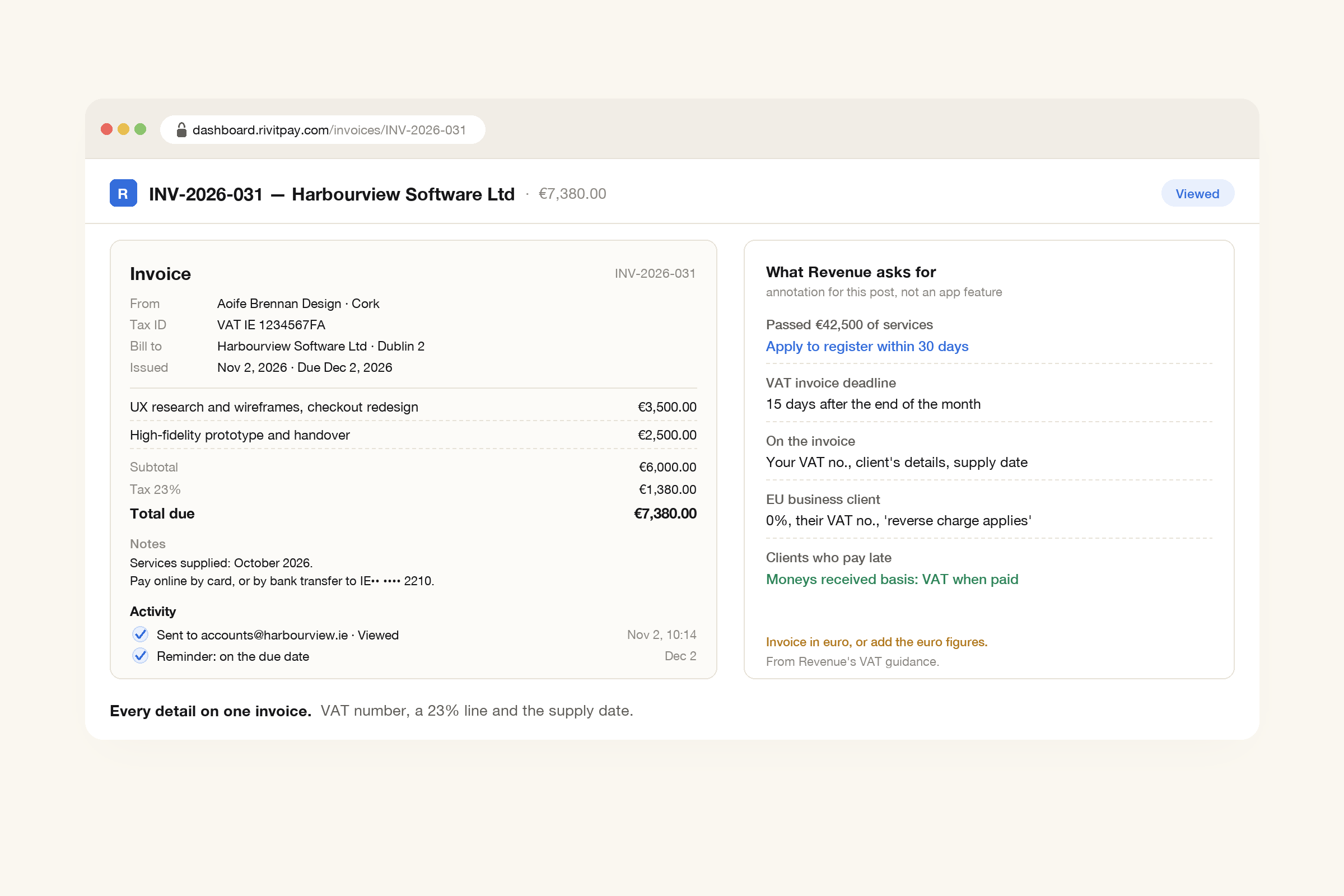
With a free account, you can email the invoice, see when it's been opened, and let clients pay by card or bank through the Pay button, straight into your own Stripe account. Automatic reminders in your own words follow up until it's paid and then stop. On the invoice basis, every late payment means VAT you've paid before you've been paid, so chasing matters.
Before you hit €42,500
Keep a running total of what you've billed this year, and know which project will take you over. When it does, register within 30 days and ask for the moneys received basis at the same time. Decide how you'll quote VAT to private clients, and get every invoice out within 15 days of the end of the month. The invoice can stay simple. It just needs your VAT number, the 23% line and the supply date.
Your VAT number, a 23% tax line, euro or any of 45 currencies, and a Pay button for card or bank. Free until you've collected $5,000.
Make an invoice, free