Getting paid for creative work
Who owns the work before the invoice is paid?
You delivered the logo files three weeks ago. The invoice is unpaid. This morning you saw the logo on the client's new website, looking great. A thought arrives: if they haven't paid for it, are they even allowed to use it?
The honest answer is "it depends", and mostly on what you wrote down before you started. US copyright law gives freelancers more ownership than most people assume, and then one court decision takes back most of the leverage. Here's how both halves work, and the one sentence that changes things.
The default: you own what you make
The US Copyright Office's guide to works made for hire (Circular 30, revised August 2024) starts from a simple rule. Ordinarily, "the author is the person or persons who actually created the work." The exception is a "work made for hire", where the hiring party is treated as the author and owner.
For a freelancer, that exception is narrow. Work made for hire applies to employees working within their job, or to commissioned work that meets all four of these tests:
- It's in one of nine categories: a contribution to a collective work, part of a film or other audiovisual work, a translation, a supplementary work, a compilation, an instructional text, a test, answer material for a test, or an atlas.
- There's a written agreement between you and the client.
- The agreement expressly says it's a work made for hire.
- Both of you signed it.
Circular 30 is blunt: "If a work fails to satisfy any of these requirements, it is not a work made for hire." A logo, a website design, a photo shoot or a brand illustration usually isn't in those nine categories, so even a signed work-for-hire clause may not do what the client thinks.
Transferring the copyright instead has its own formality. Under 17 U.S.C. § 204(a), a transfer of copyright ownership "is not valid unless" it's "in writing and signed by the owner of the rights conveyed". So with no signed paper, a client who commissioned your logo generally doesn't own its copyright. You do.
The catch: they probably have a license anyway
Before you send a takedown notice, read Effects Associates v. Cohen, a 1990 Ninth Circuit case that comes up whenever this question does. A special effects company made footage for a horror film. The deal was oral, and "no one said anything about who would own the copyright." The producer disliked one shot and paid only half for it, leaving a little over $8,000 unpaid, then used all the footage anyway. The effects company sued for copyright infringement.
It lost. There was no transfer of ownership, because nothing was in writing. But the court held that by making the footage at the producer's request and handing it over, the company had granted an implied nonexclusive license to use it. A nonexclusive license doesn't need to be written down. The Copyright Act's definition of a transfer specifically excludes it. And the court refused to treat full payment as a condition of the license: "Conditions precedent are disfavored and will not be read into a contract unless required by plain, unambiguous language."
The court said the company still had the right to sue "in state court on a variety of other grounds, including breach of contract". In other words, it could sue for the unpaid money as a contract claim, but not for copyright infringement. For most freelancers, the practical upshot is this: if you deliver the files with no terms attached, the client can likely use them while still owing you.
The sentence that changes it
Look at the court's own words again: "plain, unambiguous language". If the deal says, in writing, that rights pass only on payment in full, there's nothing left for a court to guess about. A line like this, in your contract and on the invoice:
- "All rights in the final deliverables transfer to [client] on receipt of payment in full. Until then, the deliverables are licensed for review only."
It doesn't guarantee you'll win a copyright claim. That depends on the facts and your state's contract law. But it means a client using unpaid work is using it outside the license they agreed to, rather than under one a court has to infer. And it gives you something firmer to say in your second reminder than "please pay".
RivitPay's free freelance contract template already works this way: "Once Client has paid in full, Contractor assigns Client all rights in the final deliverables," while you keep your pre-existing tools and materials. The UGC contract template does the same for creators, granting usage rights once the brand pays.
Can you actually enforce it?
Mostly, the clause works as leverage before anyone files anything. If it does come to a claim, the Copyright Office runs a cheaper option than federal court: the Copyright Claims Board, which hears claims of up to $30,000 in total damages. Filing costs $100 in two payments ($40, then $60), and you need to have at least applied to register the work first.
Its latest statistics, covering June 2022 to March 2026, show who's using it: 1,920 claims filed, 67% by people representing themselves, and 36% about pictorial, graphic or sculptural works, the largest single category. They also show the limits. Only 47 claims had reached a final decision. 787 were dismissed after the board's compliance review, and in 168 the respondent opted out, which it's allowed to do because participation is voluntary.
The board hears copyright claims, not unpaid invoices. If the client has a license, there's no infringement to claim, so your route is the same one as for any unpaid bill: reminders, a demand letter, and if needed small claims court. The payment clause is what can turn "they owe me money" into "they're using my work without permission".
Where RivitPay fits
Put the rights line where the client sees it when they pay: on the invoice. In the RivitPay generator, anything in Notes / terms prints on the PDF and travels with the share link, so the person approving the payment reads the same terms your contract does.
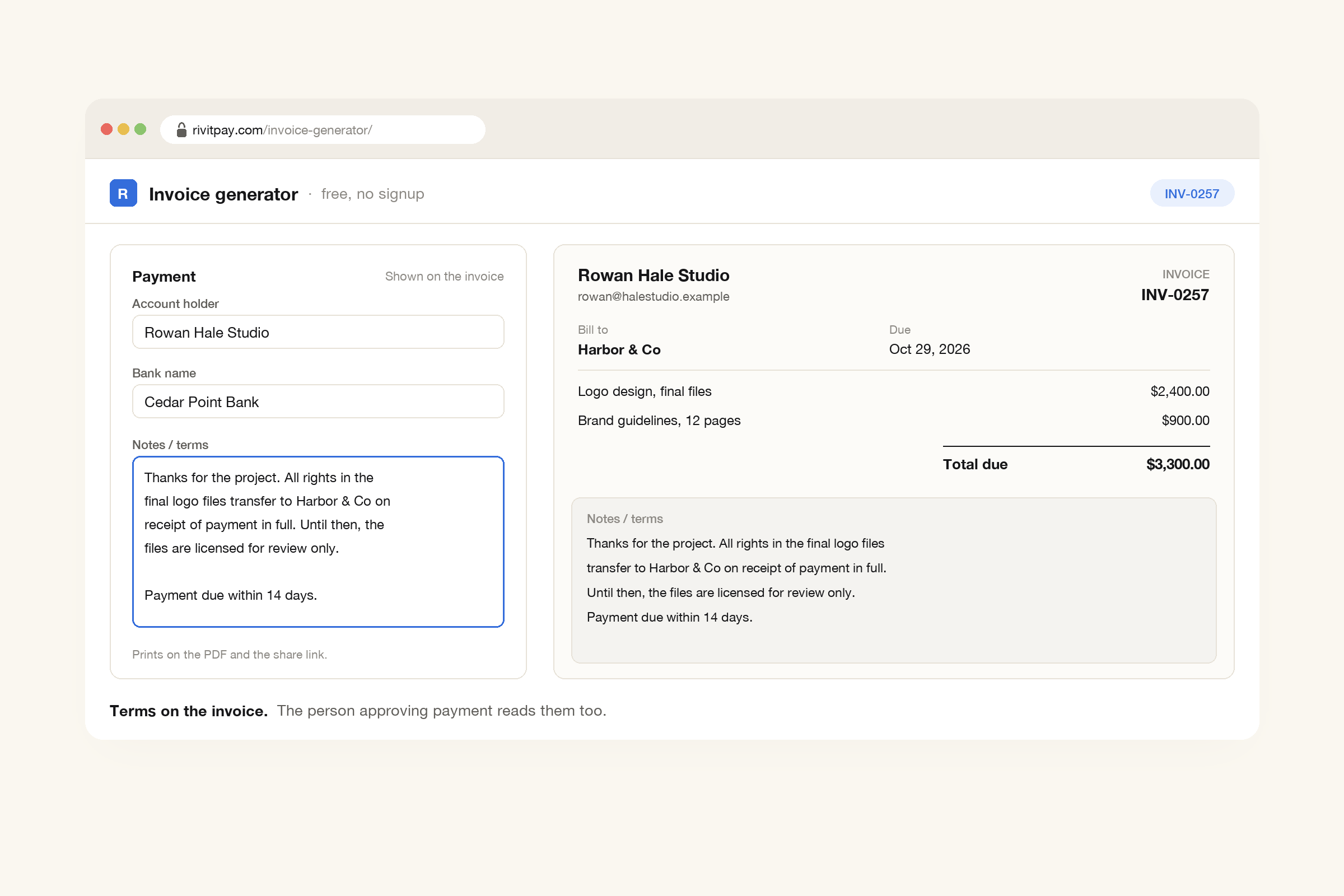
With a free account, the invoice also gets a Pay button, so the client can pay by card or bank straight into your own Stripe account. You can see when they've opened it, and automatic reminders in your own words stop the moment it's paid. Once it's paid, the rights pass and nobody has to think about this again. Invoicing is free, and there's no RivitPay fee until you've collected $5,000 through the Pay button.
Write it down before you hand it over
Most clients pay, and most never think about who owns the logo. But the moment to decide what happens if they don't pay is before you send the files, not after. One plain sentence in the contract and on the invoice costs nothing. Without it, a court may decide you agreed to let them use the work, whether they paid or not.
Invoices with your notes and terms on the PDF, a Pay button that settles to your own Stripe account, and reminders in your own words. Free until you've collected $5,000.
Make an invoice, free