When they don't pay
Is your unpaid invoice worth small claims court?
The invoice was $4,200. It went out on August 3, the client opened it the same afternoon, and it was due on the 21st. Three reminders later it's mid-October, and the last email you got back said "looking into it" five weeks ago.
At some point most freelancers type "small claims court" into a search bar and then close the tab, half because it feels dramatic and half because they have no idea what it involves. It's less dramatic than it sounds, and cheaper. It's also less of a guaranteed payday than people hope. Here's an honest look at both sides, using what the courts themselves say.
More people are going
You wouldn't be unusual. The National Center for State Courts reported in August that small claims filings rose from about 671,000 in 2021 to nearly 1 million in 2025, and that "contract and small claims filings account for nearly all recent growth" in civil cases. That's based on preliminary data from about 20 states and territories, not a national count.
California, which reports its own numbers, recorded 77,487 small claims filings in fiscal year 2024–25, according to the Judicial Council's 2026 Court Statistics Report. It defines those as cases where someone is seeking $12,500 or less "and is not represented by counsel."
What small claims actually is
It's a simplified court for small money disputes, designed for people without lawyers. In some states you're not allowed one. California's self-help site says: "You can ask a lawyer for advice before you go to court, but you can't have one with you in court." In Washington, attorneys can't appear for either side "unless the judge grants permission." That works in your favour against a client with a legal department, because their lawyer can't come either.
It's also cheap to file. In California the fee is $30 for claims up to $1,500, $50 up to $5,000 and $75 up to $12,500. You may also pay to have the papers served on the other side.
How much you can claim
Every state sets its own limit. A few, from the courts' own pages and the statutes:
| Where | Limit | Worth knowing |
|---|---|---|
| California | $12,500 individual, $6,250 business | No more than two claims over $2,500 a year |
| New York City | $10,000 | Corporations, partnerships and associations can't file here |
| Texas (justice court) | $20,000 | Set by Government Code §27.031 |
| Illinois | $10,000 | Supreme Court Rule 281 |
| Washington | $10,000 person, $5,000 others | Lawyers only with the judge's permission |
| Massachusetts | $7,000 | G.L. c.218 §21 |
| Philadelphia | $12,000 | Municipal Court |
Two things to check before you rely on that table. First, which limit is yours. California's self-help page says "an individual can sue for up to $12,500" but "if you're suing on behalf of your business, you can sue for up to $6,250". Washington draws its line at a "natural person". If you invoice as a sole proprietor, or through an LLC, ask the court's self-help centre which applies to you before you file. In New York City, the Civil Court Act bars corporations, partnerships and associations from small claims entirely; they use a separate commercial claims part.
Second, the limit sets what you can claim, not what you're owed. If the invoice is above it, you can usually choose to claim the limit and give up the rest, or go to a regular civil court where things get slower and more expensive.
Before you file: ask, in writing
In California this isn't optional. The courts' page on asking for the money says: "The court wants you to ask the other side for the money you think they owe you before you start a small claims case," and calls it "another step you must take before filing." You can ask in person, by letter or by email, saying how much they owe and why.
Even where it isn't required, a short, firm demand is worth sending. A letter that names a date and says what happens next reads very differently from a fourth friendly reminder, and it's the cheapest chance you'll get to be paid without a hearing. Keep it factual:
- What was agreed, with the date and where it was written down.
- What you delivered and when.
- The invoice number, amount and due date, and how many days overdue it is.
- A deadline, say 10 or 14 days, and a plain statement that you'll file in small claims if it isn't paid.
- The easiest possible way to pay, because the goal is still the money, not the hearing.
If you're in a state or city with a freelance payment law, this is also where you mention it.
Don't wait too long
Claims expire. In California you have "4 years from the date the contract was broken" for a written contract, and 2 years for an oral one. New York's CPLR 213 gives six years for "an action upon a contractual obligation or liability, express or implied." Those are generous, but evidence goes stale much faster than the deadline does. Inboxes get cleaned out, the person who approved the work leaves, and your memory of who said what in July gets vaguer.
What wins, and what doesn't
Small claims judges see a lot of he-said-she-said. What separates a freelancer who wins from one who doesn't is rarely the argument. It's the paper:
- The agreement. A signed proposal, a contract, or an email thread where the client says yes to a price and a scope.
- The invoice, itemised and dated, with a real due date, not "due on receipt".
- Proof of delivery: the files, the handover email, the client's reply.
- Proof they received the invoice and were reminded, with dates.
- Approval of anything extra. If the bill includes work beyond the original scope, the email where they asked for it.
- Your written demand, and their response or silence.
Winning isn't the same as getting paid
This is the part the "just take them to small claims" advice skips. California's courts say it directly: "The court doesn't collect the money for you." And: "Collecting money can take a lot of time and money and you may not even collect any of it." Washington's courts agree: "Even if a party has a judgment, it does not necessarily mean that they will be paid."
A solvent client who was just being slow will often pay once a court date is real. A judgment against a client who has run out of money, or who is willing to ignore a court, is a piece of paper you then have to enforce with wage garnishments, bank levies and more forms. Realistic expectations:
- Worth it: a real business, clearly able to pay, that's ignoring you. Being served can be enough.
- Probably worth it: a disputed amount where your paper trail is clearly better than theirs.
- Think twice: a client who's visibly broke, in another state, or an amount small enough that a day off work costs more.
Where RivitPay fits
RivitPay doesn't file claims or write demand letters. What it does is build most of that paper trail while you're still hoping you'll never need it. Every invoice sent from a free account keeps a dated record of what happened: when it was sent, when the client opened it, which reminders went out, and whether it's been paid:
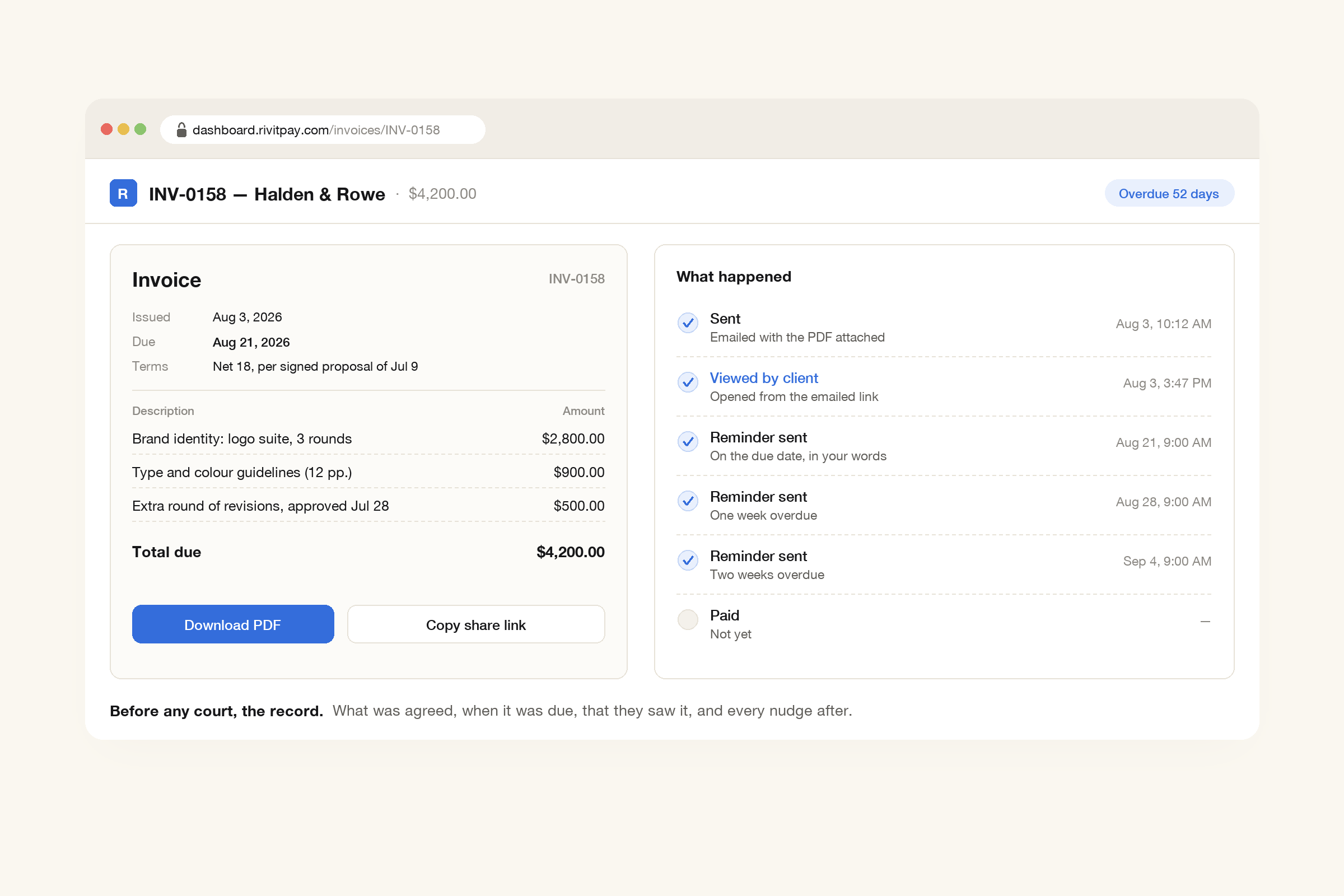
That viewed timestamp answers "we never got it" before anyone says it. The automatic reminders go out on the schedule you set, in your own words, and stop the moment the invoice is paid. Every reminder is also a dated request for payment. And because every invoice can carry a Pay button for card or bank payment, settling to your own Stripe account, the client can't say they had no easy way to pay. When your demand letter lands, the link to pay it is one click away.
The paper is the point
Most unpaid invoices never get near a courtroom, and they shouldn't. But knowing the option is real, cheap and lawyer-free changes how you write the demand, and how the client reads it. If you've kept a clean record from the first day, the hardest part of filing is already done, and the client can probably see that too.
Itemised invoices with a dated history of sent, viewed, reminded and paid, and card payments that settle to your own Stripe account. Free until you've collected $5,000.
Make an invoice — free, no signup