The cost of getting paid
Can you just add 3% for card? Not the way you're thinking.

Every freelancer arrives at this question about a week after switching on card payments. The invoice was $2,400. The deposit was $2,330.10. And somewhere in the gap is a perfectly reasonable thought: why am I paying for my client's preference?
So you do the obvious thing. You add a line at the bottom of the next invoice — Card processing fee, 3% — and feel briefly like you've solved it.
You haven't, quite. Passing the card fee to the customer is a real, permitted, named thing: a surcharge. It's also one of the most heavily regulated moves in payments, governed simultaneously by card network rules and state law, and the version that involves typing a line onto an invoice is specifically the version that isn't allowed.
What the card networks require
Visa publishes its US requirements in a merchant surcharging Q&A, and the list is longer than anyone expects. If you intend to surcharge, Visa requires you to:
- Notify your acquirer at least 30 days before you start. Not the day you decide — a month ahead.
- Send the surcharge in a dedicated field (Field 28) within the transaction message itself. Your acquirer has to enable it. A line item inside a PDF is invisible to this; the network never sees it.
- Surcharge credit cards only. Debit and prepaid cards cannot be surcharged in the US, full stop — and you don't know which one your client will reach for.
- Cap it at your merchant discount rate or 3%, whichever is lowest. You can recover the cost. You cannot profit from it.
- Disclose it three times — at the point of entry, at the point of sale or transaction, and on every receipt.
And this isn't a dormant rulebook. Visa says it actively enforces the policy, receives consumer complaints, and runs yearly mystery shopping through outside auditors — and that the acquirer of any merchant identified as surcharging improperly "may be assessed an immediate US $1,000 fine." That fine lands on your processor, which means it lands on you shortly afterwards.
Then your state gets a vote
Visa's own document is careful to say it can't give legal advice, but it lists what it understands the landscape to be. As of 15 February 2024: Connecticut, Maine, Massachusetts, Oklahoma and Puerto Rico prohibit surcharging outright, while Colorado, Minnesota, New Jersey and New York have specific requirements for it.
New York is the instructive one, because its rules describe the exact mistake most people make. Under General Business Law § 518, as amended with effect from 11 February 2024, a seller imposing a surcharge must "clearly and conspicuously post the total price for using a credit card," the final price can't exceed that posted price, and the surcharge "may not exceed the amount of the surcharge charged to the business by the credit card company." Violations carry a civil penalty of up to $500 each.
The state's Division of Consumer Protection guidance spells out the legal and illegal versions side by side. Legal: display both the credit card and cash price; or list the higher card price and advertise a discount for cash. Illegal: charging separate line items — it names convenience fee, service fee, administration fee, non-cash adjustment, technology fee, processing fee — "to credit card users on a customer receipt only, without clearly posting the total price prior to purchase."
Read that last one again with an invoice in mind. A fee that appears on the document at the end, after the price was agreed, is the thing the law is specifically about.
The cash-discount workaround, and its own small print
The usual suggestion at this point is to flip it: don't add a fee for cards, offer a discount for bank transfer. Visa does allow this — but only if your prices are displayed either as the card price alone, or as the card and cash prices side by side. And the total charged on a card must be the posted total for those items, not a number reached by adding a fee at the end. Visa is explicit that a "discount" constructed the other way round "may appear to be, and may be treated as, a surcharge."
Which is the tell for this whole topic: the rules aren't really about what you call it. They're about whether the client knew the card price before they agreed to it.
The rules may loosen. Don't build on it yet.
There's genuine movement here. On 9 June 2026, Visa confirmed that a US District Court granted preliminary approval to the long-running interchange settlement, which includes a 10-basis-point reduction in the combined average effective US credit interchange rate for five years, caps on posted rates, and expanded surcharging options — including the ability to surcharge one credit network without surcharging the others.
Preliminary is the operative word. It remains subject to final approval, and the practical rules that reach a one-person business arrive through acquirers long after the headlines. Nothing about what you may do this month has changed.
What most freelancers should actually do
Run the number before the compliance project. Stripe's standard US card rate is about 2.9% + 30¢, so on a $2,400 invoice you're looking at roughly $69.90 — and Visa's cap means the most you could ever recover is that same amount, never more. You're not choosing between $69.90 and nothing. You're choosing between $69.90 and a rulebook.
The unglamorous answer is the one most established freelancers land on: put it in the rate. A 3% adjustment to what you charge is invisible in a proposal and requires nothing from anyone. A 3% line at the bottom of an invoice is a conversation, a disclosure obligation, and a slightly worse relationship with a client who was about to pay you.
The other honest lever is to make the free rail easy. Terms and friction drive payment timing far more than fees drive your margin, and a client who'll send a bank transfer costs you nothing at all.
What we do about it, and what we don't
RivitPay has no surcharge feature, deliberately. We can't populate Field 28, we can't file your acquirer notice, and we can't know your state — so a "card fee" toggle would produce something that looks like a compliant surcharge and isn't one. That's a worse product than not having the button.
What the invoice does instead is give you one posted total and two ways to pay it. Bank details and a Pay button sit on the same document, so the client picks the rail and the price never moves:
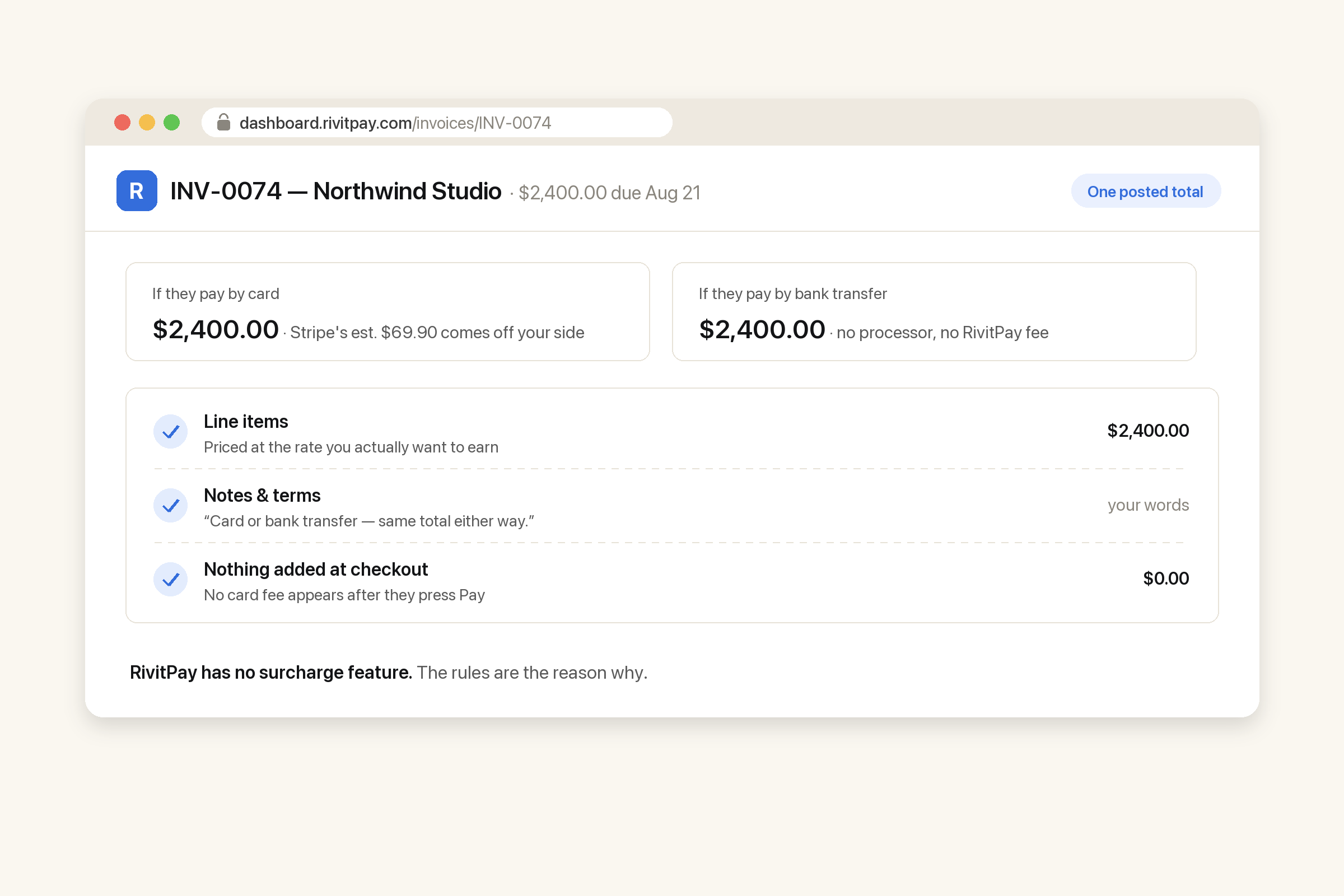
The economics underneath are the same idea. Stripe's processing goes to Stripe, as it would anywhere. Our own cut is nothing until you've collected $5,000 through the Pay button and 1.5% after that — and invoices your client pays by bank transfer never count toward it and are never charged. If you want the full comparison including the cases where we're not the cheapest option, we wrote that one down too.
The fee is real. The line item isn't the fix.
Nobody enjoys paying 2.9% to be paid on time. But the version of fixing it that takes ten seconds is the version regulators wrote rules about, and the version that's actually compliant costs more in setup than it recovers for most one-person businesses. Price it in, keep one posted total, and spend the energy on the invoices that haven't been paid at all.
Bank details and a card Pay button on the same invoice, with no fee bolted on at checkout. Free until you've collected $5,000.
Make an invoice — free, no signup