International invoicing
Your best client lives in another country. Getting paid shouldn't be the hard part.
Somewhere along the way, freelancing quietly went global. Your favorite client is in Berlin, the referral that came in last week is in Singapore, and the agency that keeps sending you overflow work bills out of Toronto. The work part of this is a solved problem — Figma doesn't care about borders, and neither does Google Docs.
The getting-paid part? That's where things get weird.
Ask any freelancer with international clients and you'll hear a version of the same story: the client is happy to pay, the money leaves their account, and then it enters a fog of intermediary banks, currency conversions, and fees nobody mentioned. What arrives is less than you invoiced, later than you expected, and explained by nobody.
The quiet tax on cross-border work
Cross-border payments are enormous — McKinsey's global payments research puts the flow at roughly $8 trillion a year, with freelance and gig work a meaningful and growing slice of it. And almost every rail that money travels on was designed for corporations, not for one person invoicing another business.
Here's what the popular options actually cost you on a $1,000 invoice, once you count everything — the transfer fee and the exchange-rate markup that hides inside "free":
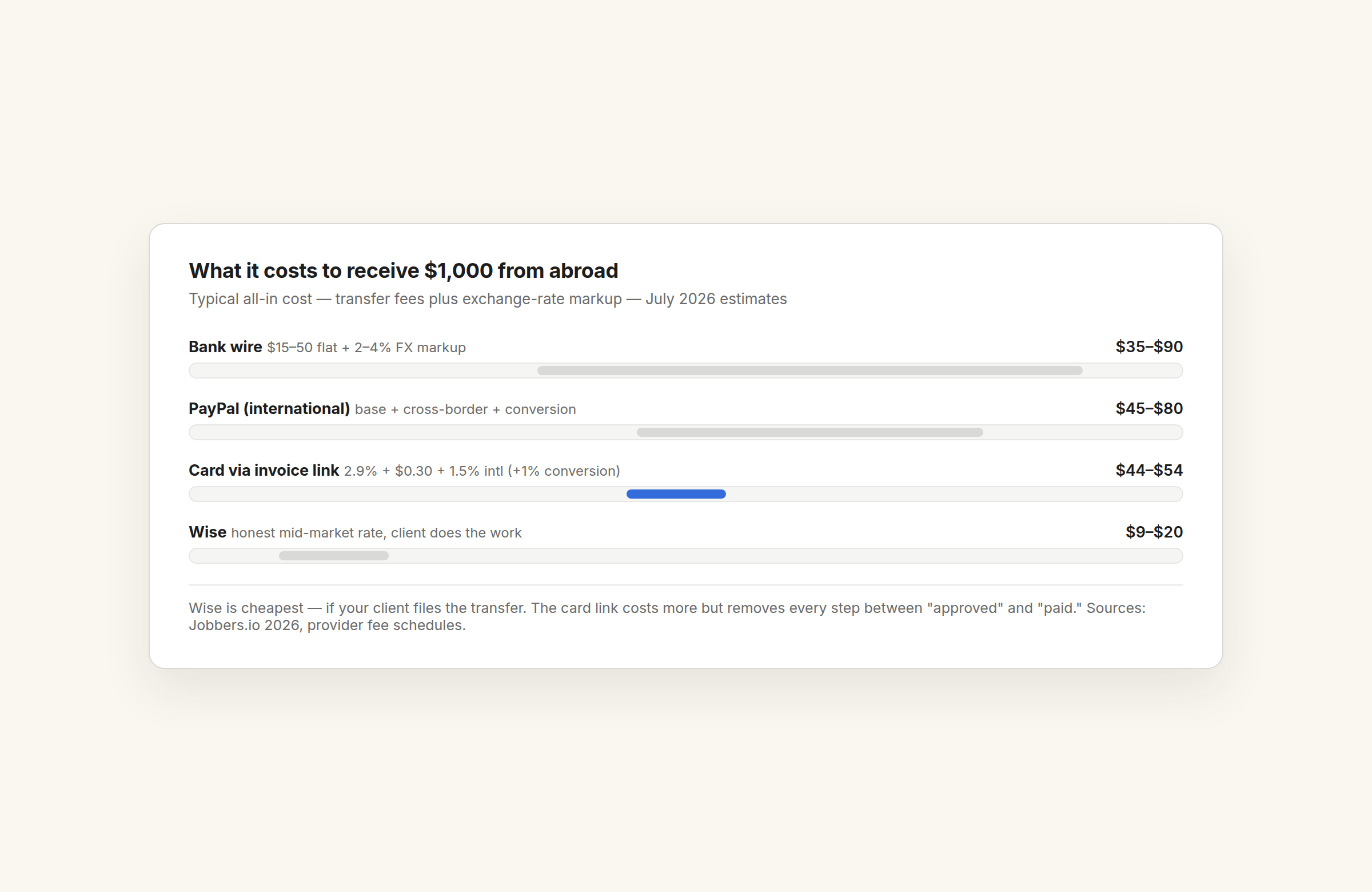
A few things jump out of that chart:
- Bank wires punish small amounts. A $15–$50 flat fee plus a 2–4% exchange markup is tolerable on a $25,000 milestone payment. On an $800 invoice, it can approach 10% of your money — before your bank's receiving fee, if it charges one.
- PayPal's convenience compounds. The Jobbers.io Global Freelance Payment Methods Report works out the full international stack — base fee, cross-border surcharge, currency-conversion markup — at 4.5% to 8% or more. And on marketplace platforms that take a commission first, freelancers can lose "close to a quarter of the original gross payment to combined fees."
- The cheap options put the work on you. Wise is honestly priced (commonly under 2%), but it requires your client to go do a transfer — another task on their to-do list, in their banking interface, on their schedule. Anything that adds a step for the client adds days to your payment.
And that's before the softer frictions: quoting a price in dollars to a client who thinks in euros, invoices that look foreign (literally), and the time-zone guessing game of whether your invoice email even landed while you were asleep.
The fix isn't a cheaper wire. It's a smaller ask.
The insight that changed how we think about this at RivitPay is that the fastest international payment is the one that feels domestic to the client.
When your Berlin client opens an invoice for €1.850,00 — their currency, familiar formatting — with a Pay online button that takes a card they already have, there's no decision to make and no wire form to fill out. They pay the way they pay for everything else. The money settles directly into your own Stripe account, in your currency, without ever passing through ours.
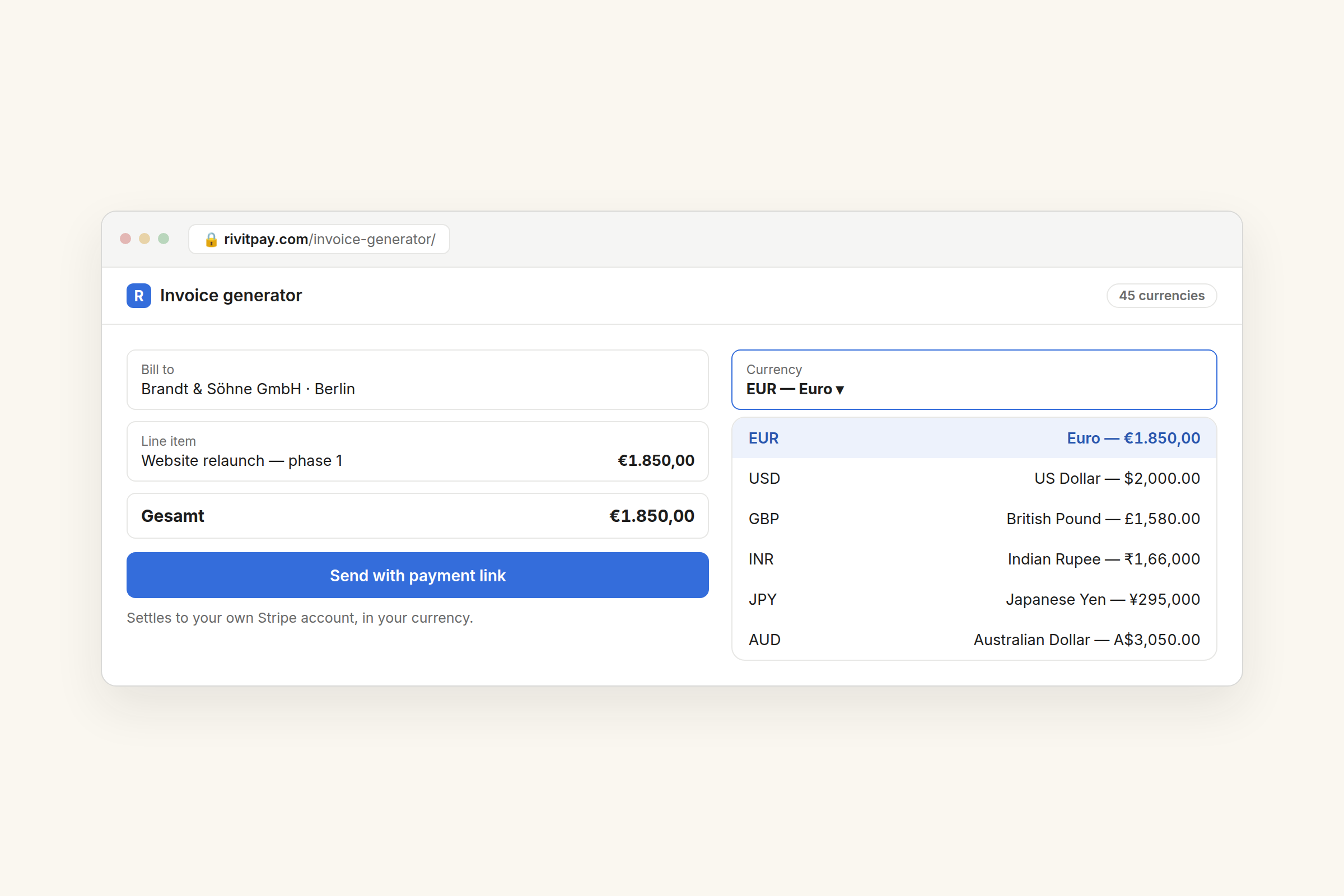
Here's what that looks like in practice:
- Bill in any of 45 currencies. Type the amount in euros, pounds, rupees, or yen — the invoice comes out properly formatted for the person reading it. Clients pay faster when the number looks like money to them.
- No signup to send your first one. The invoice generator is free and doesn't ask you to create an account, so "I should invoice that client in Sydney" becomes a two-minute task, not a project.
- See the moment it's opened — in any time zone. With an eight-hour offset, the difference between "unpaid" and "unopened" is everything. RivitPay shows you live when your client views the invoice, so you know whether to relax, resend, or follow up. (Our post on invoice tracking goes deep on why this matters.)
- A USDC option for US sellers. For clients in places where cards are painful, US-based sellers can accept USDC — settlement in minutes, without the intermediary-bank fog.
The honest fine print
The work already crosses borders fine. Your invoices can too.
Create the invoice in their currency, send the link, watch for the viewed badge. Free until your first $5,000.
Make an invoice — free, no signup