Getting paid, actually
A client asks to pay you in USDC. Now what?
It usually arrives as a casual line at the end of an email. "Would you be open to being paid in USDC? It's much easier on our end." And most freelancers do the same two things in response: they say they'll look into it, and then they don't.
Which is fair. The subject arrives wrapped in the worst marketing on the internet. So here is the honest version — including the part where the headline numbers are mostly fictional, and the part where a real advantage survives anyway.
The big numbers are mostly not real
You will have seen the claim that stablecoins now move more money than Visa and Mastercard combined. It comes from a genuine figure: transfer volume of $27.6 trillion in 2024, which does indeed surpass the combined value the card networks processed. Stablecoin market capitalisation has also recently exceeded $260 billion.
Both of those numbers come from a November 2025 piece by Rod Garratt and Michael Junho Lee on the New York Fed's Liberty Street Economics — and so does the sentence that the marketing never quotes: "Less than 10 percent of stablecoin transaction volumes are organic." The rest is bots, arbitrage, and automated shuffling between venues. Anyone citing $27.6 trillion as evidence that the world pays in stablecoins is quoting a number they haven't read the footnote for.
The same authors give the figure that's actually worth knowing. Stripped of the noise, organic stablecoin transaction volume rose from $3.29 trillion in 2021 to $5.68 trillion in 2024 — roughly an 80% increase. Smaller than the headline by an order of magnitude. Still trillions, still growing, and it's the number a sensible person plans around.
The one problem it genuinely solves
Strip away the ideology and stablecoin payment is a rail with a specific shape: it settles peer to peer, in minutes, without correspondent banks, and without a payout step at the end. That combination is unremarkable if your client is in the next town. It is a meaningful difference if your client is in another country — which is the case where a normal bank transfer gets slow and expensive, and where the gap between "paid" and "spendable" gets widest.
The people already doing it report exactly that. In BVNK's Stablecoin Utility Report 2026, freelancers, gig workers and marketplace sellers who get paid in stablecoins take around 35% of their income that way, and three in four say it has increased their ability to do business internationally.
Read that with the methodology attached, because it changes what the number means. The survey covered 4,658 adults across 15 countries in September and October 2025, and everyone in it either already held crypto in the last year or intended to acquire some. So it tells you how stablecoin payment works out for people already inclined to use it. It tells you nothing about how common this is among freelancers generally — and the answer to that is still "not very".
One thing did change structurally: the GENIUS Act became Public Law 119-27 on July 18, 2025, putting a federal framework around payment stablecoins for the first time. That doesn't make any of the practical tradeoffs below go away. It does mean the honest answer to "is this a regulated thing yet?" is no longer simply "no".
What it actually looks like to do
Mechanically it's less exotic than it sounds. The invoice is priced in your currency as normal; it names a token and a network; it carries your wallet address and a QR code your client's wallet reads. They scan or click, the transfer happens on-chain, and it's done — no processor, no payout schedule, nothing sitting in anyone's balance in between.
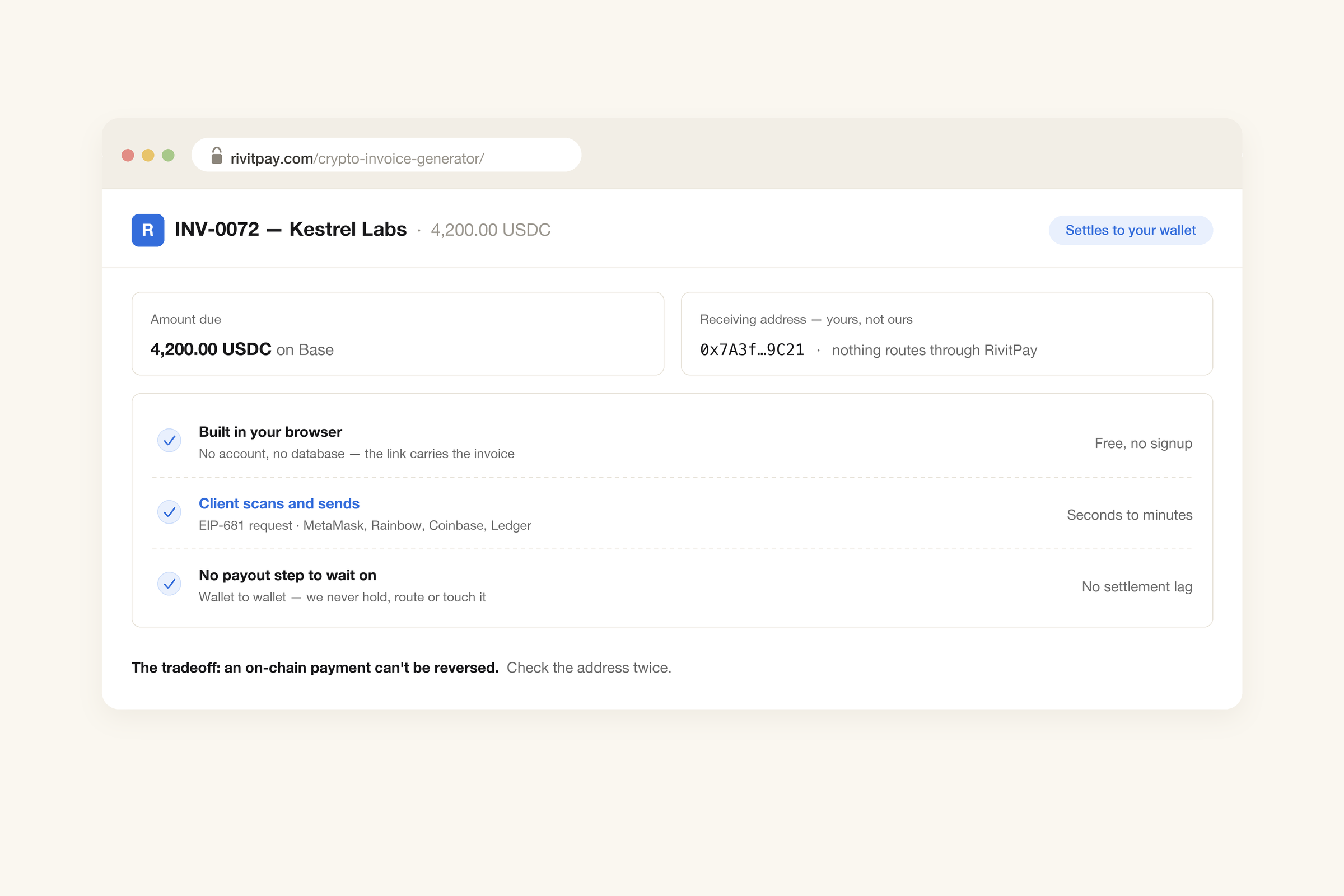
RivitPay's crypto mode is free and needs no signup, like the rest of the generator — it runs in your browser, and the share link carries the invoice, so there's no database holding it. It covers USDC, USDT, DAI, PYUSD and EURC plus the native coins, across Ethereum, Base, Arbitrum, Optimism, Polygon, BNB Chain and Avalanche, with the correct contract address and decimals filled in for each pairing. The payment QR follows the EIP-681 standard, so it works with MetaMask, Rainbow, Coinbase Wallet, Ledger Live and most others, and it encodes the chain ID — which is the single most effective guard against the classic wrong-network mistake.
The money goes from your client's wallet to yours. We never hold it, route it, or touch it. That's the same principle as our card payments, which settle into your own Stripe account — it just has fewer moving parts here, because there's no bank at the end of it.
Add it, don't switch to it
The right posture here isn't conversion, and it certainly isn't the breathless version you get from people selling it. It's this: if a client asks, you should be able to say yes in about two minutes instead of saying you'll look into it. For the overseas client who currently costs you a week of transit and a chunk of FX spread, that yes is worth real money. For everyone else, keep taking cards and bank transfers, which is what the vast majority of your clients will always want to use.
A payment rail doesn't need to win to be useful. It just needs to be better than the alternative for the specific invoice in front of you — and for a small, growing, genuinely international slice of freelance work, this one now is.
A payable stablecoin invoice with a QR code, on seven networks — free, no signup, straight to your own wallet.
Make a crypto invoice — free