India
Invoicing foreign clients from India? When GST starts, and what the invoice must say
You're a designer in Pune, a developer in Kochi or a writer in Jaipur. Your clients are in London, Austin and Berlin, and they pay you in pounds, dollars and euros. At some point someone tells you, "exports aren't taxed, you don't need GST." Someone else tells you to add 18%.
Neither is quite right. Selling services abroad can be zero-rated, which means no GST on the invoice. But that income still counts towards the registration threshold. Once you're registered, the invoice has to carry a specific line, and you have a deadline to get paid. Here's how it works, with the rules as they stand in November 2026.
A lot of India's exports are invoices like yours
The Reserve Bank of India's latest monthly figures, released October 30, 2026, put India's services exports at US$39,305 million in September 2026, 7.2% higher than a year earlier. The RBI says the July to September figures are provisional. Most of that comes from large IT and business services firms, not freelancers. But the GST rules below apply the same way whether you're a firm or one person sending invoices from a laptop.
Foreign income counts towards the ₹20 lakh
Under section 22 of the CGST Act, a supplier has to register "if his aggregate turnover in a financial year exceeds twenty lakh rupees". The limit is ten lakh rupees if you supply from one of the special category States listed in that section. The ₹40 lakh limit you may have heard of is only for suppliers "engaged exclusively in the supply of goods", so it doesn't apply to freelancers.
The part people miss is the definition. "Aggregate turnover" includes "exports of goods or services or both". So if every one of your clients is abroad, all of that income still counts towards the threshold. Here's an example: foreign invoices worth about ₹1.8 lakh a month add up to ₹21.6 lakh over a financial year, which is over the threshold. Once you're liable, section 25 says to apply "within thirty days from the date on which he becomes liable to registration". You can also register voluntarily before that.
Below the threshold, you don't have to register, even though the law treats an export as an inter-State supply. Section 7(5)(a) of the IGST Act treats a supply "when the supplier is located in India and the place of supply is outside India" as inter-State. Section 24 would normally require anyone "making any inter-State taxable supply" to register. But Notification 10/2017-Integrated Tax exempts people making inter-State supplies of taxable services whose aggregate turnover doesn't exceed twenty lakh rupees.
Is it an export at all?
Your work counts as an "export of services" only if it meets all five conditions in section 2(6) of the IGST Act:
- You're located in India.
- Your client is located outside India.
- The place of supply is outside India.
- You've been paid "in convertible foreign exchange or in Indian rupees wherever permitted by the Reserve Bank of India".
- You and the client aren't just two establishments of the same person, like an Indian branch billing its own head office.
For most services, the place of supply is "the location of the recipient of services", under section 13(2). Some services have their own rules. One change is new: intermediary services used to take the supplier's location. That clause was omitted with effect from March 30, 2026, after the GST Council recommended moving them to the default rule. If you broker deals for a foreign client, rather than doing the work yourself, check how this applies to you.
Look at the fourth condition again. Payment is part of what makes something an export. That's why the payment deadline below matters.
Zero-rated, with an LUT
Exports are zero-rated under section 16 of the IGST Act. You can export "without payment of integrated tax, under bond or Letter of Undertaking". There is also a route where you pay IGST and claim it back as a refund, but with an LUT no tax leaves your account in the first place, which is simpler for most freelancers.
The Letter of Undertaking (LUT) has to come first. Rule 96A says you furnish it "prior to export". It's filed online on the GST portal, and the portal's guide gives the path: "Services > User Services > Furnish Letter of Undertaking (LUT)", then Form GST RFD-11, where you select the financial year it covers. The FAQ says you'll need the details of "two independent and reliable witnesses", and you sign with DSC or EVC.
Two details worth knowing. CBIC's LUT circular says that if it isn't accepted within three working days, "it shall deemed to be accepted". It's also good for one year only: the LUT "shall be valid for the whole financial year in which it is tendered", and the portal changes its status to Expired "at the end of the respective FY". Put a reminder in your calendar for April to file the next one.
The line your invoice has to carry
Rule 46 sets out what a tax invoice must contain. For an export under an LUT, the wording changed on November 1, 2024. The invoice now has to carry this endorsement:
"SUPPLY MEANT FOR EXPORT/SUPPLY TO SEZ UNIT OR SEZ DEVELOPER FOR AUTHORISED OPERATIONS UNDER BOND OR LETTER OF UNDERTAKING WITHOUT PAYMENT OF INTEGRATED TAX"
It must also show the client's name and address, the "address of delivery" and the "name of the country of destination". The usual particulars still apply too:
- Your name, address and GSTIN.
- "A consecutive serial number not exceeding sixteen characters", unique for the financial year.
- The date of issue.
- An HSN code for goods or services (the codes for services are usually called SAC codes).
- A description of the service and the value.
- A "signature or digital signature of the supplier or his authorised representative".
If you sell services in India too, those invoices carry GST. Most professional services are at 18%. That's the "other professional, technical and business services" entry in Notification 8/2017-Integrated Tax (Rate), and 18% stayed the standard rate when the GST Council moved to "a 2 rate structure with a Standard Rate of 18% and a Merit Rate of 5%" in September 2025.
The deadline to get paid
This is the part that makes chasing payment important. The RBI's new export regulations came into force on October 1, 2026. They give exporters of services nine months from the date of invoice to realise and repatriate the money, or twelve months if the invoice is in rupees or settled in rupees. The version published in January said fifteen and eighteen months. The RBI changed it on September 22, before the new regulations took effect. Your bank (the Authorised Dealer) can allow more time "if the Authorised Dealer is satisfied of the reasons cited".
GST has its own deadline on top of that. Under rule 96A, an LUT exporter agrees to pay the tax "along with the interest" if the money isn't received in foreign exchange (or rupees where the RBI permits) within "fifteen days after the expiry of one year, or the period as allowed under the Foreign Exchange Management Act", including any RBI-permitted extension, whichever is later. If you don't pay, "the export as allowed under bond or Letter of Undertaking shall be withdrawn forthwith". It's restored once you pay what's due.
So a foreign client who never pays doesn't just cost you the fee. If the money hasn't arrived after a year, you can owe GST plus interest on income you never got, and you can't use your LUT until you pay it. Here's an example: if a US$3,000 invoice dated January 5, 2026 is still unpaid, the one-year-plus-15-days point falls on January 20, 2027.
Where Rivit Invoices fits
The free invoice generator makes invoices in dollars, pounds, euros or any of 45 currencies, with no signup. Put your GSTIN in the Tax ID field, the client's full address and country in the Client field, and set Tax % to 0. Use Notes / terms for the endorsement, word for word, plus the financial year your LUT covers. Add the SAC code to each line description. Your bank details go in the payment block, including the SWIFT code a foreign client's bank needs. The invoice number generator helps keep the numbering consecutive and under 16 characters.
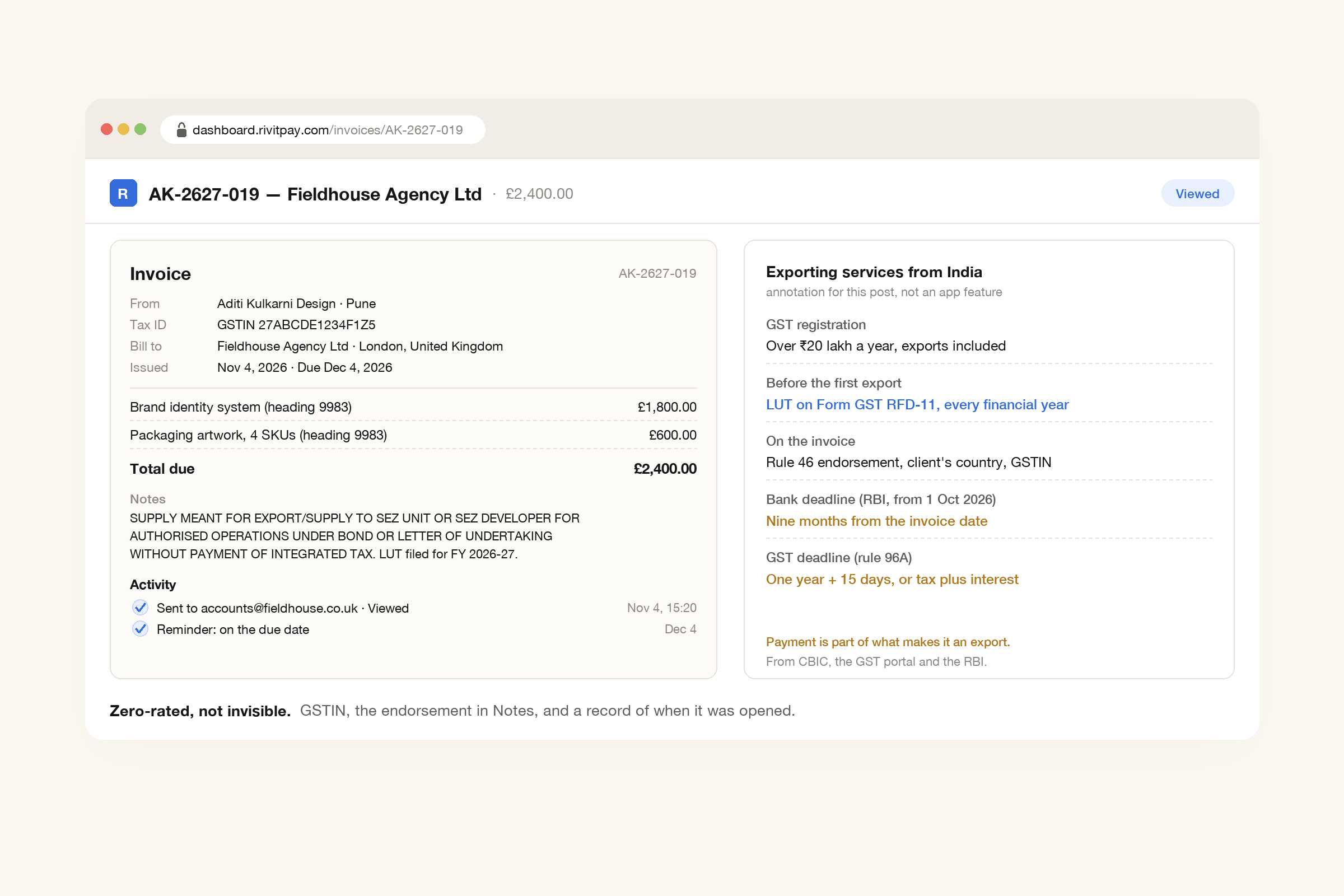
With a free account, you can email the invoice, see when the client opens it, and set automatic reminders in your own words. With a nine-month bank deadline and a one-year GST deadline, those follow-ups aren't just about cash flow. One limit specific to India: the Pay button runs on your own Stripe account, and Stripe says "Stripe services are invite-only in India". So most Indian freelancers will be paid by bank transfer to the details on the invoice, which costs nothing through Rivit Invoices. Reminders stop automatically only when an invoice is paid through the Pay button, so when a client pays by bank transfer, check that no reminder is still scheduled. For Indian clients and the MSMED Act's 45-day rule, see your Indian client has 45 days.
Register on time, file the LUT, chase the money
Foreign income counts towards the ₹20 lakh threshold from the first rupee. Once you're registered, file an LUT every April, put the export endorsement on every foreign invoice, and treat a slow-paying overseas client as a problem with a fixed deadline.
Your GSTIN, the export endorsement in Notes, your bank details, and a record of when it was opened. Invoicing is free.
Make an invoice, free