Late payment in India
Your Indian client has 45 days: the MSME rule, the 17.25% interest and what changed on 15 October
If you freelance in India and bill Indian companies, you've probably seen the purchase order that says "payment 90 days from invoice", or the accounts team that pays "in the next cycle". You might not know that, for a lot of freelancers, the law says something different.
The Micro, Small and Medium Enterprises Development Act, 2006 (the MSMED Act) gives registered micro and small enterprises a hard payment deadline, a high interest rate when a buyer misses it, and a government forum to claim through. A sole proprietor doing design, development or consulting can qualify. The Act was also amended this year, and some of the changes started on 15 October. Here's what applies today, and what doesn't yet.
The 45-day rule, and the 15-day default
Section 15 of the Act sets the deadline. When the government added a related tax rule in 2023, the Finance Ministry's memorandum to the Finance Bill summed it up like this: section 15 "mandates payments to micro and small enterprises within the time as per the written agreement, which cannot be more than 45 days. If there is no such written agreement, the section mandates that the payment shall be made within 15 days."
Two things follow from that. First, a "net 90" clause doesn't stretch the deadline past 45 days. Second, if nothing is in writing, the deadline is 15 days, which is shorter than most freelancers would ever ask for. The clock runs from when the client accepts the work, so get that acceptance in writing too. An email that says "approved, thanks" with a date on it will do.
Miss it, and interest runs at three times the bank rate
Section 16 is what gives the deadline teeth. The Office of the Development Commissioner (MSME) summarises it this way: a buyer who doesn't pay within 45 days of accepting the goods or services is liable to pay "compound interest with the monthly rests to the supplier on the amount at the three times of the bank rate notified by RBI".
The Reserve Bank of India's current rates show a Bank Rate of 5.75%. Three times that is 17.25% a year, added monthly. Compounding monthly, that works out to about 18.7% over a full year.
Here's what that means on a ₹2,00,000 invoice (two lakh rupees):
- One month late: ₹2,875
- Three months late: ₹8,749.58
- Six months late: ₹17,881.93
Those figures assume the bank rate stays at 5.75%. If the RBI changes it, the rate on your invoice changes with it. Compare that with what most freelancers can charge elsewhere. In the US, interest usually depends on what you agreed (we covered that in what you can charge when a client pays late). The MSMED rate comes straight from the Act.
Your client's tax bill has a stake in this too
Since 2024, there's been a second reason for buyers to pay on time. The Finance Act 2023 added section 43B(h) to the Income-tax Act, 1961. Under it, a sum owed to a micro or small enterprise "beyond the time limit specified in section 15" can only be deducted when it's actually paid. The usual leeway of paying by the return due date doesn't apply. The February 2025 draft of the new Income-tax Bill carried the same rule over as section 37(2)(g), and the Finance Ministry confirmed in a Rajya Sabha answer on 21 July 2026 that 37(2)(g) of the Income-tax Act, 2025 is the successor to 43B(h).
In practice, a client who sits on your invoice past the deadline can lose the deduction for that tax year. Their finance team knows this, especially near the 31 March year end. Mentioning it politely in a reminder is often more effective than threatening interest.
It only works if you're registered
These protections are for micro and small enterprises, and the government's own guide to Udyam registration lists "Protection against delayed payments" among the benefits of registering. Registration is on the Udyam portal, which says "Registration Process is totally free. No Costs or Fees are to be paid to anyone." It's based on self-declaration, using your Aadhaar number, plus your PAN and, if you're required to have one, your GSTIN. Ignore any site that charges you to register.
You'll almost certainly count as micro. Since 1 April 2025, a micro enterprise is one with investment up to ₹2.5 crore and turnover up to ₹10 crore. You won't be alone: the portal's dashboard for 28 October 2026 shows 5,52,88,270 Udyam registrations (about 55 million), 5,46,54,360 of them micro.
Register before you take on the work. The Act's protections are written around a registered supplier, so a registration dated after the contract gives a buyer something to argue about.
Claiming it: the Facilitation Council
If a buyer still won't pay, you can refer the dispute to your state's Micro and Small Enterprises Facilitation Council (MSEFC). Under section 18 as it stands, the council first tries mediation under the Mediation Act, 2023. If that fails, it arbitrates the dispute itself or sends it to an arbitration centre. The council where you're based can hear a claim against a buyer "located anywhere in India". A buyer who wants a court to set the award aside has to deposit 75% of it first.
The weak spot has been speed. Crisil Intelligence, reading the ministry's MSME Samadhaan data, reported in August that as of 14 August 2026, micro and small enterprises had filed 256,892 applications over delayed payments worth ₹55,244 crore. Claims worth ₹20,979 crore were still pending, and about 40,580 applications, or 16%, had been unresolved for more than a year. The load is uneven: Karnataka's 35 councils handle an average of 397 applications each, while Rajasthan's nine handle 1,767 each.
What changed on 15 October, and what hasn't yet
Parliament passed the MSMED (Amendment) Bill, 2026 in August (Rajya Sabha on 3 August, Lok Sabha on 7 August). It became Act 16 of 2026. But it's coming into force in stages. The ministry's notification S.O. 5575(E) of 12 October brought in "sections 2 to 7 (both inclusive), section 11 and sections 13 to 17 (both inclusive)" on 15 October 2026, and section 12 on 15 December.
Matching those section numbers against the Bill as introduced, here's what's in force now:
- Central public sector enterprises have to settle MSME invoices through TReDS, the RBI-authorised invoice-discounting platforms. Governments can extend this to other buyers.
- States have to set up enough Facilitation Councils and have them meet regularly.
- A new penalty scale applies to buyers who don't report unpaid MSME dues in their annual accounts: a warning first, then ₹10,000 to ₹50,000, then ₹50,000 to ₹1 lakh.
- Registration is now free and voluntary for every MSME, on a national digital platform, and the Act itself lets the government classify enterprises by turnover as well as investment.
And here's what's not in force yet, because sections 8, 9 and 10 haven't been given a date. Councils will have to "complete the mediation within a period of ninety days from the date fixed for first appearance". A failed mediation will have to go to arbitration within 30 days, and the award will be due within 90 days of the pleadings closing. Awards will be recoverable "as an arrear of land revenue" through the District Collector. And if a buyer's challenge has been pending for more than six months, the court will have to release at least 50% of the award to you. Those are the changes that would actually speed up a freelancer's claim, and they're still waiting.
Where RivitPay fits
The Act does the heavy lifting, but it only helps if your paperwork shows the terms, the dates and that the client got the invoice. That's what the invoice is for.
The free invoice generator, with no signup, makes the invoice in Indian rupees or any of 45 currencies. Put your Udyam number (or your GSTIN) in the Tax ID field and set a due date no more than 45 days out. Use Notes for the clause: payable within 45 days of acceptance, with interest under section 16 after that. Add your bank account or UPI details for payment. The free estimate generator puts the terms in writing before you start, so you're never stuck with the 15-day default by accident. With a free account, you can email the invoice and see when it's opened (more on that in your client opened your invoice, now what). Automatic reminders in your own words go out on a schedule and stop the moment it's paid.
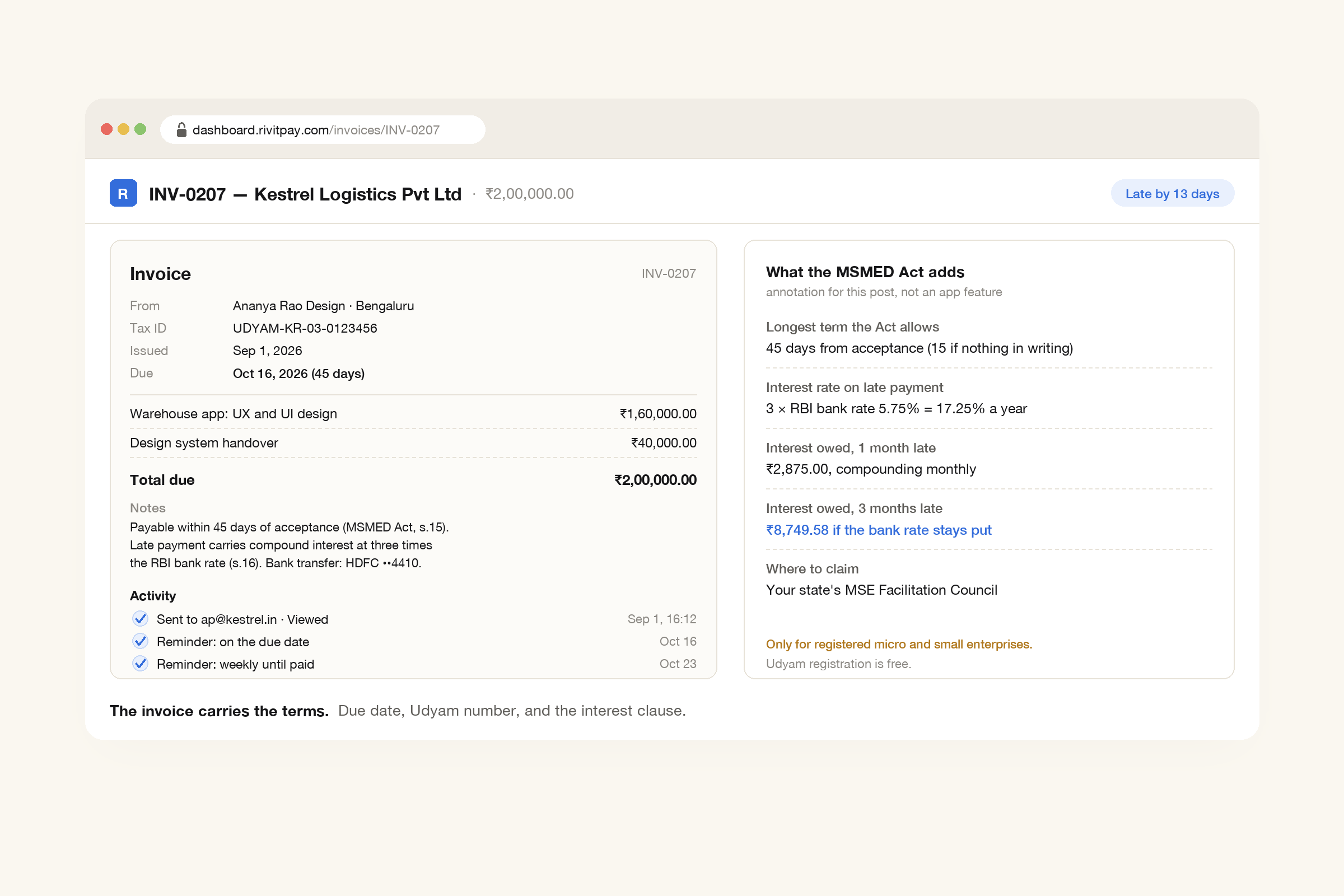
Put the 45 days on the invoice
Most clients who pay slowly aren't doing it on purpose. Their accounts team runs on whatever terms the PO says. A Udyam number, a 45-day due date and a one-line interest clause on the invoice tell that team the law has a different deadline, and that their own tax deduction depends on meeting it. You may never need to go to the Council. But it helps for the client to know you could.
Rupees or any of 45 currencies, a Tax ID field for your Udyam number, a live Viewed status and reminders that stop on payment. Free, no signup to start.
Make an invoice, free