Disputes
PayPal's Seller Protection probably doesn't cover your freelance work

You finish a brand identity project, send a PayPal invoice for $1,800, and the client pays the same day. Three weeks later, PayPal emails you. The client has opened a dispute: the work "isn't what was agreed". You're not too worried, because PayPal has Seller Protection.
Then you read the terms. For most freelance work, Seller Protection doesn't cover the kind of dispute you're most likely to get. Here's what PayPal's US terms actually say, what a lost dispute costs, and what helps when you sell services.
What Seller Protection covers
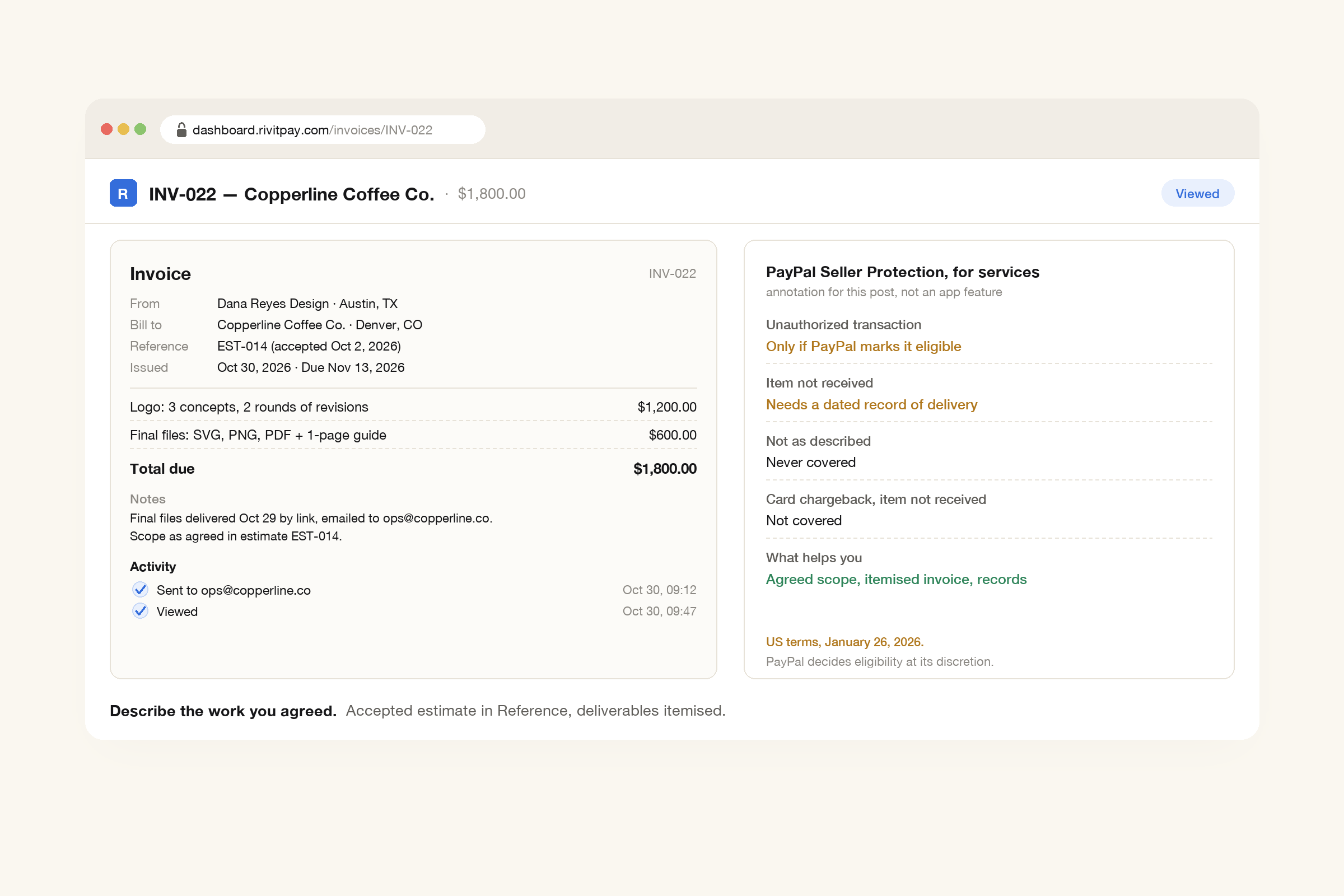
PayPal's Seller Protection Program (last updated January 26, 2026) covers two kinds of claim. One is an "Unauthorized Transaction", where the buyer says they didn't authorize the payment. The other is "Item Not Received". It also covers reversals from successful chargebacks where the cardholder says they didn't authorize the payment, and bank-funded payments that the buyer's bank reverses.
It's written around parcels. The basic requirements say "the item must be a physical, tangible good that can be shipped, except for items subject to the Intangible Goods Additional Requirements." Services and digital work fall under those extra requirements, which are stricter:
- Unauthorized claims are only covered if PayPal "has marked the intangible good transaction as 'eligible'" on the transaction page, or told you in writing.
- You must have delivered, and be able to prove it. For intangible goods, proof means "a system of record showing the date the item was sent" and that it was "electronically sent to the recipient, including the recipient's address (email, IP, etc.)" or "received or accessed by the recipient."
Then there's the list of what's never covered. It includes "items where the buyer claims (either with us or their card issuer) that the item you sent isn't what was ordered (referred to as a Significantly Not as Described claim)." It also excludes Item Not Received claims "that result from buyers filing chargeback claims with their issuers for card-funded transactions." And the US program needs your PayPal account's primary address to be in the United States.
So the dispute freelancers get most, "this isn't what we agreed", is the one Seller Protection never covers.
Custom work helps you, until the client uses a card
There's a detail on the buyer's side that cuts your way. PayPal's Purchase Protection program lists "Significantly Not as Described claims for wholly or partly custom-made items" as ineligible. It also says an item may not count as not-as-described if it "was properly described but did not meet your expectations." A lot of freelance work is custom-made by definition. Whether a particular project counts is PayPal's call, though, since it decides eligibility "in its sole discretion".
The same page then warns buyers who paid by card that "applicable card chargeback rights may be broader than those available to you under PayPal's Purchase Protection program", and that through the card issuer they "may be able to recover amounts you paid for unsatisfactory items even if they don't qualify." The user agreement (updated September 14, 2026) says what that means for you: a payment can be reversed if "your buyer pursues a chargeback related to a card-funded transaction and the transaction is not eligible for PayPal's Seller Protection program. The card issuer, not PayPal, determines whether a buyer is successful."
The timelines matter too. A buyer filing with PayPal has to open a not-as-described dispute "within 30 days of the date of delivery or fulfillment" or within 180 days of paying, "whichever is sooner". Item Not Received gets the full 180 days. Once a dispute is open, PayPal will "place a hold on all funds related to the transaction" until it's resolved, and the buyer has 20 days to escalate it to a claim.
What losing costs
If you lose a claim, you give back "the full purchase price", and PayPal adds: "You will not receive a refund of the PayPal fees that you paid in connection with the sale." There's also a dispute fee on top. Under the user agreement it applies "when the buyer pursues a claim directly with PayPal, a chargeback with their card issuer, or a reversal with their bank." PayPal's fee page (last updated October 1, 2026) sets the standard fee at $15. It's $30 if your dispute ratio is 1.5% or more and you had more than 100 sales over the previous three full calendar months.
Here's the $1,800 project, paid through PayPal Checkout on the invoice. The invoicing rate for that is 3.49% + $0.49, so $63.31 (the PayPal fee calculator works this out for other amounts). Lose the dispute and you refund the $1,800, PayPal keeps the $63.31, and the $15 dispute fee comes off your balance once the claim is decided. You're $78.31 out of pocket, and you've done the work for nothing.
The fee isn't charged on everything. You won't pay the standard dispute fee if the dispute is "resolved directly between you and the buyer and not escalated to a claim with PayPal", or if it's "decided in your favor". That's a good reason to answer a dispute quickly and talk to the client before it's escalated.
What actually protects you on service work
No payment processor's terms protect you well against "this isn't what I asked for". What helps is the evidence you build up before the dispute starts:
- A written scope the client agreed to. PayPal's own test for not-as-described is whether the item is "materially different from the seller's description of it." For service work, your description is the scope and the invoice. "Logo: 3 concepts, 2 rounds of revisions, final files in SVG and PNG" holds up much better than "Design work".
- A record of delivery. Send final files by email or a link that shows dates, and keep the thread. That's the "system of record" PayPal asks for.
- Smaller amounts at risk. A deposit and milestone invoices mean any single dispute is over part of the fee, not all of it.
- Fast replies. The user agreement lets PayPal reverse a payment if you "fail to respond or provide accurate and complete information" in time.
Where RivitPay fits
Honestly, RivitPay doesn't have a seller protection program either. When a client pays by card through an invoice's Pay button, the money goes straight into your own Stripe account, and cardholders can still dispute it with their bank. Our chargeback post explains how that works on Stripe. What RivitPay does is help you build the evidence before a dispute.
Write the scope as an estimate in the free estimate generator. It includes an acceptance line the client can sign. When they accept, press Turn into invoice and the line items carry over, so the invoice describes the same work the client agreed to. With a free account you can email the invoice and see the moment the client opens it, and automatic reminders in your own words follow up until it's paid. If you'd rather avoid card disputes altogether, put your bank details on the invoice. A bank transfer made outside RivitPay costs nothing.
The short version
PayPal's Seller Protection was built for shipped parcels. It never covers "not as described" claims, and for services it only covers the rest with extra conditions. Custom work gives you some cover if the client files with PayPal, but much less if they go to their card issuer. Get the scope agreed in writing, keep a record of delivery, invoice in stages, and answer disputes fast.
Turn an accepted estimate into an invoice, see when it's opened, and get paid by card or bank into your own Stripe account. Free until you've collected $5,000.
Write an estimate, free