Getting paid, actually
Your client can un-pay you (it's called a chargeback)

Here is a thing almost nobody tells you when you start taking card payments: the money arriving in your account is not the end of the transaction. It's the middle of it.
Six weeks after a job closed cleanly, an email lands. The client's bank has taken the payment back. Not paused it, not asked you about it — taken it. The amount is already gone from your balance, there's a fee on top, and you have about two weeks to explain yourself to a stranger at a bank who will never speak to you directly.
This is a chargeback, and it is the single least-understood part of getting paid by card. It's also rare enough that most freelancers meet it exactly once, at the worst possible moment, with no idea how the machine works.
What actually happens, in order
When a cardholder disputes a payment, the card network doesn't ask you first. Per Stripe's disputes documentation, the network pulls the disputed amount straight out of your balance, adds a dispute fee, and holds those funds for the entire duration of the dispute. You also can't issue a normal refund while it's open — the dispute process is the only channel now. And your dispute rate with that network goes up the moment it's filed, whether you eventually win or lose.
Then the clock, which is longer and stranger than you'd expect:
- Up to 120 days for them to file. Card networks typically let cardholders dispute a payment within 120 days of it being made. For work paid for in advance, the window generally starts on the service date, not the payment date — so a deposit taken in March for an October project can still be disputed well into the following year.
- 7–21 days for you to answer. That's the whole response window, depending on the network, and you get one submission. You can't edit it, add a file you forgot, or send a follow-up.
- 60–75 days for the issuer to decide. The full lifecycle runs two to three months, and you can't speed it up except by giving in.
The outcome is final either way. Neither you nor the client can appeal it afterwards.
The fees, and the odds
In the US, Stripe charges a $15 dispute received fee the moment a dispute is filed, and — since a pricing change on 17 June 2025 — a further $15 dispute countered fee if you fight it. The countered fee comes back if you win. The received fee never does, and it applies even if you simply accept the dispute and walk away.
As for winning: Stripe's own win-likelihood scale, shown on the dispute page in its Dashboard, tops out at a 60% chance on its most favourable five-dot rating and drops to 5% at the bottom. Their evidence best-practices guide puts it plainly: "Even in the most favorable cases, it's very difficult to overturn a disputed payment." That's the house telling you the odds at their own table.
Which reframes the whole thing. A chargeback is not a court case you can win with a good enough argument. It's a claim you're trying to make obviously wrong to a busy reviewer in under a minute.
Why freelancers get them (it's usually not fraud in the movie sense)
Stripe reports that fraudulent disputes account for over half of all disputes — but "fraudulent" is a reason code, not a character assessment. A large share of these start with a cardholder who genuinely doesn't recognise a line on their statement. Stripe describes the pre-dispute inquiry phase exactly that way: the bank is asking for clarification "often because the cardholder doesn't recognize the transaction description."
For freelance work, the usual suspects are boring and preventable-ish:
- The name on the statement isn't the name they hired. You're Jordan Reyes in their inbox and RYS STUDIO LLC on the card line.
- A long gap between paying and receiving. Deposits are the classic — money out in spring, work delivered in autumn, and the memory of agreeing to it has faded.
- A relationship that soured after payment. Revisions stalled, the scope argument got ugly, and disputing the charge is the fastest lever the client has.
- Someone else pays. An office manager's card, a founder's personal card for a company expense — the person who filed the dispute may not be the person you dealt with at all.
Note that only the last one is fraud in any ordinary sense. The rest are memory and paperwork problems, which is good news: memory and paperwork are things you can fix in advance.
What to actually do
Never ignore an inquiry. Some networks open a preliminary phase before a formal chargeback. Stripe is blunt about this: failing to respond signals implicit acceptance and can escalate it into a formal, "likely unwinnable" chargeback. Answer it the day it arrives — you can often close it with a clear explanation and no fee at all.
Assemble everything before you submit anything. One shot, remember. Stripe's guidance is to present evidence chronologically, group it by type, and keep it short — issuers review thousands of these a day and won't hunt through your full terms of service for the relevant clause. Send the paragraph, not the document.
Prevention counts more than winning. Network monitoring programmes measure disputes received, not lost — a dispute you win still counts. Stripe notes that the industry treats dispute activity above 0.75% as excessive, and a sudden spike can flag an account before it gets there. For a freelancer sending a handful of invoices a month, two disputes in a quarter is a bad quarter statistically, not just financially.
Make your statement descriptor match your invoice. Genuinely the highest-leverage fifteen minutes available here. If the name on their card line matches the name on the invoice, an entire category of disputes never starts.
What we do about it, and what we can't
RivitPay's card payments are direct charges, which matters here in a way that cuts both ways. Because the money lands in your own Stripe account, a dispute debits your balance — Stripe's Connect documentation is explicit that for direct charges the disputed amount comes out of the connected account, not the platform's. There is no RivitPay float absorbing it and no middleman deciding your case. You own the payment, so you own the dispute.
What we can do is make sure the boring record exists before you need it. Every invoice carries an itemised scope with dates and rates, a client name and email, a reference or PO field, your own notes and terms as the client saw them, the PDF exactly as it was sent — and a viewed timestamp for when they opened it:
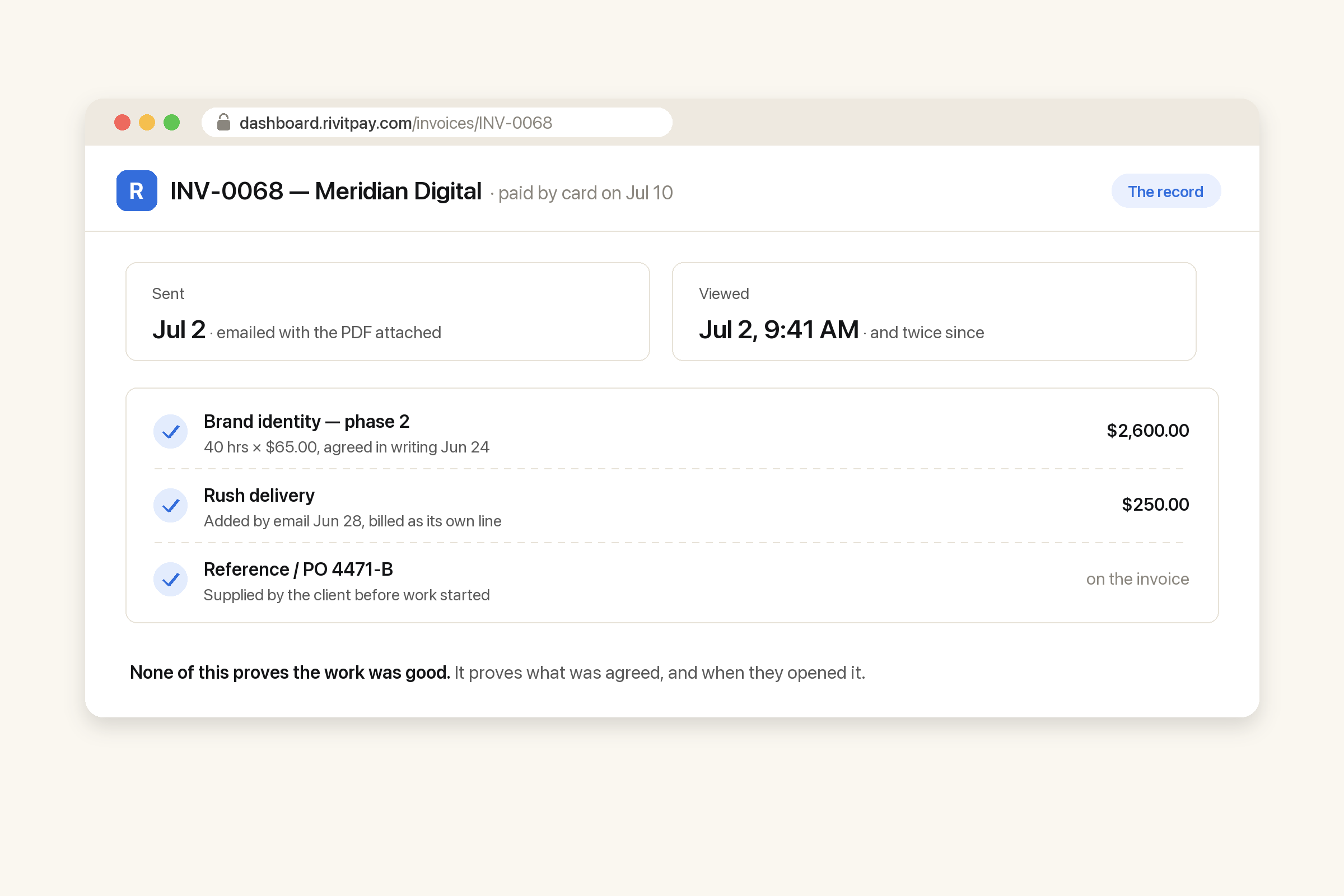
Read that list again next to what a card issuer asks for — a description of the product or service, the customer's name and email, communication showing they knew about and accepted the work, the receipt they were sent. It's largely the same list. Not because an invoice is a legal instrument, but because a specific invoice is a dated, itemised account of what was agreed, and vagueness is what loses these.
What we can't do is fight it for you, or make it come out your way. Stripe facilitates the case and doesn't influence the outcome; neither do we. Nobody in this chain can overrule a card issuer.
Rare, survivable, and much easier with a paper trail
Most freelancers will go years without one of these. The point isn't to be afraid of card payments — the alternative rails have their own arithmetic and delays, and card is still the fastest way to get a client to actually pay. The point is that "paid" has a 120-day asterisk on it, and the ten minutes you spend making an invoice specific are the same ten minutes that answer the dispute you'll probably never get.
Itemised invoices, viewed timestamps, and card payments that settle to your own Stripe account. Free until you've collected $5,000.
Make an invoice — free, no signup