Charging for your work
Scope creep is just work you haven't invoiced
"While you're in there, could you also—"
Every freelancer knows the rest of that sentence. The logo project that quietly becomes a brand kit. The five-page site that's somehow eleven pages now. The "tiny tweak" that's four hours of unpicking someone else's decisions. None of it arrived as a new project. All of it arrived as a favor.
Project managers have a name for this — scope creep — and it isn't a freelancer quirk: 52% of projects experience it, per the Project Management Institute's Pulse of the Profession survey of thousands of project professionals. Big companies fight it with change-control boards and steering committees. You fight it alone, mid-email, while trying to sound easygoing.
But here's the reframe that makes scope creep manageable: it isn't really a boundaries problem. It's a billing problem. The moment extra work gets a price, it stops being creep and becomes revenue — or it stops being asked for, which is also fine. What kills freelancers isn't the client asking; it's the work getting done without ever touching an invoice.
Why you absorb it (and why that math is worse than it feels)
You say yes for reasonable reasons. The ask is small. The client is nice. Re-opening the price conversation feels awkward, and you'd rather spend twenty minutes doing the thing than an hour negotiating it.
But absorbed work compounds in the worst possible way. It doesn't just cost the hours; it resets the client's sense of what's included, so the next ask is bigger and more awkward to charge for. And it stacks on top of everything else you already do for free: freelancers already spend an average of 102 hours a year just chasing invoices and doing unpaid administrative work around getting paid (Freelancers Union) — we did the full math on that in Chasing Invoices Is a Part-Time Job. Free work on top of free chasing is how a decent day rate quietly becomes a mediocre one.
The three-sentence system
You don't need a change-control board. You need a reflex — one that routes every new ask toward the invoice instead of around it.
1. Name it, cheerfully. "Good idea — that's outside the original scope, so I'll quote it as an add-on." No apology, no drama. You're not saying no; you're saying this has a price, which is what professionals say. The clients worth keeping hear it as competence.
2. Price it in writing before you do it. A two-line email is a contract's scrappy little cousin, and it works: "Adding the extra two pages: $400, delivered Friday with the rest. Reply yes and I'll get started." Get project changes in writing every time — undefined territory is exactly where creep lives.
3. Put it on the invoice as its own line. This is the step people skip, and it's the one that changes client behavior. When the extras appear as named line items — "Additional page designs (2) — $400" — the client sees what asking costs, and next time they ask knowingly or don't ask at all. Itemized invoices also get disputed less: nobody argues with a line they approved by email on Tuesday.
Adding that line takes about ten seconds in RivitPay's generator — description, quantity, rate, done:
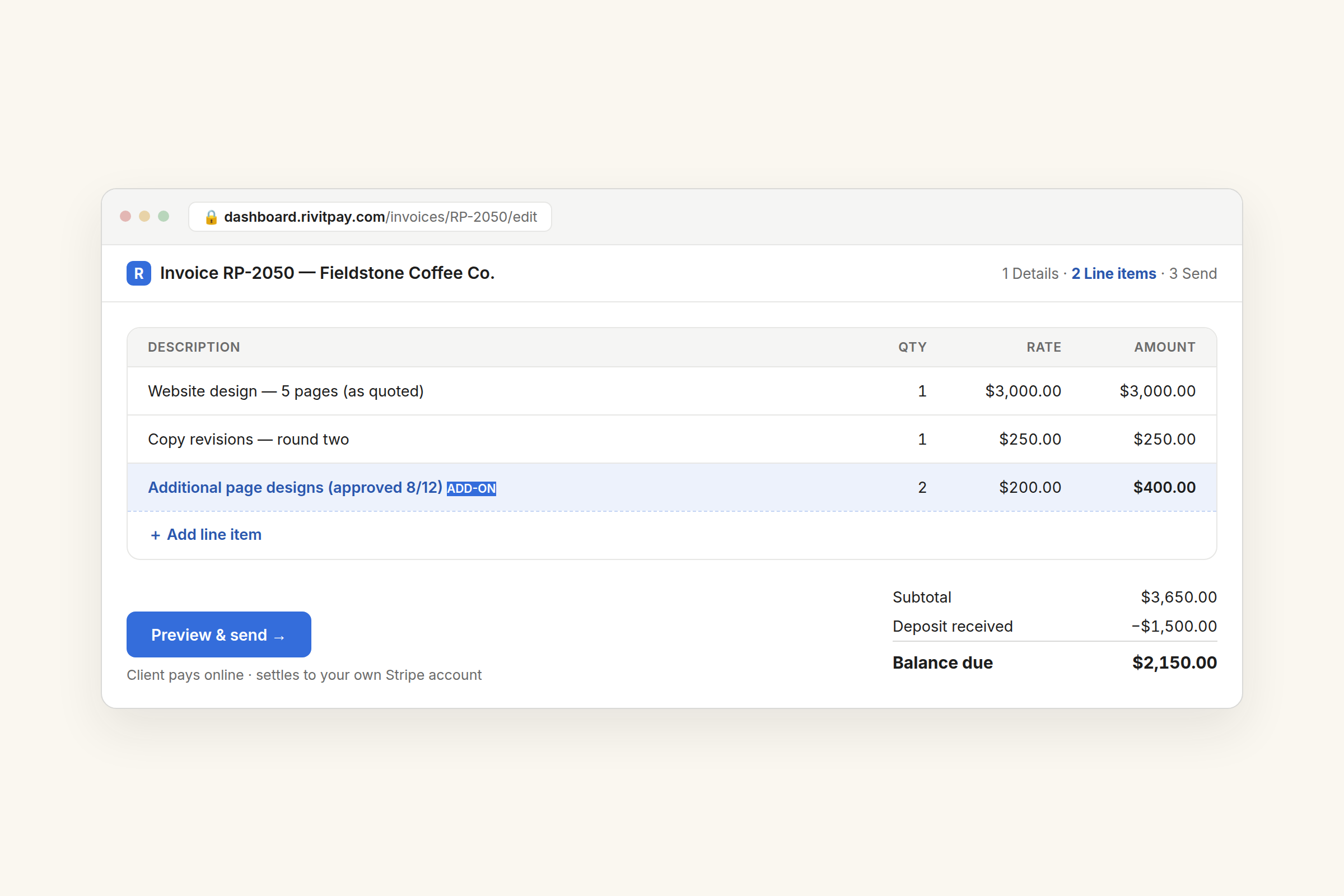
And for the mid-project asks that are too big to bolt onto the final bill — the redesign, the extra deliverable, the second audience version — don't wait for the end at all. Send a small separate invoice now. It takes under a minute, it gets the extra work paid while everyone still remembers approving it, and it keeps your final invoice small — which matters, because the data says the bigger the invoice, the later it pays: invoices over $20,000 are 3× more likely to be late than small ones (Bonsai, from 100,000+ freelancers' invoices). Scope creep you absorb doesn't just go unpaid — it inflates your final invoice into exactly the kind that pays late.
The honest caveats
Scope creep survives on friction: the awkwardness of naming it, the effort of billing it. Remove the friction and it's just… more work, at your rate, on an invoice.
Line items in seconds, a whole invoice in under a minute — free until you've collected $5,000.
Make an invoice — free, no signup