The slow ways to get paid
The check is in the mail. So are the people stealing them.
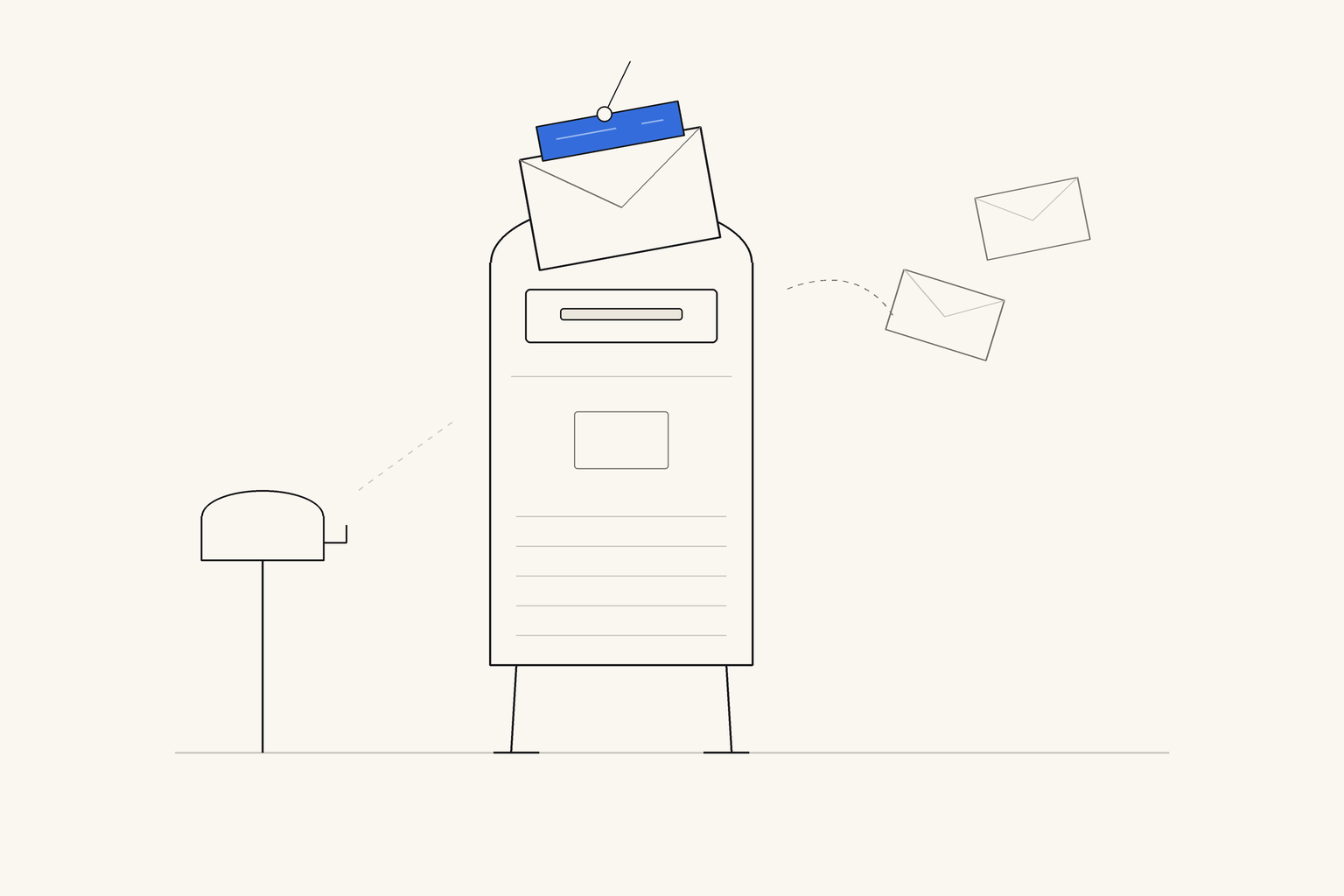
The client's accounts payable person writes back on day 12: "The check went out on the 3rd." That was nine days ago. Nothing has arrived. You check the mailbox twice a day now, which doesn't help.
Most of the time the check is just slow. But "it's in the mail" now covers a real risk too, and if your clients still pay by check, it's worth knowing what that risk is, what the bank can make you wait even when the check does arrive, and how to move a client off paper without making it awkward.
Checks are still the most targeted way to pay
The Association for Financial Professionals runs a survey of corporate treasury and finance staff every year. The 2026 edition, based on 465 respondents and covering 2025, says it plainly: "Checks remain the payment method most frequently impacted by fraud." 58% of organizations reported check fraud in 2025, "outpacing ACH fraud and wire fraud."
A lot of that starts in the mail. After FinCEN, the US Treasury's financial crimes unit, warned banks about a "nationwide surge" in mail theft-related check fraud in February 2023, it went back and counted what came in. Its follow-up analysis, published in September 2024, found that in the six months after the alert, banks and credit unions filed 15,417 reports from 841 financial institutions, covering more than $688 million in suspicious activity.
FinCEN also broke down what happened to the stolen checks: 44% were altered and then deposited, 26% were used as templates to make new fake checks, and 20% were fraudulently signed and deposited. "Altered" usually means washed: the payee and amount are dissolved off the paper and rewritten, keeping the real signature. Your client's check to you, with your name on it, is exactly the kind of thing that gets washed.
Those numbers cover everyone who writes or receives checks, not freelancers specifically. Nobody counts stolen freelance invoice payments on their own. But a check from a client goes through the same blue collection boxes as everyone else's.
What happens if yours goes missing
Generally, a check that never reached you hasn't paid you. The client still owes the invoice, and the stolen check is a problem between them and their bank. That's the good news. The bad news is everything that has to happen before you see the money:
- Someone has to notice. Usually that's you, a week or two after the check "went out".
- The client has to stop the check and reissue it. That's another approval, another print run and often another payment cycle on their side.
- The new one goes back into the mail. Same route as the one that was stolen.
The US Postal Inspection Service's mail theft advice is that if you're expecting valuable mail and it doesn't arrive, "contact the sender as soon as possible and inquire about it." Don't wait out a month of politeness. If a check is a few business days later than the post should take, say so.
And when it does arrive, the bank can still make you wait
Depositing a check isn't the same as having the money. Federal rules, under what's called Regulation CC, set the longest your bank can usually hold it. The Federal Reserve's compliance guide says money from an ordinary local check generally has to be available by the second business day after you deposit it. Two of the dollar amounts in those rules were raised for inflation on July 1, 2025, according to the Fed and CFPB's final rule:
- $275 (up from $225): the part of a day's check deposits your bank generally has to make available by the next business day.
- $6,725 (up from $5,525): the large-deposit threshold. Anything above it in one banking day can be held for "a reasonable period", which the rule defines as up to five extra business days for an ordinary check. The same $6,725 limit applies to new accounts in their first 30 calendar days, and the rest of a big deposit into a new account can wait until the ninth business day.
So an $8,000 check from a client, deposited on a Monday into an established account, could legally be spread out: $275 on Tuesday, most of the rest by Wednesday, and the last $1,275 as late as the Wednesday after. If you opened a business account last month to look more professional, it could be slower still. Your own bank may well be faster than this. These are the outer limits, and its funds-availability policy says what it actually does.
We've written before about the gap between paid and spendable on every payment rail. Checks just have the longest one, and the only one that starts with a trip through the mail.
Moving a client off paper without a fight
Many clients pay by check because nobody ever offered them anything else, not because they insist on it. A few things that help:
- Put the alternatives on the invoice itself. Your bank details for a transfer, and a link they can pay online. The person who prints the check often isn't the person who chose to, and they'll use whatever's easiest.
- Ask once, at the start. "Can you pay by bank transfer? It saves us both the postage" goes down better on the first invoice than after a check has gone missing.
- If it has to be a check, ask for the date it was mailed and the check number. Then you know when to start worrying and what the client should stop.
- Deposit it the day it arrives, and keep the paper until the money is safely available, if you deposit it on your phone.
- Use the reminder you'd send anyway. If a check is late, the next reminder can offer an online payment instead, and the client can choose.
Where RivitPay fits
Every RivitPay invoice can carry your bank details for a transfer, and with a free account it also gets a Pay button. Clients pay by card or bank through it, straight into your own Stripe account. No envelope, no collection box, and no check to wash. RivitPay never holds the money.
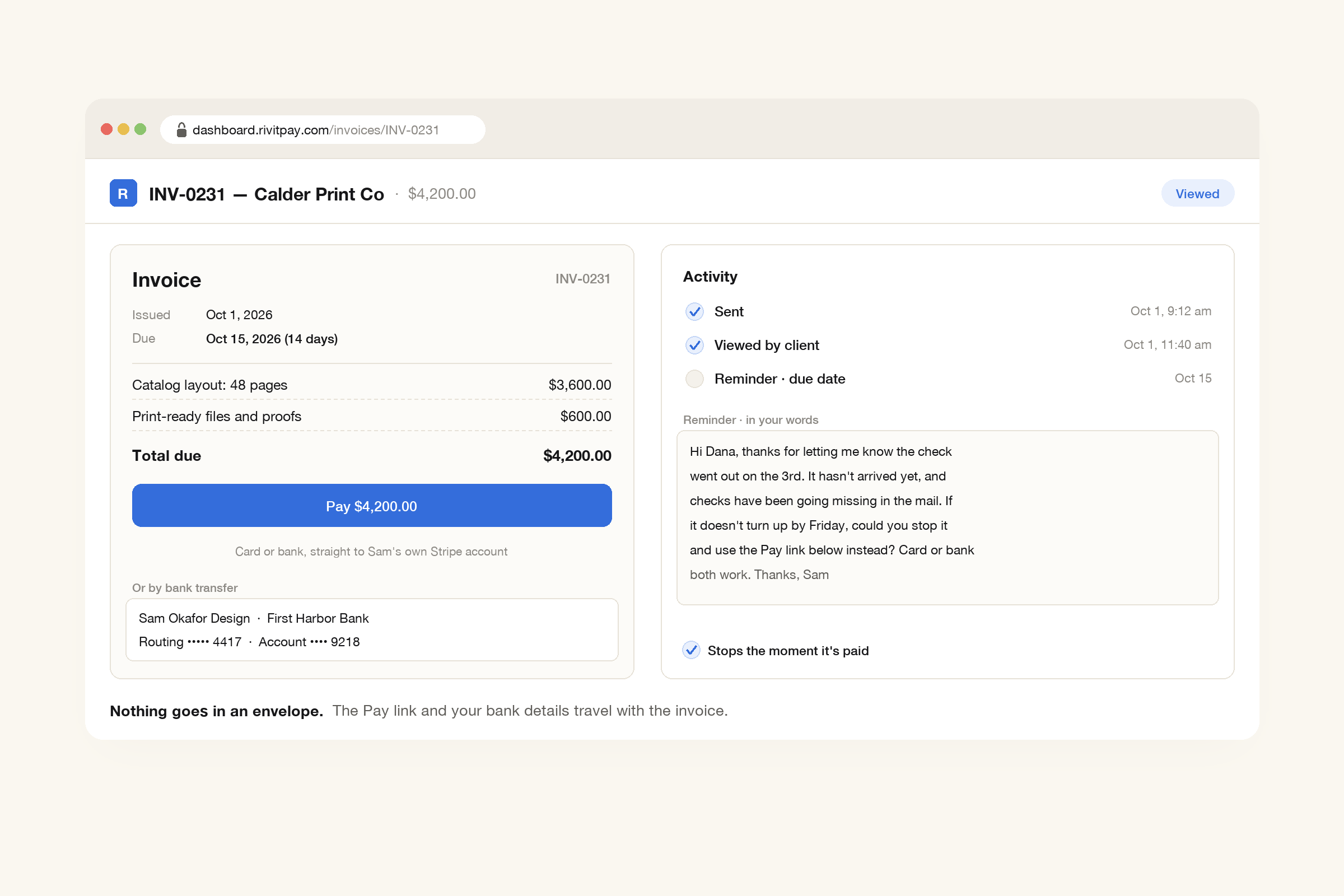
The record shows when you sent the invoice and when the client opened it, so you know whether the delay is on their side or in the post. Automatic reminders go out on a schedule you set, in your own words, so the reminder on the due date can say "if the check hasn't gone out yet, the link below is quicker". They stop the moment the invoice is paid. Invoicing is free, and there's no RivitPay fee until you've collected $5,000 through the Pay button. Bank transfers to the details on your invoice never cost anything and don't count toward it.
The cheapest fix is offering something else
Most checks still arrive, and most get deposited without a problem. But a check is the only way to get paid that sits in a metal box on a street corner overnight. You can't stop someone fishing in that box. You can make sure every invoice gives your client an easier way to pay, so fewer of your payments go through it.
Invoices with your bank details and a Pay button that settles to your own Stripe account, plus reminders in your own words. Free until you've collected $5,000.
Make an invoice, free