Tax
Your California client paid 7% less than your invoice. Here's why, and how to stop it
You flew to Los Angeles for a three-day shoot, sent the invoice, and the payment came in short. No dispute, no email, just 7% missing. That's almost always California's nonresident withholding: when someone who doesn't live in California earns money for work done there, the client has to hold back 7% and send it to the state. It isn't a fee and it isn't lost, but it's your money tied up until you file. Here's when it applies, when it doesn't, and the forms that stop it before the payment goes out.
The rule: 7% of California work, once you pass $1,500
The Franchise Tax Board's nonresident withholding page says payers "are required to withhold 7% on payments or distributions to nonresident payees when the total payments or distributions of CA source income exceeds $1,500 for the calendar year." For freelancers, the FTB's Publication 1017 spells out what that 7% applies to: "Gross payments made to nonresident independent contractors for services performed in California."
Two details in Publication 1017 explain most of the surprises. First, withholding is "at the discretion of the withholding agent until payments exceed $1,500 during a calendar year." Some clients withhold from the first dollar, others wait. Second, there's no catching up: once the year's total passes $1,500, withholding "must begin as soon as" it does, but earlier payments aren't revisited. And the client doesn't have to warn you. Publication 1017 says payers "are not required to notify nonresidents of the withholding requirements," though the FTB recommends they do.
Why are accounts payable teams so strict about it? Because the bill lands on them if they get it wrong. The FTB's page says a payer that doesn't withhold "may have to pay the amount you're required to withhold, including penalties and interest." Holding back 7% is the safe choice for them, even when it isn't the right one for you.
What counts is where you did the work
This is the part most freelancers don't know, and it works in your favour. Publication 1017 is blunt about it: "Where the nonresident lives, the location where the contract for services is entered into, or the place of payment does not determine the source of income from personal services. The location where the personal services are performed determines the source of income."
So a developer in Austin building an app for a San Francisco startup, entirely from Austin, isn't earning California-source income at all. The FTB lists "Paying for services performed outside of California" as a case where withholding isn't required. The withholding applies when you're physically there: the shoot in Los Angeles, the on-site workshop in San Diego, the week embedded with a client's team in Oakland. Publication 1017 names seminar providers and expert witnesses, and the FTB page lists public speaking and software installation.
Living abroad doesn't get you out of it either. Publication 1017 says California "does not conform to federal law relating to income protected by U.S. tax treaties." A designer from Toronto who works a week on-site in California can fill in a W-8BEN for the IRS and still have 7% held back for the state.
A worked example
Say you're a photographer in Portland. You invoice a Los Angeles brand $6,000: three shoot days in LA at $1,200 a day, $3,600, and two days of editing back in Portland, $2,400. If the client treats the whole invoice as California work, they hold back 7% of $6,000, which is $420. If they split it by where the work happened, only the $3,600 is California-source, and the withholding is $252.
Publication 1017 says how that split should be done. Contractors are normally allocated "based on working days in California to total working days in and out of California," counting the days actually worked on the job, and "Professionals and others who bill by the hour allocate compensation based on the number of billable hours worked in California." An invoice that already shows the days or hours by location makes that split obvious.
Expenses can be kept out too, with conditions. If a reimbursement "is separately accounted for and is not subject to IRS Form 1099 reporting," Publication 1017 says withholding isn't required on it. Otherwise the client "should withhold on the total payment." Whether your flights end up on a 1099 is the client's call, so put them on their own lines and ask.
The forms that stop it before the payment goes out
- Form 590, if you live in California. California residents are exempt, and the Withholding Exemption Certificate is how you say so. It must include your taxpayer ID to be valid, and it doesn't need renewing each year. Publication 1017 says a payer can also rely on a California street address, but not a PO box.
- Form 587, if some or all of the work happened outside California. The allocation worksheet has a box for "Performs services totally outside California", marked no withholding required, and columns to split the rest. Publication 1017's own example: on a $100,000 contract where $60,000 of the work happens in California, the withholding is $4,200, not $7,000. The client can rely on a signed 587 without checking further.
- Form 589, if 7% of the gross is far more than you'll owe. You can ask the FTB for a lower amount based on your costs, but claimed expenses can't exceed 50% of the California payment, and it has to be done before you're paid. Publication 1017 says to allow at least 10 business days online, or 21 by mail or fax. Without the approval letter in hand before payment, the client withholds 7%.
- Form 588, if you already file in California. A waiver is possible if you have California returns on file for the two most recent years you had to file, or you're making estimated payments, and you're up to date. The FTB generally answers within 21 working days, and waivers last up to two years.
One more thing: give the client your taxpayer ID. California has backup withholding too, also at 7%, and the FTB says it "cannot be reduced or waived." It's the same reason a missing W-9 holds up a first payment, which we covered in your first payment is waiting on a W-9.
If the money's already been withheld
It isn't gone. The client sends it to the FTB and gives you a Form 592-B showing what was withheld, and the FTB says that "When you file your tax return, you can claim your withholding." For an individual nonresident, getting it back or credited means filing a California nonresident return (Form 540NR) for the year, even if California was one shoot. If you get a waiver after the client has withheld but before they've paid it over, Publication 1017 says they "must return any amounts withheld."
In the meantime, treat the short payment as paid in full. In your own records, note the 7% as tax withheld rather than an unpaid balance, keep the 592-B with the invoice, and don't send a reminder for the missing 7%. The client did what California requires.
Where RivitPay fits
The free invoice generator, with no signup, lets you lay out the invoice so the split is obvious: one line for the shoot days in Los Angeles, one for the editing days at home, and separate lines for flights and hotel. Use Notes to say where the work was done, for example "3 days on-site in Los Angeles, CA; 2 days in Portland, OR", and that a signed Form 587 is attached. If the client's accounts team wants a tax ID on the invoice, an EIN can go in the Tax ID field. Keep your Social Security number for the forms themselves, not the invoice.
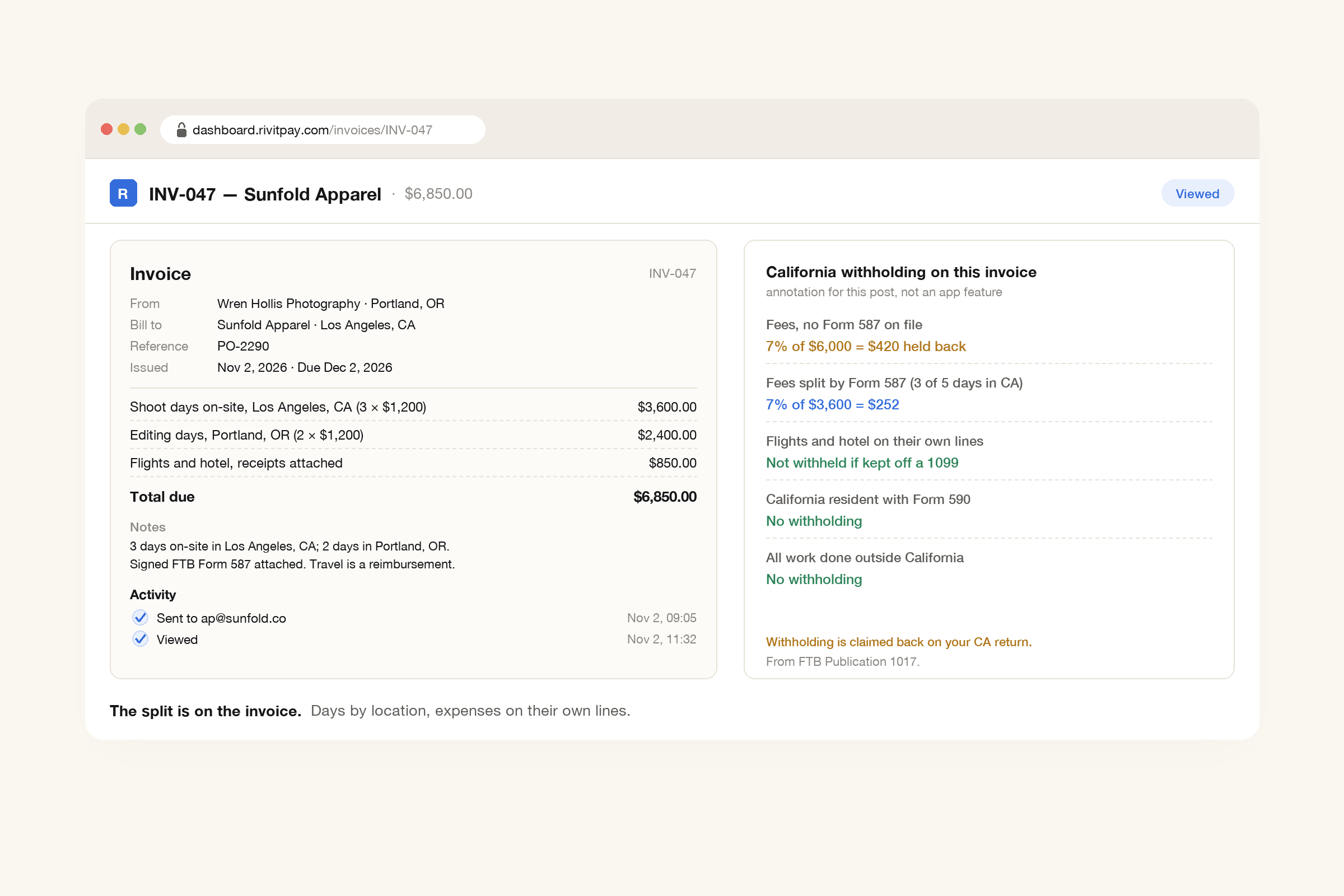
With a free account, you can email the invoice and see when it's been opened, which is a good moment to check whether accounts payable has your 587 or 590. Your client can pay by card or bank through the Pay button, into your own Stripe account. Automatic reminders in your own words follow up until it's paid and then stop. If you need to confirm what actually arrived, the receipt generator makes a receipt for the amount received, with the invoice number on it.
Before your next trip to California
Ask the client's accounts team which form they want, before you travel, not after the payment is short. If you live in California, send a 590. If you don't, send a 587 that splits the work by where you did it, and put the same split on the invoice. If the job is big and your costs are high, file a 589 at least two weeks ahead. That's an email, a one-page form and a clearer invoice, and the full amount arrives.
Separate lines for on-site and remote days, expenses on their own lines, a Notes field for the location, and a Pay button for card or bank. Free until you've collected $5,000.
Make an invoice, free