Before the first payment
Your first payment is waiting on a W-9
You land a new client. A bigger one than usual, with a procurement team and a finance inbox. You do the work, you send the invoice, and then nothing happens for three weeks.
Eventually you chase it, and the answer comes back from someone you've never heard of: we can't set you up as a vendor without a W-9. Your invoice wasn't late. It was never in the queue. It was sitting in a pile of "incomplete vendor records" waiting for one page of tax paperwork nobody told you to send.
This is one of the most common reasons a freelancer's first payment from a new US client is late, and it's almost entirely avoidable. It's also worth understanding properly, because the form carries one very specific threat: a missing or wrong one can cost you nearly a quarter of every payment.
What a W-9 actually is
Form W-9 is how you give a US business your taxpayer identification number. In the IRS's words on the form's own page, you use it "to provide your correct Taxpayer Identification Number (TIN)" to the person who has to file an information return about you. For a freelancer, that's usually the client who will report what they paid you on a 1099.
Three things worth knowing up front:
- It goes to the client, never to the IRS. The top of the form says it in bold: "Give form to the requester. Do not send to the IRS."
- The current version is Rev. March 2024. If a client sends you an older one, fill in the current one anyway. The main change was a new line 3b, which only matters to partnerships, trusts and estates with foreign owners.
- Line 1 is your name as it appears on your tax return. If you have a single-member LLC, that's still your own name, with the business name on line 2. This one line causes more problems than the rest of the form combined, for reasons below.
The rules on which clients have to file a 1099 for you changed this year, and fewer of them will. But plenty of finance teams still collect a W-9 from every new vendor before the first payment, whatever the amount, because it's simpler than deciding case by case.
The 24% reason they're strict about it
The client isn't being fussy. They have a legal problem if they pay you without it.
The IRS's instructions for whoever requests a W-9 are blunt: "If you do not receive the payee's TIN at that time, you must begin backup withholding on payments." And: "The backup withholding rate is 24% for reportable payments." The W-9 itself lists "nonemployee pay" among the payments it covers.
In plain terms, a client who pays you without a valid TIN on file can be required to hold back 24% of the payment and send it to the IRS. On a $5,000 invoice, that's $1,200 you don't receive. Most finance teams would rather not deal with that at all, which is why their system refuses to release a payment until the W-9 is in.
The money isn't gone. The IRS's backup withholding page says to "report the federal income tax withholding (shown on Form 1099 or W-2G) on your return for the year you received the income", so it's credited against your tax. But it comes back when you file, possibly a year later, which is a long time to lend the government a quarter of your invoice.
The form also carries penalties that land on you, not the client. Per the W-9 itself:
- $50 for each failure to give a requester your correct TIN, "unless your failure is due to reasonable cause and not to willful neglect."
- $500 if you make a false statement "with no reasonable basis" that results in no backup withholding.
Why a correct-looking W-9 can still bounce
Many payers run what you hand them through the IRS's TIN Matching program, which the requester instructions describe as letting a payer check a name and TIN combination before filing. If the name on line 1 doesn't match the name the IRS has for that number, the mismatch comes back to the client, sometimes much later as a backup withholding notice. The instructions say a payer who gets one "may have to send a 'B' notice to the payee to solicit another TIN".
So the common failures are boring:
- Business name on line 1 instead of your own. For a sole proprietor or single-member LLC, line 1 is you.
- An EIN with a name it isn't registered to. The number has to match whichever name you put first.
- A recent name change. If the name on your W-9 isn't the one on file for your number yet, it won't match.
SSN or EIN?
If you're a sole proprietor, the W-9 says: "If you are a sole proprietor and you have an EIN, you may enter either your SSN or EIN." Its own name-and-number chart adds that "the IRS encourages you to use your SSN". So both are allowed, and the IRS has a mild preference.
The argument for an EIN is about where your Social Security number ends up. A W-9 is a document with your SSN on it, and you'll send one to every client who asks. It sits in their vendor system, their shared inbox and probably an attachment somewhere. An EIN is a number you can hand out without that exposure, and per the IRS's EIN page, "You never have to pay a fee for an EIN." It's issued online in minutes. The same page warns: "Beware of websites that charge for an EIN."
One related warning, straight from the W-9's identity theft section: "The IRS does not initiate contacts with taxpayers via emails." A W-9 request that claims to come from the IRS is phishing. A W-9 request from a client you've never worked with, arriving from an address that doesn't match their domain, deserves the same suspicion you'd give a changed bank detail.
If you're not in the US
A W-9 is for US persons only. If you're a freelancer abroad billing a US client, the form they need is a W-8BEN (W-8BEN-E if you invoice through a company). The IRS instructions, revised October 2021, say the same thing about where it goes: "Do not send Form W-8BEN to the IRS. Instead, give it to the person who is requesting it from you."
The starting point for foreign persons is a 30% US tax on income from US sources. But the IRS's source-of-income table says compensation is sourced "where services performed". Work you do from outside the US is generally not US-source income, even when the client is American. That's what the W-8BEN is there to establish. A signed one generally stays valid until the last day of the third calendar year after you sign it, unless your circumstances change.
The fix: send it before anyone asks
The delay in the opening story didn't come from the form. It came from finding out about the form three weeks late. So:
- Send a signed W-9 with the contract, or with your first invoice at the latest. "Here's my W-9 for your vendor setup" saves a full round trip with someone in finance you'll never meet.
- Ask whether they have a vendor portal. The requester instructions allow payers to set up electronic W-9 submission. If they have one, it's better than emailing a PDF with your TIN on it.
- Keep the signed PDF. The next client will ask too. Update it if your name, business structure or TIN changes.
- Ask who approves new vendors and how long it takes. Then put that time into your payment terms rather than finding it in your bank balance.
Where RivitPay fits
We built a free W-9 filler because this form shouldn't take an evening. You answer a few questions and download the official IRS Form W-9 (Rev. March 2024), filled in and ready to sign. It runs entirely in your browser: your SSN never leaves your device, nothing is saved, and that page runs no analytics.
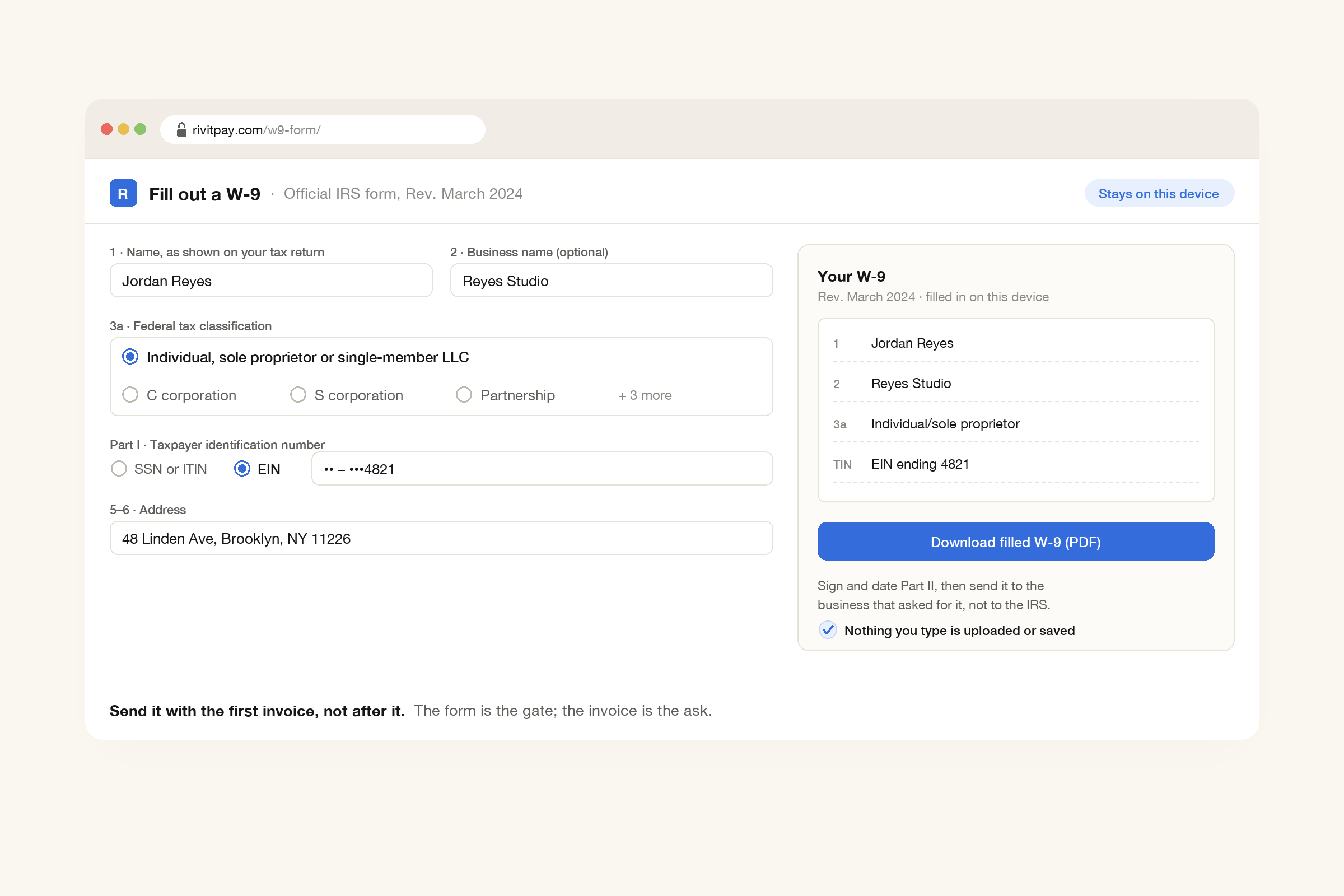
Then send it alongside your first invoice. If you send that invoice from a free RivitPay account, the live Viewed status shows when the client opens the link. That's a useful tell with a new client: an invoice that's been opened but not paid usually means it's stuck in a process, not forgotten. Asking which step it's on beats a generic "just following up". Automatic reminders go out in your own words and stop the moment it's paid. When the client does pay by card, the money settles to your own Stripe account. RivitPay never holds it.
One page, sent early
Most freelancers learn about the W-9 the way the person in the opening did: from a finance team, weeks after the invoice, with the payment on hold. Learning it this way, the cost is a few minutes and one attachment on your next first invoice, before the client has to ask.
The official IRS form, filled in your browser, plus invoices that show when they're opened and get paid to your own Stripe account. Free until you've collected $5,000.
Fill out a W-9, free