Invoice hygiene
Your client's bank now checks the name on your invoice. If it doesn't match, they get a warning
Say you're a designer in Dublin. You invoice as Northlight Studio, but your bank account is in your own name, Aoife Brennan. Your client in Munich types "Northlight Studio" and your IBAN into their banking app. Before they can press send, the app warns them that the name doesn't match the account, and that the money might go to someone else.
Many people stop there.Your client emails to ask what's going on, or puts the payment aside until someone has checked, or wonders whether your invoice is a scam. In each case you get paid later than you should have, and it isn't the client's fault.
Since October 2025, every bank in the euro area has to run this check, and UK banks have run their own version for years. Here's how it works, how often the names don't match, and how to make sure yours do.
What changed
The EU's Instant Payments Regulation made banks check the payee's name against the account number before the payer sends the money. The European Central Bank's summary says it "applies to both standard and instant credit transfers" and must be "offered free of charge to the payer". Banks in euro-area countries had to start by 9 October 2025. Banks in EU countries outside the euro, such as Poland or Sweden, have until 9 July 2027.
It's called Verification of Payee. In the UK the equivalent is Confirmation of Payee. The Payment Systems Regulator's November 2025 report says it covers "around 99%" of the market and that "over 2 million CoP checks are completed every day".
The checks exist to stop fraud, and they work. In a July 2026 consultation, the regulator quotes Pay.UK's figure of "a 59% reduction in claims for payments to the wrong account" since Confirmation of Payee started. The side effect is that a genuine freelancer whose names don't line up looks, at first glance, like the kind of thing the check was built to catch.
What your client sees
There are four possible results: a match, a close match, no match, and a check that couldn't be done. The Dutch Payments Association's guide describes what the payer sees:
- A close match, such as a typo or a missing middle name: "a warning with the correct name associated with the recipient's IBAN." Your client sees the name your bank holds and can fix it.
- No match: "a warning without the correct name of the recipient." This protects account holders' privacy: "You cannot enter a fake name with an IBAN to find out the correct name associated with it." Your client is left with a warning and no explanation.
The regulation says what the warning must tell them on a no-match result: that "authorising the credit transfer might lead to transferring the funds to a payment account not held by the payee indicated by the payer."
Your client can still pay. The check "does not prevent payers from authorising the credit transfer", and once they confirm, the Dutch guide says, "The bank may not subsequently block the transfer." But the risk moves to them. The regulation says a bank that has done the check properly "shall not be held liable" for money sent to the wrong person. Commerzbank's customer FAQ puts it bluntly: once you approve the transfer, the risk of paying the wrong recipient passes to you (our translation). No wonder an accounts payable clerk stops and emails you first.
How often it happens
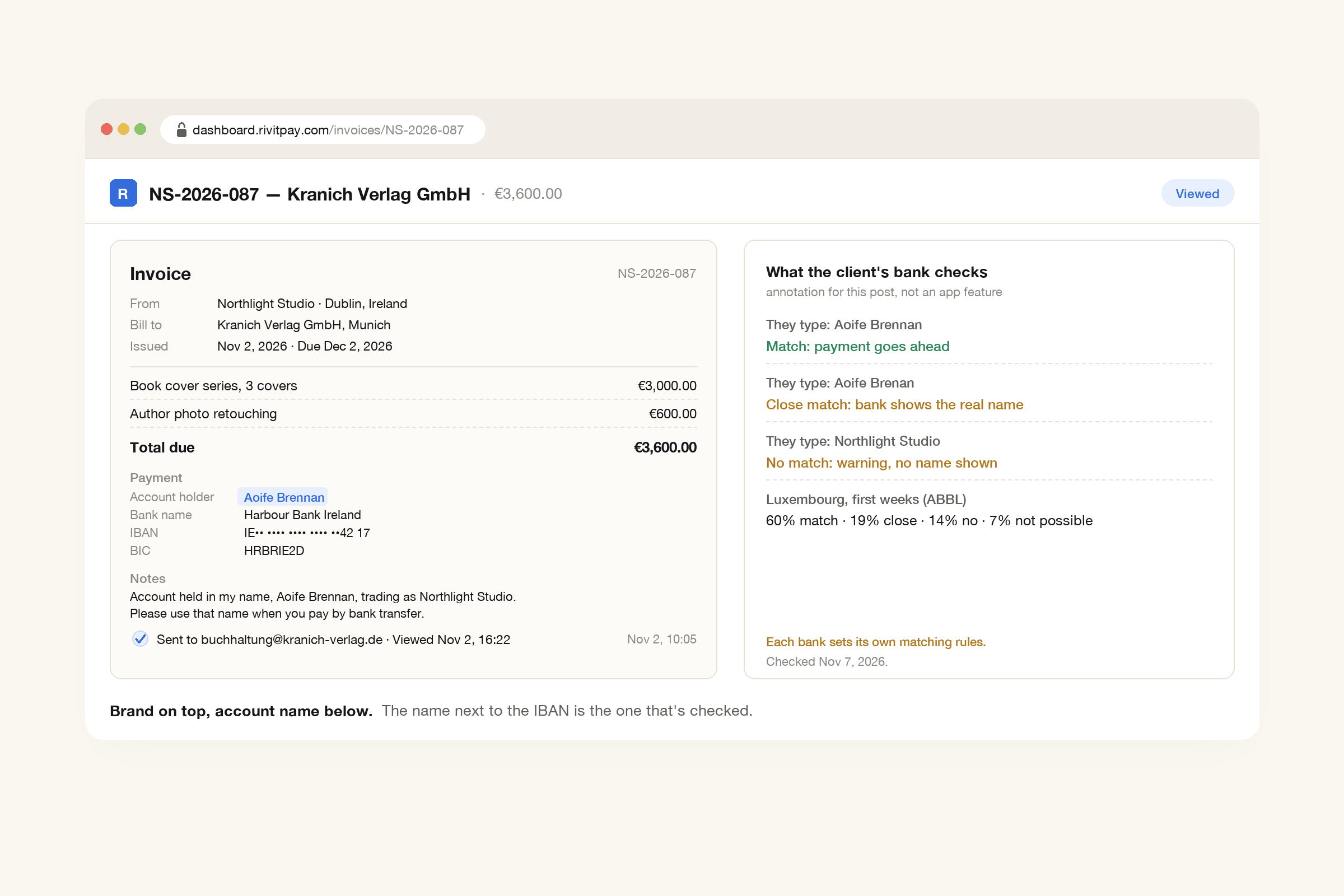
More often than you'd think. The Luxembourg Bankers' Association published early figures in November 2025: "60% of checks result in a full match, 19% in a close match, 14% in a no match, 7% in a "verification not possible" outcome." So about a third of checks in Luxembourg didn't come back as a clean match. The same report advises: "Beneficiary lists and invoices should be reviewed to ensure that the account name corresponds to what is registered by the bank."
The scale is big. By July 2026, the association reported from the European Payments Council's conference that the system "already processes more than one billion checks every month".
Why freelancers trip it
The check compares the name your client typed with the name your bank holds for the account. For most sole traders and self-employed people, that's your own legal name, not your business name.
- UK. Starling's guide for sole traders says: "The official name on the account is your personal name and not your trading name." Tide warns that if you don't give clients that name, "they'll receive an alert that the details are mismatched, which could cause a delay to you being paid."
- Belgium. UCM, the federation for the self-employed, explains that for individuals, the check runs on the name of the self-employed person (our translation). It also warns that if a client uses a trading name that isn't in the business register, they "pourrait alors s'inquiéter": they might start to worry.
- France. Caisse d'Epargne tells business customers that if they don't give clients the exact name on the account, some payments might not reach them (our translation).
Small differences count too. Each bank decides what counts as a match. The Euro Banking Association, a banking industry body, notes that the payee's bank "is therefore free to apply different criteria". It gives "ABC Ltd vs ABC Limited" as an example of a small difference that can cause trouble.
How to make your name match
- Find out the exact name on your account. It's on your bank statement or in your banking app, or you can ask your bank. Middle names, initials and "Ltd" or "Limited" all count.
- Put that name in your payment details. Put the exact account name next to your IBAN or account number on every invoice. Keep your trading name at the top as your brand, but the payment details must say who holds the account.
- Register your trading name, if your bank allows it. Some banks will. Tide lets UK sole traders verify a trading name and says it will "let you know within 48 hours". In Austria, Erste Bank and Sparkasse let business customers, including self-employed people, register trading names as aliases so payers stop seeing the warning. Ask your bank whether it does the same.
- Tell new clients before the first invoice. Send one line: "Payments go to an account in my name, Aoife Brennan, trading as Northlight Studio." It saves an awkward email later.
- Never change bank details by email. If a client sees a warning, they should call you on a number they already have. Fraudsters send fake "our bank details have changed" emails, and the name check is there to catch them. Our post on fake invoices covers how they work.
Where Rivit Invoices fits
The free invoice generator keeps your name and your bank details in separate fields, which is what you need here.
- Name or company at the top is your brand. Use your trading name if you have one.
- Account holder in the payment section is the name your client types into their banking app. Copy it exactly as your bank holds it. Bank name, Account / IBAN and Routing / Sort / SWIFT go underneath, and they appear on the PDF and the share link.
- Notes / terms can carry the one-line explanation: "Account held in my name, Aoife Brennan, trading as Northlight Studio."
- Viewed tracking. If you send from a free account, you'll see when the invoice was opened. If it was opened days ago and nothing has arrived, ask whether their bank showed a name warning.
- The Pay button. Card payments through the Pay button go to your own Stripe account. The name check applies to bank transfers, so a client who's still unsure can pay by card instead.
The short version
Since October 2025, euro-area banks check the payee's name against the IBAN before every transfer, and UK banks have done the same for years. If the name your client types doesn't match the name your bank holds, they see a warning that the money might go to someone else. In Luxembourg's early figures, about a third of checks didn't come back as a clean match. For most freelancers, the name that matters is your own legal name, not your business name. Put the exact account-holder name in your payment details, explain it in one line, register your trading name if your bank allows it, and never change bank details by email.
A free invoice with your trading name at the top, the exact account-holder name in the payment section, and a note explaining both. No signup.
Make an invoice, free