Getting paid abroad
Your international wire arrived short. Here's where the money went
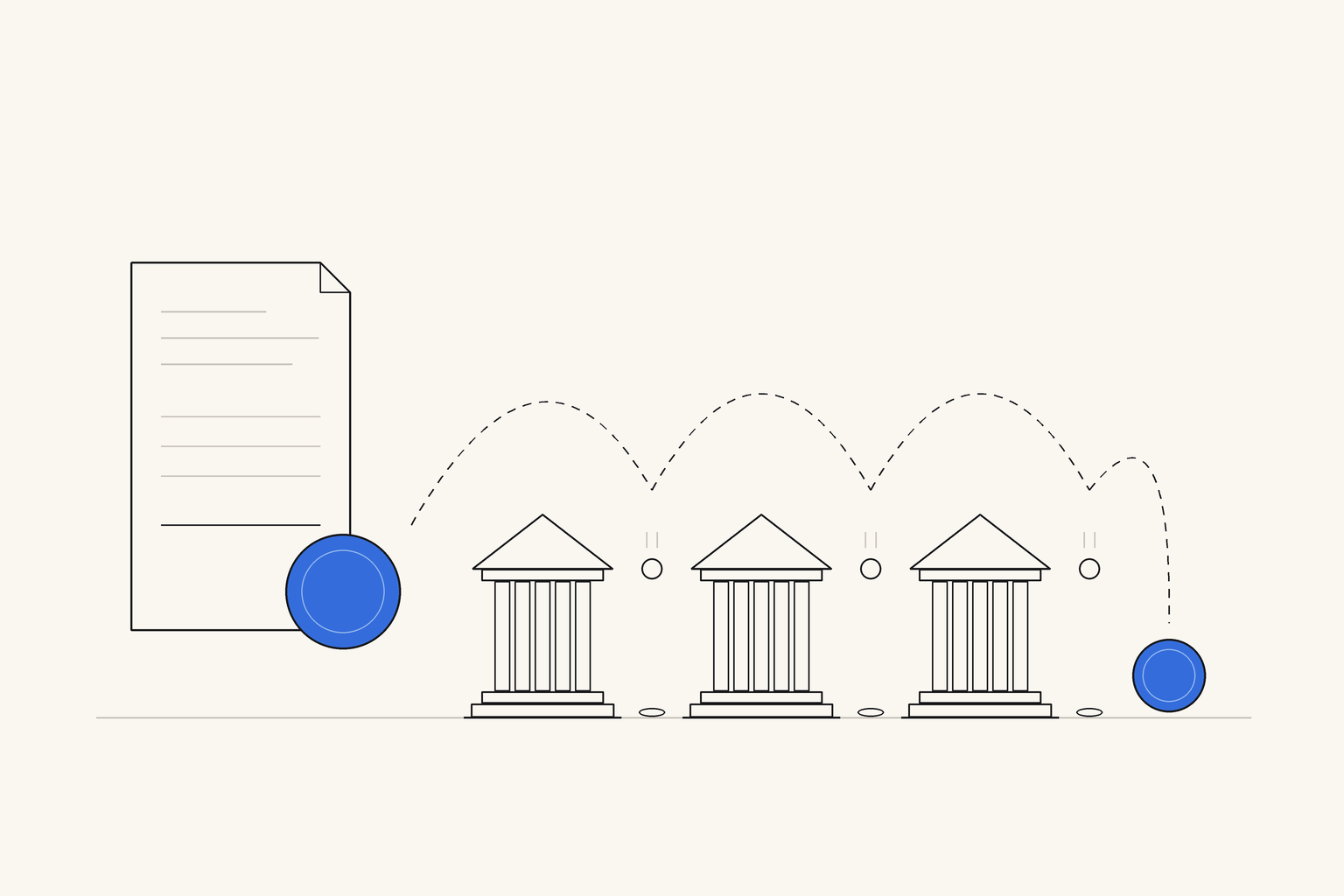
You invoice a client in Portland for US$4,000. They pay on time, by international wire, and say so. A few days later the money lands in your account in London, and it isn't $4,000. It's $25 short before your bank converts it, the conversion takes a bit more, and then there's a £6 fee for receiving it.
Nobody did anything wrong. Your client paid the full amount, and every bank along the way took a cut it was allowed to take. Now you have to choose between asking a client who paid on time to top it up, or swallowing the difference on every invoice.
Here's where the money goes, the three letters that decide who pays, and what to put on your invoice so the full amount arrives.
Where the money goes
An international wire usually passes through more than two banks. If your client's bank doesn't have a direct relationship with yours, it sends the money through one or more correspondent banks, and each one can take a fee on the way. NatWest's international payments page says it plainly: "intermediary banks may need to be involved, and they may deduct fees from the total sent amount".
Wise's help page on correspondent fees says the amount varies, "but we estimate anywhere between 15 and 50 USD or equivalent. The fee might be higher depending on the banks."
Then your own bank can take two more bites:
- A fee for receiving it. Barclays says: "We charge £6 for payments when they're over £100 unless they are received in euros either as a SEPA* payment, or from the EEA". HSBC UK says receiving euros from within the EEA is free, "Otherwise, its £5 for all other foreign currencies including pounds." In the US, Chase and Bank of America both list $15 for an incoming wire. Wells Fargo lists no fee for consumer accounts and $15 for analyzed business accounts.
- The exchange rate. If dollars arrive in a pound or euro account, your bank converts them at its own rate. Barclays says its conversion charge "will be no greater than 2.75% for personal and Premier customers". Wells Fargo says its rate "is set at our sole discretion, and it includes a markup."
Put those together on the $4,000 invoice: a $25 correspondent fee, then up to 2.75% on the conversion (about $109), then £6. That's roughly 3.5% of the invoice, gone before you've seen it. Your numbers will differ, but that's the shape of it.
The three letters that decide who pays
When your client sends a wire, their bank asks who should pay the charges. The answer travels with the payment as a code. NatWest's page describes the three options from the sender's side:
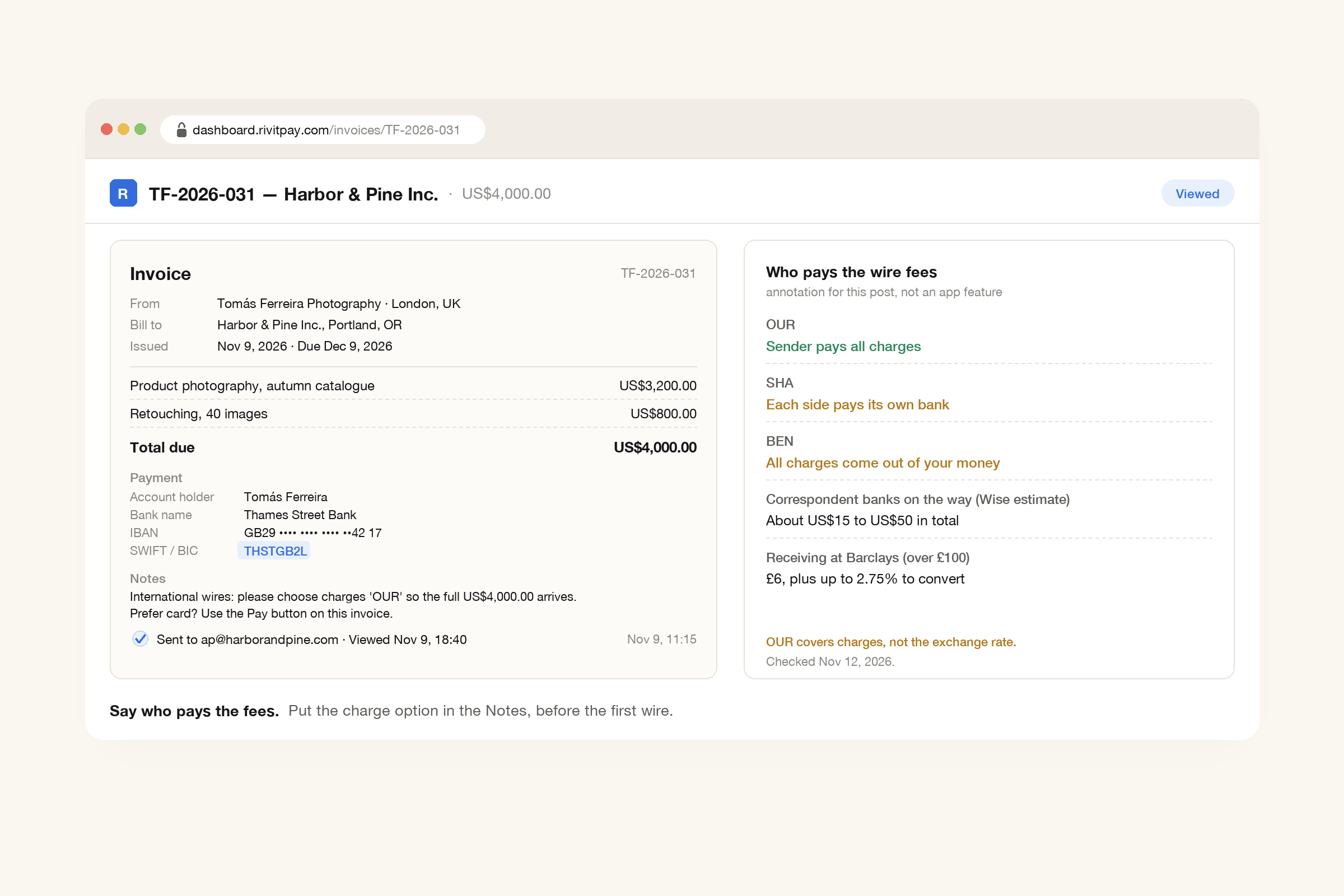
- OUR: the sender pays everything. The client pays their bank's charge and your bank's charge or agent fee. "The payee should receive the full amount of money you send."
- SHA: shared. The client pays their bank, and you pay yours, "so they may receive slightly less than you send."
- BEN: you pay everything. The client pays nothing. "Before sending the payment to the payee's bank, we deduct our charge of £30, and the payee's bank may apply a further charge before crediting the payee."
Most clients never think about this. Whatever their banking app pre-selects is what you get. On a NatWest wire, OUR costs the client about £15 plus £8.50 to £12.50 more. That's small next to a $4,000 invoice, but nobody pays it unless they're asked.
Why the law doesn't protect you here
Inside Europe, there are rules against this. The EU's payment services directive says that when both banks are in the EU, each side pays its own bank (Article 62(2)). Article 81 goes further: the banks "and any intermediaries" must "transfer the full amount of the payment transaction and refrain from deducting charges from the amount transferred." The UK kept the same each-side-pays rule for payments where both banks are in the UK (regulation 66 of the Payment Services Regulations 2017).
But look at the scope. Article 2(4) says that when "only one of the payment service providers is located within the Union", the rules apply "except for Article 62(2) and (4), Articles 76, 77, 81" and a few others. So when a US client wires money to your bank in Paris, the no-deductions rule doesn't apply. The same goes for a US client paying a UK bank. The deductions that come with a wire from outside Europe are allowed.
Even inside the EU, Article 81(2) lets your own bank deduct its fee before crediting you if you've agreed to it, as long as it shows the full amount and the charges separately. Check your bank's terms.
How big the problem is
The Financial Stability Board, which coordinates financial regulation for the G20 countries, tracks how much cross-border payments cost. The G20 target is for the "global average cost of payment to be no more than 1%" by the end of 2027.
The FSB's October 2025 progress report puts the average cost of a cross-border payment between businesses (small and medium-sized ones) at 1.6%, unchanged from the year before. Exchange rates make up most of that: 1.4 points of the 1.6, or 87.1% of the cost. "FX costs remained the largest component of overall costs", the report says.
That's the sender's side. The report also surveyed 262 payment providers about costs at the receiving end, and found they "range between 0.1 and 1.3% of the amount sent, particularly affecting lower value payments." Those costs "may either be deducted from the nominal payment amounts received by customers or invoiced by intermediary PSPs directly". When the receiving bank also does the currency conversion, it adds "additional global average FX margins" of "0.7 to 1.1%."
Speed isn't much better. Only 39.6% of the business-to-business payment services in the data credited the recipient within one business day of the payment being sent, and 2.2% within an hour. The FSB's verdict: "It is unlikely that satisfactory improvements at the global level will be achieved in line with the 2027 Roadmap timetable."
How to get the full amount
- Agree who pays before the work starts. Put it in the quote or contract: "International transfer charges are paid by the sender (OUR)." It's much easier to agree before the first invoice than to ask for the difference after it.
- Say it on every invoice. AP teams pay from the invoice, not your contract. One line in the notes does it: "For international wires, please choose charges 'OUR' so the full amount arrives."
- Decide which currency you want and who converts. If you invoice in dollars and hold a pound account, your bank converts at its rate. If you invoice in pounds, the client's bank converts at theirs, and you know what's arriving. Either is fine. Just choose on purpose. OUR covers bank charges, not the exchange rate, so this choice matters even when the client pays every fee.
- Give complete bank details. Your account holder name, IBAN or account number, and SWIFT/BIC. Missing or wrong details can bounce a wire back, and the return can cost fees too.
- If the client can't choose OUR, agree a fixed line for transfer charges, or price it into your rate for clients abroad. Don't add it quietly after the fact.
- Check what landed. Compare the credit to the invoice when it arrives. If you agreed OUR and it came short, ask your bank for the payment details. They'll often show the charges taken on the way.
Where Rivit Invoices fits
Our invoice generator already tells you to "include your IBAN and SWIFT/BIC and agree up front who pays transfer fees". Here's how to do that with it:
- Payment details. Account holder, Bank name, Account / IBAN and Routing / Sort / SWIFT are separate fields, and they print on the PDF and the share link.
- Notes / terms carries the charge line: "International wires: please choose charges 'OUR'."
- 45 currencies, one per invoice. Invoice in the currency you want to receive, so it's clear what "the full amount" means.
- The Pay button. A client who'd rather not deal with wire forms can pay by card. The money goes to your own Stripe account and the fees are known in advance: Stripe's processing fee plus 0.65% from Rivit Invoices. Stripe also charges for converting currency when the card's currency differs from your settlement currency. Its UK pricing page lists "+ 2% if currency conversion is required".
- Other ways to be paid. Wires aren't the only route from abroad. Our post on getting paid across borders compares them on a $1,000 invoice.
- Viewed tracking. If you send from a free account, you'll see when the invoice was opened.
The short version
An international wire can lose money three times: to correspondent banks on the way (Wise estimates $15 to $50), to your bank for receiving it, and to your bank's exchange rate (up to 2.75% at Barclays). The charge option your client picks decides who pays: OUR means they do, SHA means you share, BEN means you pay everything. Europe's no-deductions rule doesn't apply when one of the banks is outside it. Agree OUR up front, put it in your invoice notes, invoice in the currency you want to receive, and check what lands.
A free invoice with your IBAN and SWIFT/BIC, a note asking for charges "OUR", and a Pay button for clients who'd rather pay by card. No signup.
Make an invoice, free