Your rights
California's freelance law: a written contract, a pay date, and up to double damages
A California agency asks you to start on Monday. There's no contract, just a Slack message with a rate. Six weeks after you deliver, the invoice is still "with finance". It's an old story, but since January 2025 it's also, in many cases, against the law in California.
The state's Freelance Worker Protection Act, sections 18100 to 18107 of the Business and Professions Code, requires a written contract, sets a default pay date, and lets you sue for up to twice what's unpaid. Here's who it covers (fewer freelancers than you'd think), what the contract has to say, and how to set up your estimates and invoices so the law is on your side if you need it.
Why it exists
When the bill was introduced in February 2024, Freelancers Union, which backed it, said its studies found 71% of freelancers had experienced late or non-payment, and that only 25% consistently have written contracts. The Senate Judiciary Committee's analysis of SB 988 put it plainly: freelancers "often do not have written contracts" and "can be vulnerable to late or non-payment". The law tackles both.
Who it covers
Under section 18101, you're a "freelance worker" if you're a person, or an organization "composed of no more than one person", hired as a bona fide independent contractor to provide professional services worth at least $250, on one contract or added up across contracts with the same client over the previous 120 days. Incorporated or not, trade name or not, it makes no difference.
The client is covered if it's a "person or organization in the State of California". Federal, state and local government aren't covered, and nor are foreign governments or individuals "hiring services for the personal benefit of themselves, their family members, or their homestead". So a wedding couple isn't covered, but a San Diego startup is.
Then there's the catch. "Professional services" means the list in Labor Code section 2778(b)(2). It includes marketing (if the work is "original and creative"), graphic design, grant writing, fine art, photography, videography and photo editing, freelance writing, translating, editing, copy editing and illustration, and some others, such as HR administration and appraisal. It doesn't mention software development, web development or IT consulting. If you write code for a living, don't assume this law covers you. Some categories, including writers and photographers, also come with conditions, such as not primarily working at the client's location and not being barred from working for other clients.
It applies only to contracts "entered into or renewed on or after January 1, 2025" (section 18107).
What the contract has to say
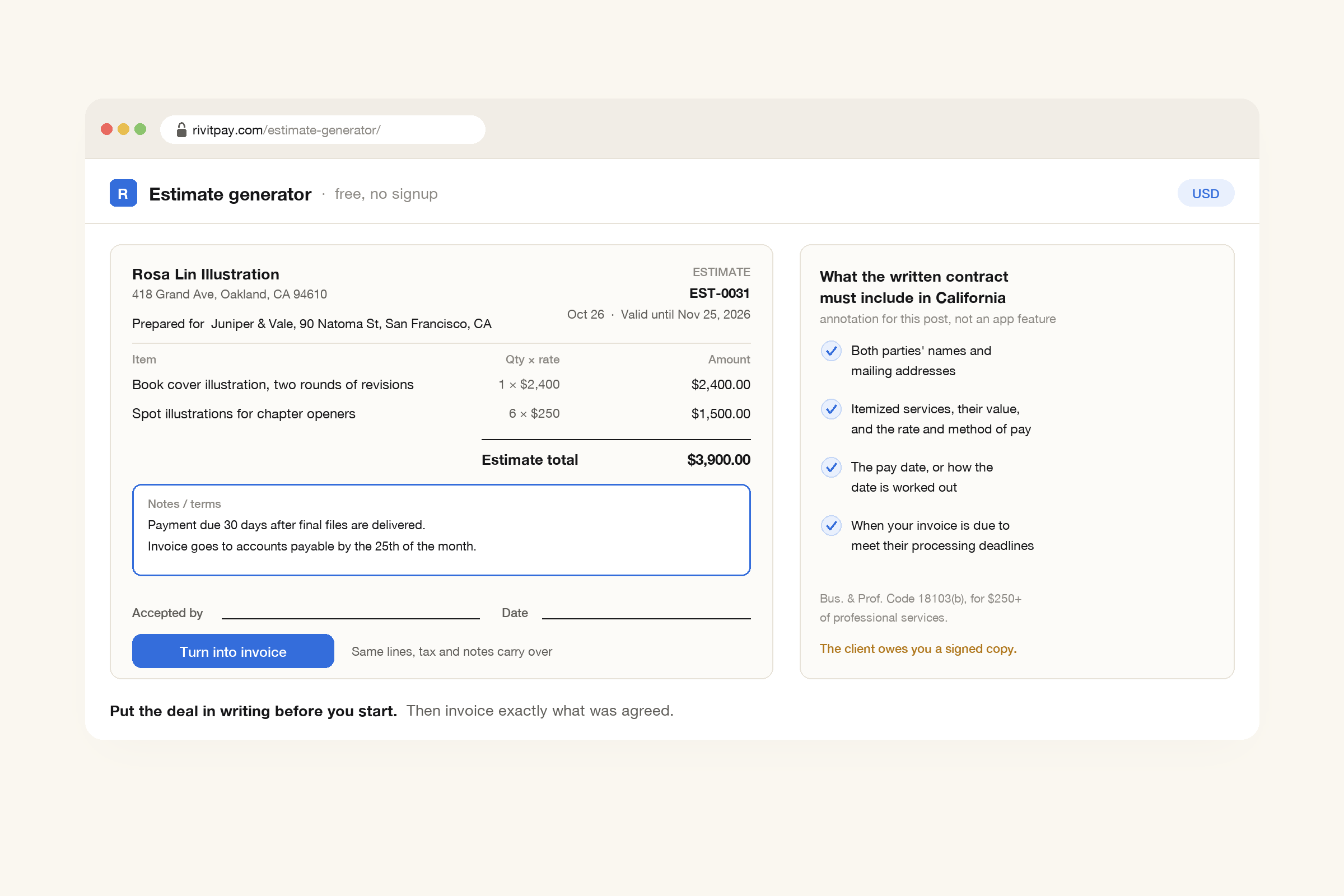
Section 18103 says the contract "shall be in writing", and that the client must give you a signed copy and keep the contract for at least four years. At minimum, it has to include:
- the name and mailing address of each party
- "an itemized list of all services", with their value and "the rate and method of compensation"
- the date the client will pay, "or the mechanism by which the date shall be determined"
- the date by which you have to submit your list of services "to meet the hiring party's internal processing deadlines"
That last item is about your invoice. If the client's accounts payable needs invoices by the 25th to pay next month, the contract has to say so. That cuts both ways: it ends the "you missed our cutoff" excuse, but you then have to invoice on time.
If the client won't sign anything, you're not out of luck. The same section says evidence a contract existed includes the client's statements about your rate, a summary "of the rate and work to be performed" that you sent in writing before you started (by email or text, for example), and the work you actually did. A written estimate, sent before you start, can be that evidence.
When they have to pay
Section 18102 says the client must pay "on or before the date compensation is due pursuant to the contract" or, if the contract doesn't give a date, "no later than 30 days after the completion" of your services. Once you've started work, the client also can't make on-time payment conditional on you accepting less money, doing more work, or handing over more intellectual property rights than you agreed.
Contract terms that try to get around any of this don't work. Section 18104 says "a waiver of any provision in this part" is "void and unenforceable", and section 18105 bars retaliation for asserting your rights.
One question the law doesn't answer is whether an agency's "we pay you when our client pays us" is a valid "mechanism" for setting the date. It's safer not to find out. Ask for a calendar date, or a fixed number of days after you invoice, in writing.
What you can recover
Under section 18106, you can bring a civil action yourself, or a public prosecutor can. If you win, you're entitled to "reasonable attorney's fees and costs", plus damages:
- Late or unpaid: "damages up to twice the amount that remained unpaid at the time payment was due". On a $4,000 invoice nobody paid, that's up to $8,000. The court sets the figure; it isn't automatic.
- No contract: an extra $1,000 if you asked for a written contract before you started and the client refused. In that case, what you were owed is "the rate the freelance worker reasonably understood to apply".
- Anything else: for other violations, such as retaliation, damages "equal to the value of the contract or the work performed, whichever is greater".
The state law doesn't set up an office to file a complaint with. The April 2024 version of the bill listed the Labor Commissioner as an enforcer, but the law that passed names only you and a public prosecutor. In practice, the law gives you leverage in a negotiation and a claim in court. For smaller amounts, see whether small claims court is worth it. And for the New York, Illinois, Los Angeles and Seattle versions of this law, see your unpaid invoice might have a law behind it.
Set up your paperwork to match
- Ask for the contract in writing, before you start. The $1,000 depends on you having asked and the client refusing, so ask in an email you can find later.
- Send an itemized estimate first. List each service, its price and your rate, with your mailing address and theirs. If the contract never comes, that email is your evidence.
- Get the pay date and the invoice deadline. Ask accounts payable when invoices have to arrive, and put that date in your calendar.
- Make the invoice match the contract. Use the same line items and rates, put the contract or PO reference on it, and set a due date that matches the contract (or 30 days after you finish).
- Keep a record. Keep the estimate, the contract, the invoice, when it was sent and when it was opened.
Where RivitPay fits
The free estimate generator, with no signup, gives you the itemized written summary before the work starts: each service on its own line with a quantity and rate, your details and the client's, a valid-until date, your terms, and an acceptance line the client can sign. Send it as a PDF or a share link. When they say yes, Turn into invoice carries the client, line items, tax and notes into the invoice generator, with the estimate number as the reference, so the invoice matches what was agreed. Swap in the contract or PO number under Reference / PO if the client issued one, set the due date, and quote the agreed payment terms in Notes.
With a free account, you can email the invoice and see when it's been opened, which is useful evidence that it arrived. Automatic reminders go out in your own words and stop once it's paid, and the Pay button lets the client pay by card or bank straight into your own Stripe account.
Get it in writing, then invoice on time
If you do creative or editorial work for a California business, the law already gives you a pay date and a remedy. Make it easy to use: ask for the contract in writing, send an itemized estimate before you start, invoice by the client's deadline, and keep the paper trail.
An itemized estimate your client can sign, turned into a matching invoice with one click, with a Pay button for card or bank. Free until you've collected $5,000.
Make an estimate, free