Late payment
Why “1.5% a month” can be worth 5% a year: interest on late invoices in Canada
"Overdue balances accrue 1.5% per month." It's on thousands of freelance invoices, including the example in our own net 30 calculator. In the US that's mostly a question of state law. In Canada, a short section of a federal law means that line, written exactly like that, may only get you 5% a year.
Here's the rule, the simple fix, what you get if you never agreed a rate, and the ceiling you can't go over.
Late is normal in Canada too
Xero's Canadian Small Business Insights, published on 30 July 2026, show how much the wait depends on the province. British Columbia had the quickest payment time in the June quarter at 25.7 days from invoice to payment, better than its 26.9 days in the March quarter. Alberta came in at 28.4 days. Invoice on 14-day terms, and even in the quickest province you'll wait almost twice as long as you asked. A late-payment clause is one of the few tools you have to push back on that.
Section 4 of the Interest Act
The federal Interest Act covers any written contract, apart from mortgages on real property, that sets interest "at a rate or percentage per day, week, month, or at any rate or percentage for any period less than a year". For those, section 4 says:
- "no interest exceeding the rate or percentage of five per cent per annum shall be chargeable, payable or recoverable"
- "unless the contract contains an express statement of the yearly rate or percentage of interest to which the other rate or percentage is equivalent."
So "1.5% per month" with no yearly figure next to it is capped at 5% a year. Anything above that, the Act says, isn't chargeable, payable or recoverable.
The fix is easy: give the rate as a yearly rate in the first place. "Interest on overdue balances: 18% per year, calculated daily from the due date" is a yearly rate, so section 4 doesn't apply. If you prefer to keep a monthly figure for clarity, write the yearly equivalent next to it.
If you never agreed a rate
Section 3 of the same Act sets a fallback. Where interest is payable "by the agreement of parties or by law, and no rate is fixed by the agreement or by law", the rate is "five per cent per annum".
In practice, if you end up in court over an unpaid invoice, provincial law usually supplies the rate. Ontario publishes its prejudgment and postjudgment interest rates under the Courts of Justice Act each quarter. For a claim started in the fourth quarter of 2026, the prejudgment rate is 2.5%. Once you have a judgment, the postjudgment rate for orders made this quarter is 4.0%. The page is clear that an agreed rate comes first: if "the rate of prejudgment interest has already been agreed to by the parties, you must indicate that interest rate" in your claim. The court rate is only for when you didn't agree one. Other provinces set their own court rates.
The Ontario prejudgment rate also doesn't start on your due date. It runs from the day the "cause of action" arose to the day of the court order.
The ceiling: 35% a year
Section 347 of the Criminal Code makes it an offence to agree to, or receive, interest at a "criminal rate". That means an annual percentage rate that "exceeds 35 per cent on the credit advanced". A normal late-payment clause won't get near that. Just don't stack a high rate on top of large flat fees without working out what they add up to as a yearly rate.
What it's worth on a real invoice
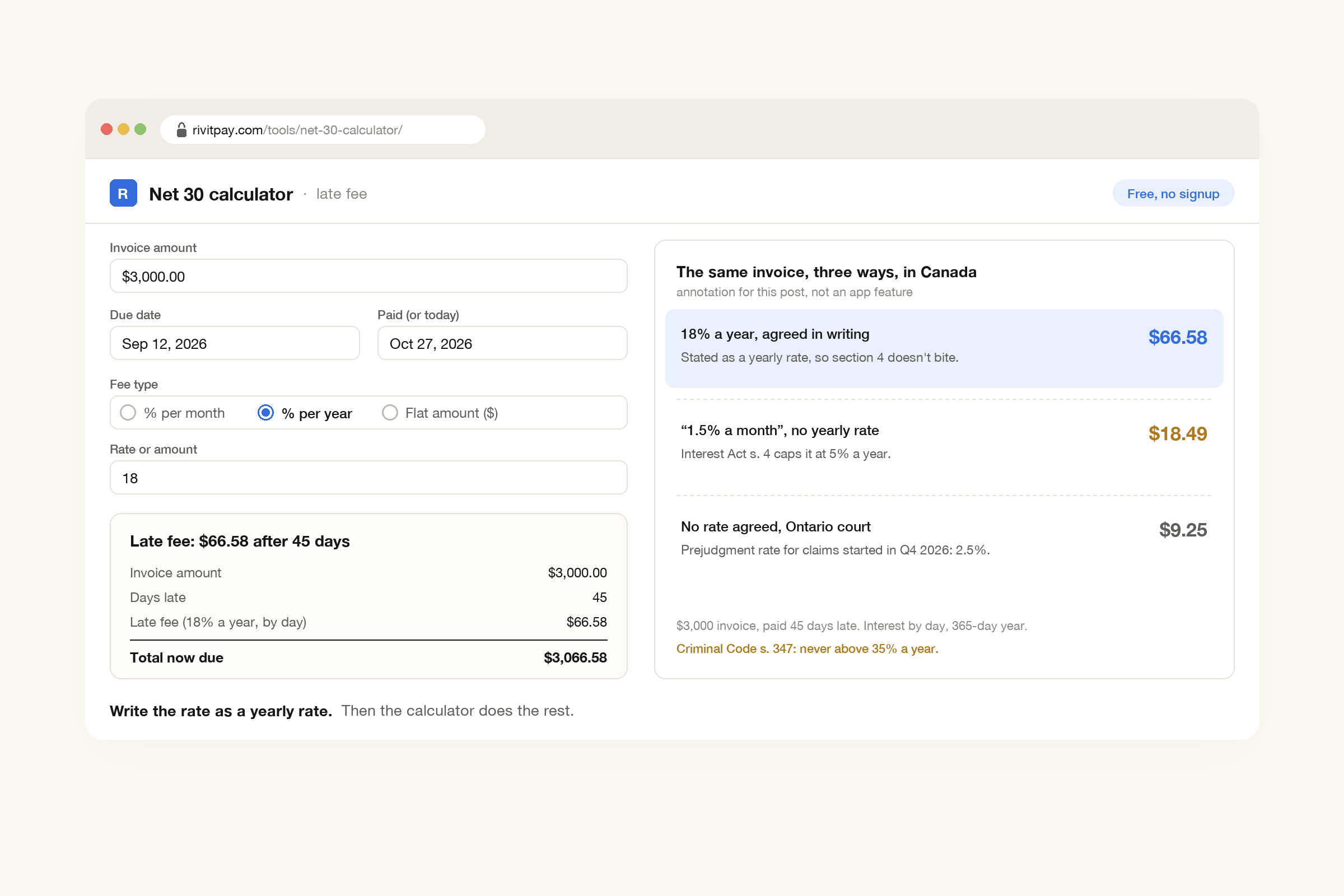
Take a $3,000 invoice that was due on 12 September 2026 and gets paid on 27 October, 45 days late:
- 18% per year, agreed in writing: $3,000 × 18% × 45 ÷ 365 = $66.58.
- "1.5% per month" with no yearly rate: capped at 5% a year, so $18.49.
- No agreed rate, Ontario's prejudgment rate: 2.5% for the same 45 days works out to $9.25. And you'd only get that by suing.
None of these amounts is large, and that's the point. Interest on a freelance invoice rarely pays for the hassle of collecting it. What it does is give the client a reason to move your invoice up the pile, and give you something to waive when you want to keep the relationship. That only works if the rate is one you can actually enforce.
Agree it before the work, not on the invoice
Section 4 talks about what "the contract" says. An interest clause that first shows up on your invoice, after the work is done, is a weak basis for a claim. Put the rate in your quote, proposal or contract, get the client to accept it, and then repeat it on every invoice. If your client is an individual rather than a business, provincial consumer protection rules may add their own requirements, so check yours.
Where RivitPay fits
The free estimate generator puts your terms in front of the client before work starts, including the interest line in its notes. The free invoice generator, with no signup, prices invoices in Canadian dollars or any of 45 currencies, and its Notes field carries the same line onto the invoice. If you're registered, your GST/HST number goes in Tax ID (more on that in when to start charging GST/HST). When a payment is late, the net 30 calculator works out the amount. Pick "% per year", enter your agreed rate and the dates, and it calculates the interest by day on a 365-day year.
With a free account, you can email the invoice, see when the client opens it, and let them pay by card or bank through the Pay button, straight into your own Stripe account. Automatic reminders in your own words, which can mention the interest term, follow up until it's paid and then stop.
Write it as a yearly rate
If your terms say "per month", change one line before your next quote goes out. Write the yearly rate, keep it well under 35%, get the client to agree to it before you start, and repeat it on the invoice. That's the difference between $66.58 and $18.49 on the same late payment.
Your interest line in Notes, invoices in CAD, reminders that stop on payment, and a Pay button for card or bank. Free until you've collected $5,000.
Make an invoice, free