Getting paid in Japan
Freelancing in Japan? Your client has 60 days to pay, and it's the law
You translate a product manual for a company in Osaka and deliver it on 2 November. There's no contract, only a few chat messages. The client says it will pay "after the next closing", and nobody says when that is.
Since 1 November 2024, Japan has had a law for exactly this. It's usually called the Freelance Act. It says the client has to put the terms in writing and has to pay within 60 days of receiving your work. Most freelancers hadn't heard of it when it arrived.
Here's who it covers, what the 60 days really mean, and what to do when a client ignores it.
Most freelancers didn't know it existed
A few months before the law took effect, Japan's Fair Trade Commission and its labour ministry ran a survey of clients and freelancers. It got 5,300 responses between 27 May and 19 June 2024. Among the 782 freelancers who had taken on work in the past year:
- 76.3% said they didn't know what the new law said.
- 44.6% said a client had at some point not stated the terms of the job.
- 28.1% said they had at some point not been paid within 60 days.
The clients saw it differently. Only 4.8% of them said they had ever paid later than 60 days. That gap is why the rules below are worth knowing by heart.
Who the law covers
The Act protects what it calls a "specified entrusted business operator". In plain words, that's you if you take on work from a business and you are either:
- "an individual that does not employ any employees", or
- a one-person company: "a corporation that has no officers" other than a single representative, and no employees.
A part-time helper doesn't always count against you. The government's Q&A on the Act (updated 23 October 2026) says an employee, for this purpose, is someone who works 20 or more hours a week and is expected to stay 31 days or more.
Three limits to know:
- The client has to be a business. Work for a private person who hires you as a consumer isn't covered.
- The payment rules apply to bigger clients. The 60-day rule and the banned practices bind a client that has employees, or a company with two or more officers. The written-terms rule binds every business client, even another solo freelancer.
- If you're really an employee, this isn't your law. The Q&A says that when someone called a freelancer is in practice a worker, labour law applies instead.
The terms have to be in writing, and chat counts
Article 3 says the client "must immediately and clearly indicate" the terms "in writing or by electronic or magnetic means" when it gives you the job. The Q&A lists what has to be there:
- both parties' names
- the date the work was ordered
- what you're delivering or doing
- the delivery date and place
- the fee and the payment date
- the date inspection ends, if the client inspects the work
It doesn't have to be a contract. The Q&A says email, chat tools and SMS all count, and so do messages sent through social media or an app. If the terms came electronically and you ask for them on paper, the client generally has to hand over a document.
What the 60 days really mean
Article 4 says the payment date "must be set on the earliest possible date that is no later than 60 days from the day on which" the client "receives the work". Four details matter:
- The clock starts when you deliver. It runs "regardless of whether or not" the client inspects the work. A slow review doesn't move the date.
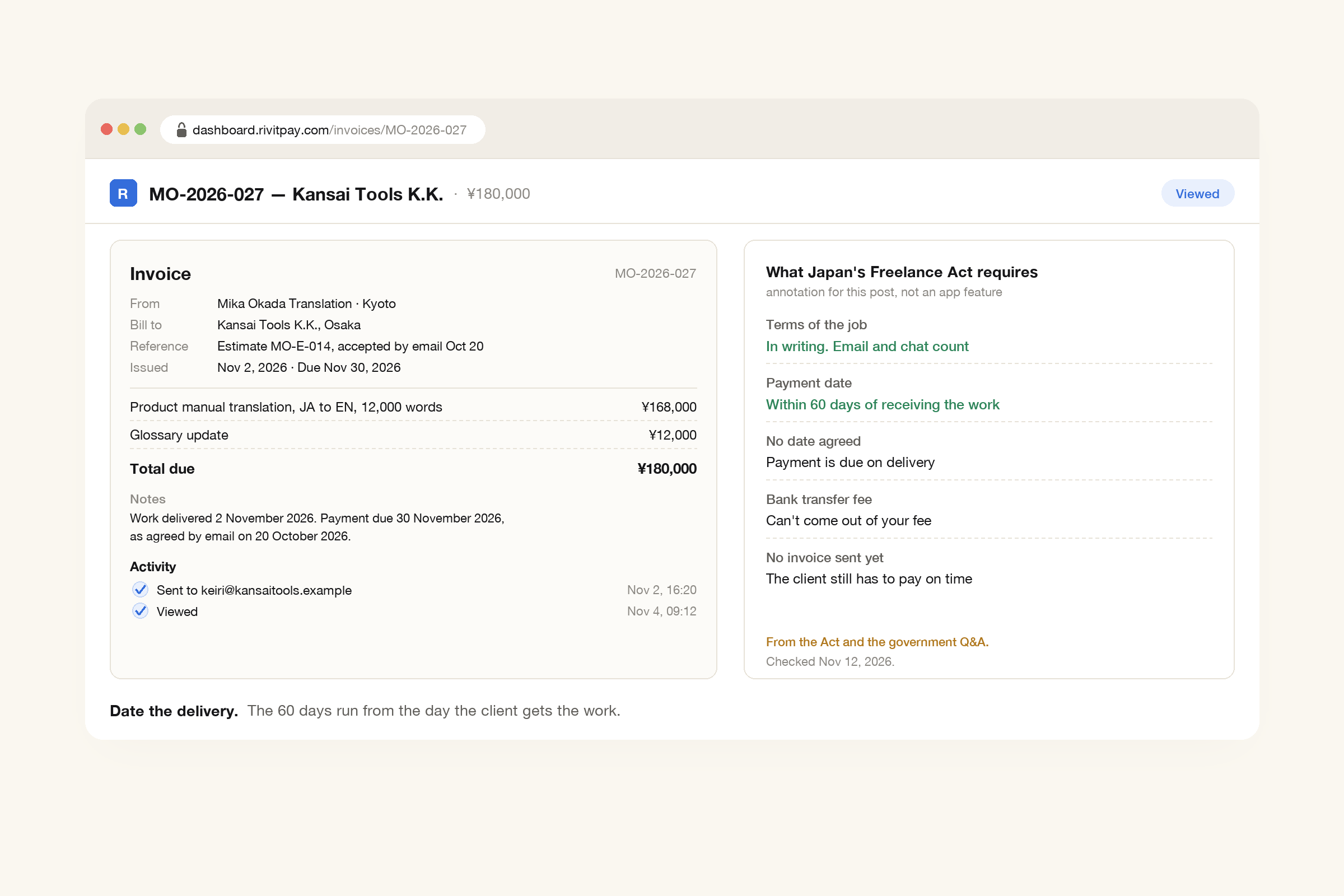
- No date agreed? Then you're due on delivery. If no payment date is set, the day the client receives the work "is deemed to be the date of remuneration payment".
- A later date is cut back to day 60. If the client sets "90 days after delivery", the law treats the last day of the 60-day period as the payment date.
- 60 days is the limit, not the target. The Q&A says a client that used to pay you promptly can't move you to 60 days just because the law allows 60.
In the Osaka example, the work arrived on 2 November 2026. The 60-day period starts that day, so its last day is 31 December 2026. Clients that pay on a monthly cycle get a little room: the Q&A says the limit is applied in practice as two months from receipt.
There is one exception. If your client is itself a subcontractor passing on part of a bigger job, it can set your payment date up to 30 days after its own client is due to pay it. That only works if it told you up front that the work is passed on, who the original client is, and when that client's payment is due. If it didn't, the 60-day rule applies.
Two answers in the Q&A are worth saving:
- "We're waiting for your invoice" isn't an excuse. The client has to pay by the agreed date whether or not you've sent an invoice. Send one anyway. It's your record.
- The bank transfer fee is the client's cost. Taking the transfer fee out of your fee counts as cutting your pay, even if you agreed to it. (If the money is coming from abroad instead, see where an international wire loses money.)
Seven things a client can't do
For jobs that run a month or longer, Article 5 bans seven practices. The first five are in a list:
- "refusing to receive work" when you've done nothing wrong
- "reducing the remuneration amount" after the job was agreed
- making you "take back the goods" after delivery
- "unjustly setting a remuneration amount at a level significantly lower than the price ordinarily paid"
- "coercing" you to buy goods or use services the client names
The other two are in the next paragraph: making you "provide cash, services, or other economic gains", and making you "change its work or redo its work" when the fault isn't yours.
What to do when a client breaks the rules
Article 6 says you "may report that fact to the Fair Trade Commission or the Commissioner of the Small and Medium Enterprise Agency". The client "must not reduce the volume of transactions, suspend transactions, or otherwise treat" you badly for doing it.
- Where. The labour ministry's reporting page has an online form shared by all three agencies. Reports about terms and payment go to the Fair Trade Commission and the Small and Medium Enterprise Agency.
- Which contracts. The page says a report can cover contracts made or renewed on or after 1 November 2024.
- What the agencies do. They investigate and can tell the client to fix the breach. The Fair Trade Commission can recommend that the client "promptly pay the remuneration". If the client ignores that, it can issue an order and "make that fact public". Breaking an order carries "a fine not more than 500,000 yen".
- What they don't do. The page is clear that the agencies won't mediate between you and the client, and won't tell you how the investigation is going. A report can lead to the client being corrected. It isn't a way to collect your own invoice.
For your own money, there's a free service. Freelance Trouble 110 is run by a Tokyo bar association for the labour ministry. Lawyers answer questions at no charge, you can ask without giving your name, and it offers a free settlement procedure where a lawyer hears both sides and proposes a way to settle.
People are using these routes. The labour ministry's report for the year to March 2026 counts 1,895 consultations about the Act, up from 1,301 in the law's first five months. Terms and payment came up 617 times, even though that part of the law belongs to the other two agencies.
Where Rivit Invoices fits
The duty to write the terms down is the client's. You can make it easy for them to do it.
- Send the terms yourself. Our free estimate generator makes a quote with the work, the price, a valid-until date and your terms, and an acceptance line. Put the delivery date and the payment date in the terms. When the client replies "OK" by email or chat, save that message.
- Turn it into the invoice. Press Turn into invoice and the client, line items and notes carry over to the invoice generator. Japanese yen is one of the 45 currencies.
- Date everything. Set the Issued and Due dates, and add a line in Notes / terms with the delivery date: "Work delivered 2 November 2026. Payment due 30 November 2026, as agreed."
- Put your bank details on it. Account holder, bank name and account number print on the invoice, so there's no reason to wait for them.
- Know it was seen. Send from a free account and you'll see when the invoice is opened. Automatic reminders go out in your own words.
The short version
If you freelance alone for a business in Japan, the client has to give you the terms in writing (email and chat count) and pay within 60 days of receiving your work. With no agreed date, payment is due on delivery. A later date is cut back to day 60. The client can't wait for your invoice or take the bank transfer fee out of your fee. Report breaches through the shared online form, and take your own unpaid invoice to Freelance Trouble 110, which is free.
A free estimate with the work, the fee, the delivery date and the payment date. When the client says yes, turn it into the invoice. No signup.
Make an estimate, free