The paperwork of getting paid
Most of your clients won't send you a 1099 this year
There's a small January ritual most freelancers have never questioned. Forms turn up — one per client, more or less — and you lay them out, add them up, and use the pile as a rough check that your own numbers aren't wildly wrong. It's not a great system. It is, for a lot of people, the only system.
Next January the pile is going to be noticeably shorter, and it's worth understanding why before you're standing over it wondering which clients forgot.
The number that moved
The threshold at which a business has to report what it paid you went from $600 to $2,000. The IRS puts it plainly in this year's general instructions: "For tax years beginning after 2025, the minimum threshold amount for reporting certain payments required to be reported on certain information returns and/or perform backup withholding on those payments increased to $2,000 and will be adjusted for inflation beginning in calendar year 2027" (IRS Publication 1099). Previously, as the same document notes, the threshold amount was $600.
For the form that actually matters to freelancers — the 1099-NEC, the one your clients file about you — the instructions now set the test at payments to the payee of at least $2,000 during the year (IRS, Instructions for Forms 1099-MISC and 1099-NEC). The 1099-MISC moved with it: rents, prizes and other income now report at $2,000 or more. A couple of lines stayed exactly where they were — royalties still report at $10 or more, and attorneys' gross proceeds still at $600 — which is a good reminder that "the threshold" was never one number.
The $600 figure had been the default for so long that most accounting software, most AP departments and most freelancers treat it as a fact of nature. It isn't anymore, and it won't sit still either: from 2027 it gets indexed, so expect it to drift upward in increments forever.
Which form we're actually talking about
This is a different form, filed by a different party, than the 1099-K threshold change we wrote about last week — and the two get mixed up constantly, including by people who should know better.
- A 1099-NEC comes from your client, reporting what they paid you directly — bank transfer, check, however. That's the one that just moved to $2,000.
- A 1099-K comes from a payment platform, reporting what flowed through it. Different rules, different thresholds, unaffected by this change.
If a client pays you by card through an invoice link, the same money can be visible to one system and invisible to the other. Neither form is your books. Both are partial copies of them.
Why a smaller pile is a real problem, not a small one
Nothing about what you owe has changed. Not one dollar. The threshold governs who has to mail a form, and it has never had any bearing on whether income is income.
What has changed is how much of your year has a third party quietly corroborating it. And the answer depends entirely on the shape of your client list. Bill three clients $40,000 each and the change is invisible to you. Bill twenty-five clients between $500 and $1,800 — which describes an enormous number of working freelancers, out of the 11.5 million U.S. independent professional service providers who work with businesses that MBO Partners counted in its 2025 State of Independence study — and most of your income just stopped generating paperwork.
The freelancers who will feel this are precisely the ones with many small clients: the ones for whom the forms were doing the most work, because there were the most of them.
What to do instead, which is duller and better
Keep a running total per client, not per form. The unit that matters at tax time is "everything Client X paid me this year," and you have always been able to know that on any given Tuesday rather than waiting until January to find out from the mail.
Expect clients to over-issue anyway. Plenty of finance teams have $600 hard-coded into a system nobody wants to touch, and issuing a form you didn't strictly have to is not an error the IRS punishes. You may well receive 1099-NECs for $700 clients for years. Reconcile them against your own figures; don't treat their arrival as confirmation of anything.
Reconcile, don't copy. The forms are a cross-check on your records. If you were ever going the other way — building your income figure from the forms — that method just quietly stopped working for a chunk of your year.
None of which requires a product. A spreadsheet does this perfectly well. It's just that the tool you already use to send the invoices is holding the numbers anyway:
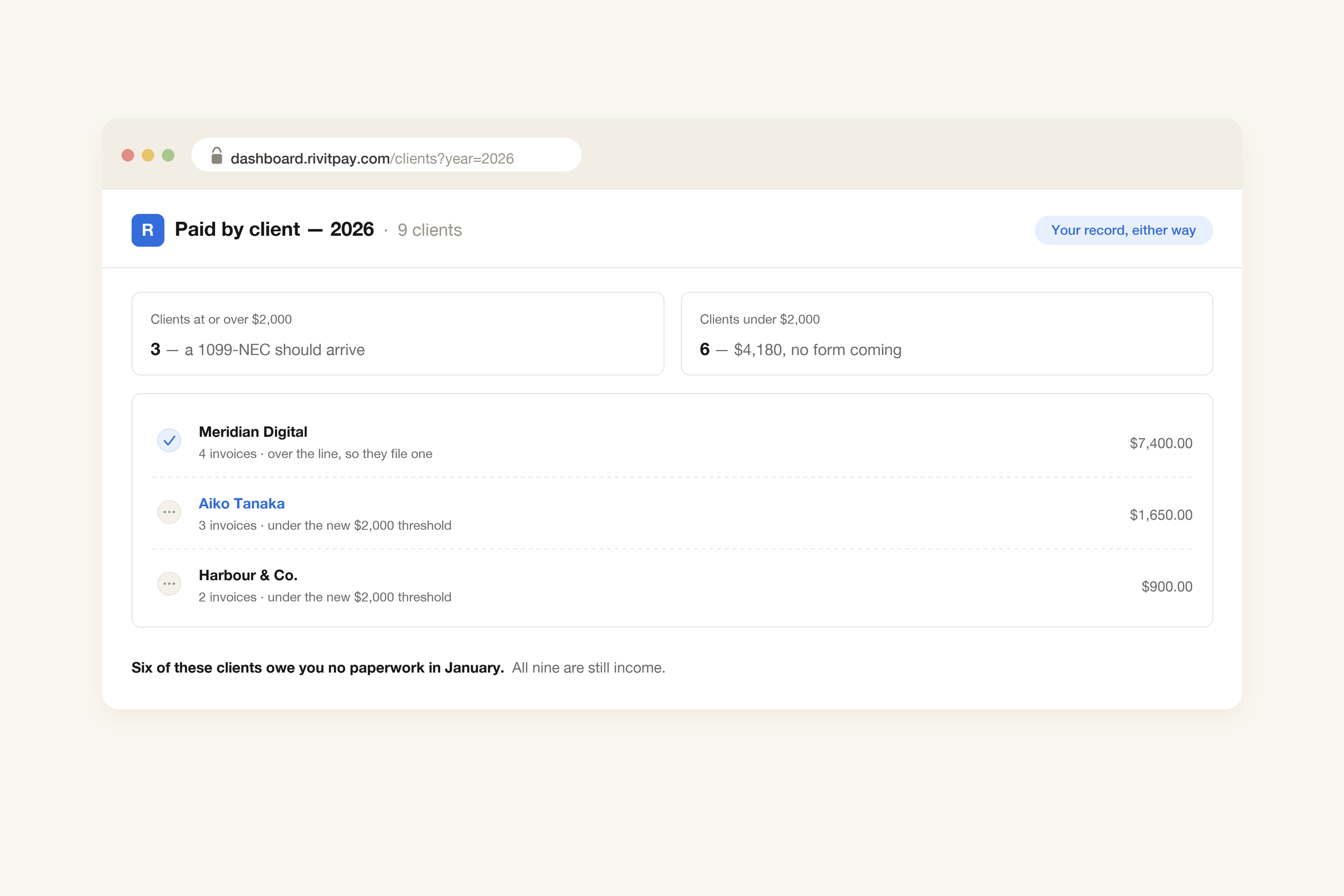
That's the view worth having in August rather than January. Every invoice you send through RivitPay is tracked as sent, viewed and paid, whether the client paid by card through the link or by bank transfer on their own — and the bank-transfer ones are exactly the payments that no processor will ever report and, under the new threshold, most clients now won't either.
The receipts were never the record
It's a strange thing to be nostalgic about a tax form, but the 1099-NEC did quietly do a favour for disorganised people: it forced a once-a-year reckoning with what you'd actually been paid. That safety net is now set considerably higher, and for a lot of freelancers most of the year will fall straight through it.
The replacement isn't complicated. It's the same list that tells you who has opened your invoice and who still owes you money, kept honestly all year. It was always the better record. Now it's frequently the only one.
Every invoice tracked as sent, viewed and paid — by card or any other way. Free until you've collected $5,000.
Make an invoice — free, no signup