When they don't pay
Taking a UK client to court over an unpaid invoice: the letter, the fee and the 41-week wait
You've sent the invoice, the reminders and the "just checking this landed" email. The client opened them, so they know. Three months later there's still nothing. At some point the question stops being "how do I nudge them" and becomes "do I actually take them to court?"
If you and your client are in England or Wales, the answer is more doable than most freelancers think. You can make a claim online, the fee is set out in a table, and most claims never get as far as a judge. But there's a step the court expects first, a fee you pay up front, and a long wait if the client decides to fight. Here's how it works, with the numbers from the government's latest court statistics.
Most claims never get defended
The Ministry of Justice's Civil Justice Statistics for April to June 2026, published on 3 September, show how ordinary these claims are. In those three months, 494,000 money claims were issued through the Civil National Business Centre, up 13% on a year earlier. (The bulletin puts much of the rise down to small claims "in relation to parking on private land", so this isn't all freelancers.)
What happens next is the useful part. Claims defended as a share of claims issued "remained stable at 14%". There were 368,000 judgments in the quarter, and 94% of them were default judgments: the defendant didn't respond, so the claimant won without a hearing. For a straightforward unpaid invoice, where the client knows they owe you and simply hasn't paid, that's the usual way it goes. They pay once the court papers arrive, or they ignore them and you get a judgment.
The bad news is for the minority who do fight. The median time from issuing a small claim to trial was 41.0 weeks, 0.7 weeks longer than a year earlier, and the bulletin notes that waits are longer in London and the South East. That figure only counts cases that end at trial. Still, if your client wants to argue about the work, expect it to take most of a year.
First, the letter before claim
The court expects you to have tried to sort it out before you sue. Which rules apply depends on who your client is.
- Your client is a company or partnership. The Practice Direction on Pre-Action Conduct applies. You write to them with "concise details of the claim": "the basis on which the claim is made, a summary of the facts, what the claimant wants from the defendant, and if money, how the amount is calculated". They should reply within a reasonable time, which it says is "14 days in a straightforward case".
- Your client is an individual, including a sole trader. The stricter Pre-Action Protocol for Debt Claims applies. It covers "any business (including sole traders and public bodies) claiming payment of a debt from an individual (including a sole trader)". Your Letter of Claim has to set out the amount, whether interest is still being added, and the details of the agreement. It also needs "details of how the debt can be paid". It goes by post (you can email a copy as well), together with the protocol's Information Sheet, Reply Form and a Financial Statement form. Then you wait 30 days from the date on the letter before you start a claim.
Skipping this step costs you money. If you don't follow the pre-action rules, the court can make you pay costs, or award you interest "at a lower rate than would otherwise have been awarded", even if you win. A clear letter is also often enough on its own. It's the first message that shows you're prepared to go further.
What it costs to start
You pay a court fee when you make the claim, based on the amount you're claiming including interest. From GOV.UK's Make a court claim for money guide:
- Up to £300: £35
- £300.01 to £500: £50
- £500.01 to £1,000: £70
- £1,000.01 to £1,500: £80
- £1,500.01 to £3,000: £115
- £3,000.01 to £5,000: £205
- £5,000.01 to £10,000: £455
- £10,000.01 to £200,000: 5% of the claim
So a £3,200 invoice, plus interest, costs £205 to put in front of a court. The guide says you can usually claim the fees back if you win, and there may be more fees later, such as for a hearing or for enforcement. Watch the band edges. A £2,950 invoice plus a few months of interest can move you from the £115 band into the £205 one.
Interest goes into the claim itself. The online service works it out for you at a single rate, which the guide says is "usually 8%". Between businesses there's a different route, statutory interest under the Late Payment Act, which we covered in your late invoice is earning interest.
Making the claim
You can claim online unless, among other exceptions, you don't know the exact amount, you're claiming against three or more people or organisations, or the client has no address in England or Wales. If your client is abroad, this isn't the route. You also can't claim against someone who's in the 'Breathing Space' debt scheme.
Claims worth up to £10,000 normally go to the small claims track (CPR 26.9). That's the informal end of the court: you can represent yourself, and the hearing may be held in a judge's room rather than a courtroom. If the client defends a claim of £10,000 or less, the guide says you'll be told you must attend free telephone mediation, an appointment of up to an hour with an HMCTS mediator. Take it seriously. If you don't turn up, the judge can strike out your claim or make you pay costs even if you win.
If the client doesn't respond by the deadline the court gives them, you request a judgment. If you claimed online, you request it through the same service. On paper, it's form N225 for a fixed amount.
A judgment isn't the money
A county court judgment (CCJ) tells the client to pay. It doesn't move any money by itself. If they still don't pay, you go back to the court and pay a fee for each step. You can ask for a company officer to come to court and explain the company's finances, send bailiffs with a warrant of control (they ask for payment within 7 days, then visit), take money from a debtor's wages through an attachment of earnings order, freeze a bank account with a third-party debt order, or put a charging order on property.
The judgment itself is often what gets you paid. GOV.UK's guide for people who receive a CCJ says judgments stay on the Register of Judgments, Orders and Fines for 6 years "unless you pay the full amount within a month", and that lenders use the register. A business that needs credit has a real reason to pay quickly. If the client is insolvent, though, a judgment won't help. That's a different process, which we covered in your client filed for bankruptcy.
The six-year clock, and how it resets
Section 5 of the Limitation Act 1980 says a claim on a contract "shall not be brought after the expiration of six years from the date on which the cause of action accrued". For an unpaid invoice, that's usually from when payment fell due. Six years is generous, but there's a detail worth knowing.
Under section 29(5), if the client "acknowledges the claim or makes any payment in respect of it", the six years start again from that date. Section 30 says an acknowledgment only counts if it's "in writing and signed by the person making it". And there's a limit: once a claim is time-barred, it "shall not be revived by any subsequent acknowledgment or payment". So a part payment, or a client writing "we know we owe you, we'll pay next month", keeps an old invoice alive. Keep those emails.
Where RivitPay fits
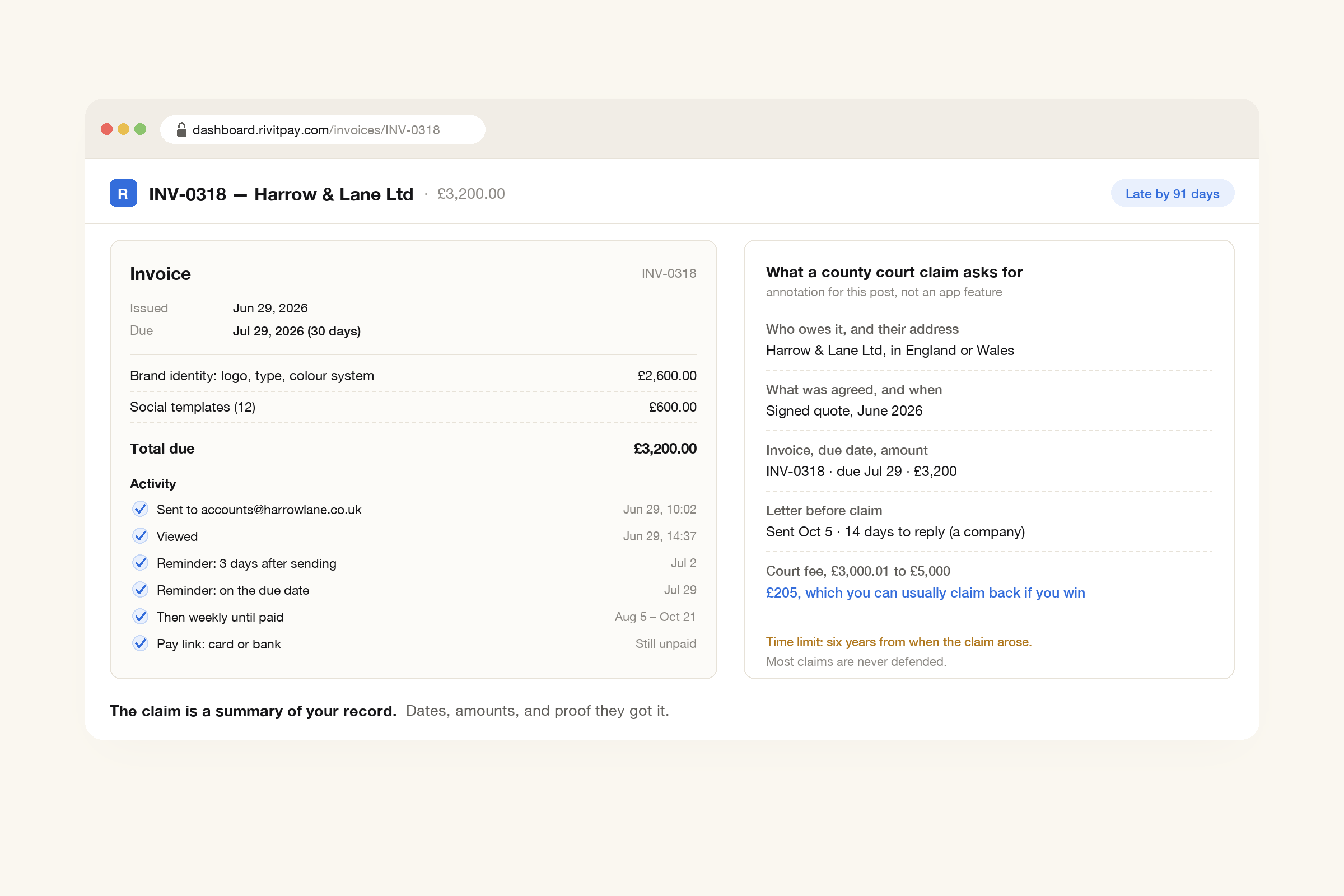
Whichever letter applies, and the claim after it, asks for the same things: what was agreed and when, the invoice, the due date, the amount, and evidence the client knew about it. That's a record you build while you're still being polite.
The free estimate generator puts the scope and price in writing before you start. The free invoice generator, with no signup, makes the invoice in pounds or any of 45 currencies, with your number, dates and terms on it. With a free account, you can email the invoice and see when the client opens it, so "we never got it" isn't believable. Automatic reminders in your own words follow up on a schedule and stop the moment it's paid. The invoice's Pay button lets the client pay by card or bank straight into your own Stripe account. That covers the protocol's "details of how the debt can be paid", and it's the easiest way out for a client who suddenly decides to settle.
The letter is the real tool
Most freelancers never need to go to court, and most claims never reach a judge. What changes things is a clear letter that shows you're prepared to go further, backed by a record that would hold up if you did. Send the letter, give them the 14 or 30 days, and know the fee before you need it. If they still don't pay, the claim form takes less time to fill in than a month of polite reminders.
Invoices in pounds, a live Viewed status, reminders that stop on payment, and a Pay button for card or bank. Free until you've collected $5,000.
Make an invoice, free