Disputes
The check says "paid in full." Your invoice says otherwise.
You invoiced $3,000. The client thinks the extra revision rounds weren't worth $600, and you've gone back and forth about it by email. Then an envelope arrives: a check for $2,400, and on the memo line, in neat handwriting, "payment in full".
It's tempting to deposit it and keep arguing about the $600. In most of the US, that's how you lose the $600. Cashing a check offered as full payment of a genuinely disputed bill can settle the whole bill at the check's amount. Lawyers call it accord and satisfaction. Here's how it works, the two narrow ways out, and why New York is different.
Checks are fewer, but they're bigger
This is still a live problem because checks haven't gone away for business payments, and the ones that remain are big. The Federal Reserve's 2025 Payments Study, released in July 2026, counted 9.2 billion check payments worth $24.45 trillion in 2024. That's 1.8 billion fewer than in 2021. Checks are now just 4% of noncash payments by number but 17% by value. And the average check was $2,653 in 2024, up from $945 in 2000. That's about what a freelance invoice is.
Those are national figures covering every kind of payer. But if your clients still pay by check, a "paid in full" check is a risk you need to know about.
The rule: UCC 3-311
Most states follow section 3-311 of the Uniform Commercial Code, "Accord and satisfaction by use of instrument". (An instrument here means a check, for practical purposes.) The model text says the client, the "person against whom a claim is asserted", has to prove three things first:
- Good faith. They "in good faith tendered an instrument to the claimant as full satisfaction of the claim."
- A real dispute. "The amount of the claim was unliquidated or subject to a bona fide dispute."
- You got the money. "The claimant obtained payment of the instrument." Depositing it counts, mobile deposit included.
If all three are true, the claim is discharged as long as the check "or an accompanying written communication contained a conspicuous statement to the effect that the instrument was tendered as full satisfaction of the claim." A clear memo line or a cover letter is enough.
The second test is the one people miss. If nobody disputed the amount, and the client simply sends less than an agreed, undisputed invoice, this section doesn't apply. But clients who send these checks usually have a dispute ready, and a dispute about whether the extra rounds were in scope is exactly the kind that counts.
Crossing it out doesn't work. Two narrow exits do.
Writing "under protest" next to your signature or crossing out the memo line feels like it should protect you. In most states, it doesn't. The model Code's reservation-of-rights section, 1-308, protects someone who accepts "with explicit reservation of rights", but subsection (b) adds: "Subsection (a) does not apply to an accord and satisfaction."
Section 3-311 has two narrow exits:
- Pay it back within 90 days. The claim isn't discharged if "within 90 days after payment of the instrument, the claimant tendered repayment of the amount of the instrument." That's useful if a check got deposited before you noticed the memo. It doesn't cover a deliberate deposit: under subsection (d), the claim is still discharged if you knew the check was offered as full payment before you deposited it.
- A designated address, for businesses only. An "organization" can tell its clients in advance that communications about disputed debts must go to a particular person or address, and isn't bound by a full-payment check sent somewhere else. Under UCC 1-201, an organization "means a person other than an individual", so this one helps an LLC or corporation, not a sole proprietor.
New York is different
New York kept the older version of the Code's article on checks, and its version of the reservation section leaves the key sentence out. N.Y. UCC 1-308 says a party accepting "with explicit reservation of rights" doesn't prejudice those rights, and that "such words as 'without prejudice,' 'under protest,' or the like are sufficient." It has no subsection (b).
New York's top court applied the earlier version of that rule to a contractor in Horn Waterproofing Corp. v. Bushwick Iron & Steel Co. (1985). Horn billed $1,241 for two days of roof repairs, then cut the bill to $1,080 when the client objected. The client sent a $500 check stamped as "full payment, settlement, satisfaction, release and discharge of any and all claims". Horn wrote "Under Protest" beneath it, deposited it and sued for the $580 balance. The Court of Appeals held that "a creditor may preserve his right to the balance of a disputed claim, by explicit reservation in his indorsement of a check tendered by the debtor as full payment". It didn't matter that the work was services rather than goods.
That's a real difference, but don't rely on it casually. A New York court can still find that you accepted a settlement if everything else you did said so. If you're in New York with real money at stake, talk to a lawyer before you endorse anything.
California has two rules
California has adopted 3-311 as Commercial Code 3311, word for word on the parts above, including the 90-day repayment rule. It also has an older Civil Code 1526, which says accepting a "payment in full" check "does not constitute an accord and satisfaction if the creditor protests against accepting the tender in full payment by striking out or otherwise deleting that notation." The two sections point in different directions. Which one a court applies is a question for a California lawyer. Don't stake $600 on a pen stroke.
What to do when the check arrives
- Read the whole thing before you deposit it. Check the memo line, the back and any letter that came with it. Mobile deposit makes it very easy to cash a check you haven't read.
- If you dispute the amount, don't deposit it. Reply in writing that you don't accept it as full payment. Ask for a check for the undisputed amount without the condition, or return it.
- If it's already deposited, act quickly. In a 3-311 state, the 90-day repayment window may help if you didn't know what the check said. Get advice before the 90 days run out.
- Settle on purpose, if at all. Sometimes $2,400 now is worth more than a fight over $600. That's a fine decision to make, as long as you make it knowingly rather than by accident.
Better: don't put the disputed part on the same invoice
A full-payment check works because the disputed part and the undisputed part are on the same invoice. Separate them and the client has no reason to hold back the part they agree with. When a dispute starts, invoice the undisputed work on its own, and put the disputed work on a second invoice. The client can pay the first one in full and have nothing to bundle into a "full payment" check. Itemizing helps here too: a line that says "4 revision rounds beyond the 2 in the quote, at $150" is easier to agree on than one lump sum. For heading off scope arguments in the first place, see scope creep is just unbilled work.
Where RivitPay fits
The free invoice generator lets you itemize every line, add a Reference / PO number and write Notes / terms in your own words, with no signup. That makes it quick to reissue the undisputed work as its own invoice and put the disputed rounds on another. If the dispute began with a quote, the estimate generator turns an accepted estimate into an invoice, so the approved scope carries over.
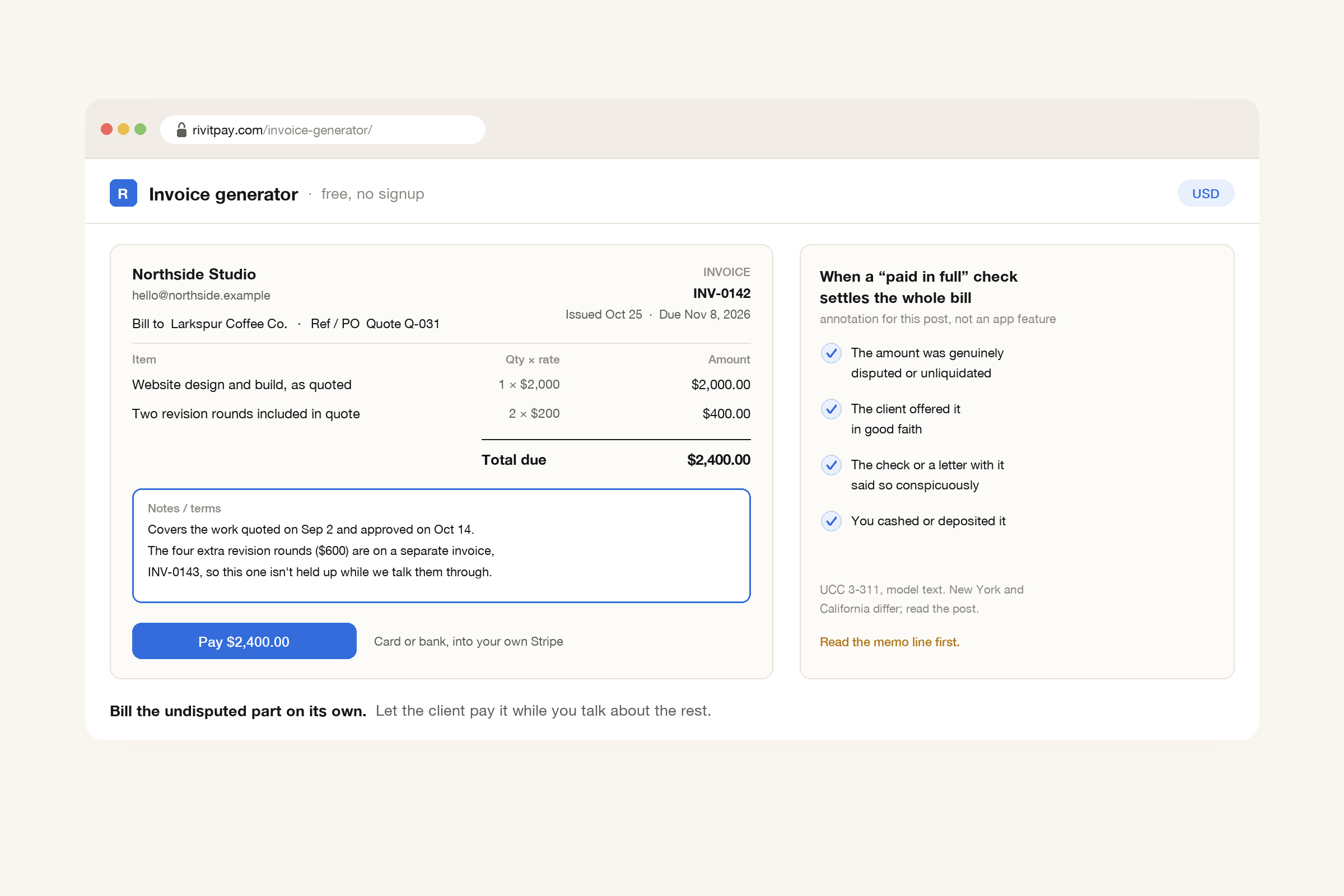
With a free account, you can email each invoice, see when it's been opened, and let clients pay through the Pay button by card or bank, straight into your own Stripe account. A payment through a button has no memo line or endorsement for anyone to write "payment in full" on. Automatic reminders in your own words follow up on the undisputed invoice and stop the moment it's paid. And if a client still prefers checks, here's what else can go wrong with them.
Read the memo line before you deposit
A "paid in full" check is the client offering a settlement. In most states, depositing it means you've accepted, whatever you write on the back. So read the check before you deposit it, put any disagreement in writing, and keep disputed work on its own invoice so the rest gets paid in full.
Itemized invoices, your terms in your own words, and a Pay button so clients can pay online instead of by check. Free until you've collected $5,000.
Make an invoice, free