Late payment
What you can actually charge when a client pays late
The invoice was due three weeks ago. The client has gone quiet, then says it's "in the next payment run". You'd like to add something for the wait. Can you add 5%? A flat $50? Interest?
It depends on two things: what you agreed before the work started, and which state's law governs the deal. Some states give you interest even if you never mentioned it. Others limit how much you can charge even if you did. Here's how it works in four big states, with the statutes linked.
Waiting is normal. Waiting longer is getting more common.
Xero's latest US Small Business Insights, published 30 July 2026, found that small businesses waited an average of 29.3 days to be paid in the June quarter, up from 28.6 days in the March quarter. Payments arrived 8.5 days late on average. Where you are matters too: small businesses in California were paid, on average, 11.9 days quicker than those in Texas.
Those are averages across Xero's small-business customers, not just freelancers. But eight and a half days late on every invoice adds up, and a late fee is the main tool you have to make lateness cost the client something.
The fee you agreed is the one you can collect
A late fee works best as part of the deal: written into your contract or proposal before the work starts, and repeated on every invoice. A fee that appears for the first time on an overdue invoice is something the client never agreed to, and you'll struggle to collect it.
How far an agreed fee can go depends on the state.
California: reasonable fees with businesses, 10% if you said nothing
- Business clients. Under Civil Code 1671(b), a contract term that sets damages for a breach is valid "unless the party seeking to invalidate the provision establishes that the provision was unreasonable under the circumstances existing at the time the contract was made." A late fee in proportion to the cost of waiting is on firm ground. A punitive one isn't.
- Individuals buying for personal use. Stricter. For services bought "primarily for the party's personal, family, or household purposes", such a term is void unless actual damages would be "impracticable or extremely difficult to fix" (1671(c) and (d)).
- No rate agreed. Civil Code 3289(b): if a contract made after 1 January 1986 doesn't set a rate, the obligation "shall bear interest at a rate of 10 percent per annum after a breach." An agreed rate, under 3289(a), keeps running after the breach.
Texas: 6% by default, and careful above 10%
- No rate agreed. Under Finance Code 302.002, if you haven't agreed any interest, you "may charge and receive" interest at 6% a year, "beginning on the 30th day after the date on which the amount is due."
- The 10% line. Section 302.001 says interest above 10% a year "is usurious unless otherwise provided by law." The Finance Code's optional rate ceilings are the main "otherwise". Under section 303.009, those ceilings never fall below 18% a year and top out at 24%, or 28% for business credit.
- The penalty is steep. In a commercial transaction, a creditor who contracts for or receives too much interest owes the client three times the excess, under section 305.001.
Texas usury law is technical. If you want to charge Texas clients more than 10% a year, have a Texas lawyer look at the clause first. The familiar "1.5% a month" is 18% a year.
New York: 9%, but a court awards it
New York's default runs through the courts. CPLR 5001 says interest "shall be recovered upon a sum awarded because of a breach of performance of a contract", computed "from the earliest ascertainable date the cause of action existed". CPLR 5004 sets the rate at 9% a year, unless another statute says otherwise. So if you take an unpaid invoice to court and win, interest from the date it was due comes with the award. If you're thinking of going that route, we've covered whether small claims is worth it. New York freelancers also have a separate, much stronger remedy: double damages under the state's freelance law.
Illinois: 5% on a settled account
Illinois sets a lower default. Under 815 ILCS 205/2, creditors "shall be allowed to receive" 5% a year on money due "on the settlement of account from the day of liquidating accounts between the parties and ascertaining the balance", and on "money withheld by an unreasonable and vexatious delay of payment."
What that's worth on a $2,000 invoice
Take a $2,000 invoice paid 45 days late, with simple interest by the day:
- Agreed 1.5% a month (18% a year): $44.38.
- California's 10% default: $24.66.
- New York's 9% court rate: $22.19, if a court awards it.
- Texas's 6% default, starting on day 30: about $5.
None of those is life-changing, and that's the honest point. A late fee rarely makes you whole. Its job is to change the order in which the client's accounts payable team pays its bills. A clearly stated, agreed fee moves your invoice up the pile. A default rate you never mentioned rarely moves it at all.
How to set one up
- Put it in the contract. One sentence: the rate, when it starts and how it's calculated. A monthly percentage is easier to defend than a large flat fee on a small invoice.
- Print it on every invoice. Same wording, every time, next to the due date.
- Stay inside your state's limits. Keep the rate at or under what your state allows, and be extra careful with clients who are individuals rather than businesses.
- Mention it before you charge it. A reminder on the due date that says "interest starts accruing on the 1st" often gets you paid without ever adding it.
- Decide in advance when you'll waive it. For a good long-term client paying a few days late, waiving it can buy goodwill. Just make it your choice, not a habit.
Where RivitPay fits
The free invoice generator prints your due date, and anything you write in Notes / terms, on every PDF, with no signup. That's where your late-fee sentence goes. To work out what's owed, the free net 30 calculator has a late-fee mode: enter the invoice amount, the rate as a percentage per month or per year (or a flat amount), the due date and the payment date, and it shows the fee and the new total.
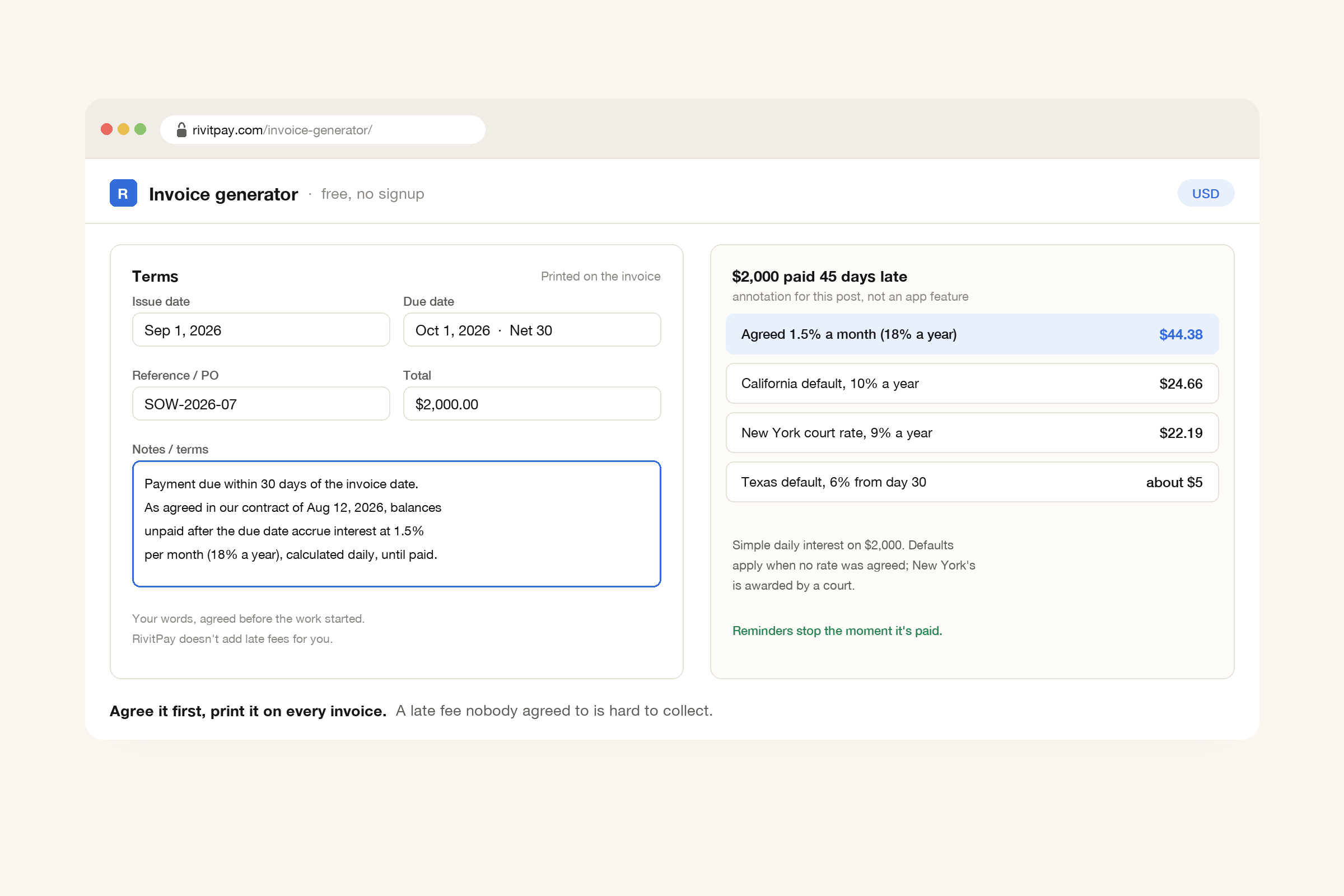
With a free account, you can email the invoice, see when it's been opened, and set automatic reminders in your own words, so the due-date reminder can mention your late fee. Reminders stop the moment the invoice is paid. Clients can pay by card or bank through the Pay button, straight into your own Stripe account.
Agree it first, then mention it often
You usually can charge for late payment, but only up to what your contract and your state allow, and the amounts are small. What makes a late fee work is that the client saw it before they signed, sees it on every invoice and hears about it in the reminder on the due date. Put it in writing now, before the next slow payer.
Due dates, your terms in your own words, and reminders that stop the moment you're paid. Free until you've collected $5,000.
Make an invoice, free