Late payment in Europe
Your EU client owes you interest when they pay late
You invoiced a studio in Rotterdam on net 30. Day 30 comes and goes. On day 45 the money arrives, with no apology and no explanation. Most freelancers just feel relieved and move on.
In the EU, that late payment came with a price, and you were entitled to it. Since 2011, an EU directive has said that a business paying another business late owes interest and a fixed sum for the trouble, without you having to ask first. Hardly anyone claims it. That's worth knowing, especially when you're deciding what your terms should say.
Late payment is the norm, not the exception
When the European Commission reviewed the rules in 2023, its impact assessment started with the scale of the problem: "Each year around 18 billion invoices are exchanged in the EU," and "almost 50% are paid late." A Council background note for ministers put the cost more starkly: "late payments account for 25% of bankruptcies in the EU nowadays."
Freelancers sit at the far end of that. You have the least bargaining power and the thinnest cash buffer, so you're the one who notices when a payment is a few weeks late.
What the directive gives you
The Late Payment Directive (Directive 2011/7/EU) covers "commercial transactions," meaning business to business, or business to public authority. It doesn't cover consumers. You don't need a company to qualify. An "undertaking" is any organisation acting in its business or profession, "even where that activity is carried out by a single person."
- Interest starts on its own. If you did the work and weren't paid on time, you're entitled to interest "without the necessity of a reminder" (Article 3).
- No date in the contract? It's 30 days. Interest starts 30 calendar days after the client receives your invoice, or after they receive the work if that comes later.
- Long terms need a reason. Business clients can only agree payment terms over 60 days if the contract says so expressly and it isn't "grossly unfair" to you. Public authorities get 30 days, and 60 at the very most (Article 4).
- A fixed €40 on top. Once interest is due, you can claim at least €40 for your recovery costs, also without a reminder. If recovering the debt costs you more than that, for example a lawyer or a collection agency, you can claim reasonable compensation for the rest (Article 6).
- Clients can't contract out of it. A term that excludes late-payment interest "shall be considered as grossly unfair," and one that excludes the €40 is presumed to be (Article 7).
It's a directive, so each country wrote it into its own law, and countries were allowed to be more generous. Germany is one example. Its Civil Code sets interest between businesses at "nine percentage points above the basic rate of interest" (section 288), one point more than the EU minimum, and gives a €40 lump sum. Its "basic rate" is a German rate published by the Bundesbank, not the ECB rate itself.
Working out the rate
The directive's statutory rate is the "reference rate" plus "at least eight percentage points," charged as simple interest. For euro countries, the reference rate is the ECB's main refinancing rate. It's fixed twice a year: the rate in force on 1 January applies for the first half of the year, and the rate in force on 1 July applies for the second half.
The ECB's key rates table shows the main refinancing rate at 2.40% from 17 June 2026. That's the rate that was in force on 1 July, so for invoices late between 1 July and 31 December 2026 the minimum is 10.40% a year. (The ECB raised the rate again, to 2.65%, from 16 September. If that's still in force on 1 January, it sets the rate for the first half of 2027.)
Back to the Rotterdam client. Say the invoice was €4,000 and they paid 45 days late in the second half of 2026:
- €4,000 × 10.40% = €416 a year
- €416 × 45 ÷ 365 = €51.29 in interest
- plus the fixed €40, for a minimum claim of €91.29
Not life-changing on one invoice. Across a year of slow payers, it adds up. Mostly, though, it's leverage. A client who knows lateness has a price tends to find the payment run a little sooner. Countries differ on small details, such as the day count, so treat the arithmetic as an illustration.
The 30-day cap that hasn't happened yet
You may have read that the EU is capping payment terms at 30 days. The Commission did propose it. The September 2023 proposal would replace the directive with a regulation, set binding maximum payment terms of 30 days for all transactions between businesses and with public authorities, drop the "grossly unfair" escape hatch, and make a €50 flat fee automatic for every late transaction.
The European Parliament voted on its position on 23 April 2024. Then it stalled. As of this week, the Parliament's Legislative Observatory still lists the file as "Awaiting Council's 1st reading position." Until that changes, the 2011 directive and your country's version of it are the law. (The UK left the EU and has its own rules. We've covered its statutory interest and its proposed 60-day cap separately.)
Asking for it without losing the client
The right to interest is automatic. Whether you claim it is up to you, and most freelancers don't, because they want the next project. A few ways to use the rule without starting a fight:
- Put it in your terms before you start. One line on every invoice saying late payment carries statutory interest and the €40 fixed sum. It's not a threat. It's what the law already says, and it tells the client's accounts team you know it.
- Mention it in the first overdue reminder, not the first email. "Just a reminder this was due on the 1st. Under our terms, statutory interest applies from the due date" is firm and polite.
- Save the actual claim for repeat offenders. A client who is late every month is using you as a free loan. Billing them the €40 and the interest is reasonable, and the law is on your side.
Where RivitPay fits
The free invoice generator prices the invoice in euros (or any of 45 currencies), puts your IBAN and SWIFT in the payment details, prints the due date, and has a Notes / terms field for your late-payment line. No signup. In a free account, the client gets the invoice by email with the PDF attached and a Pay button, so they can pay by card or bank into your own Stripe account. You can see when they opened it, and automatic reminders in your own words go out on schedule and stop the moment it's paid.
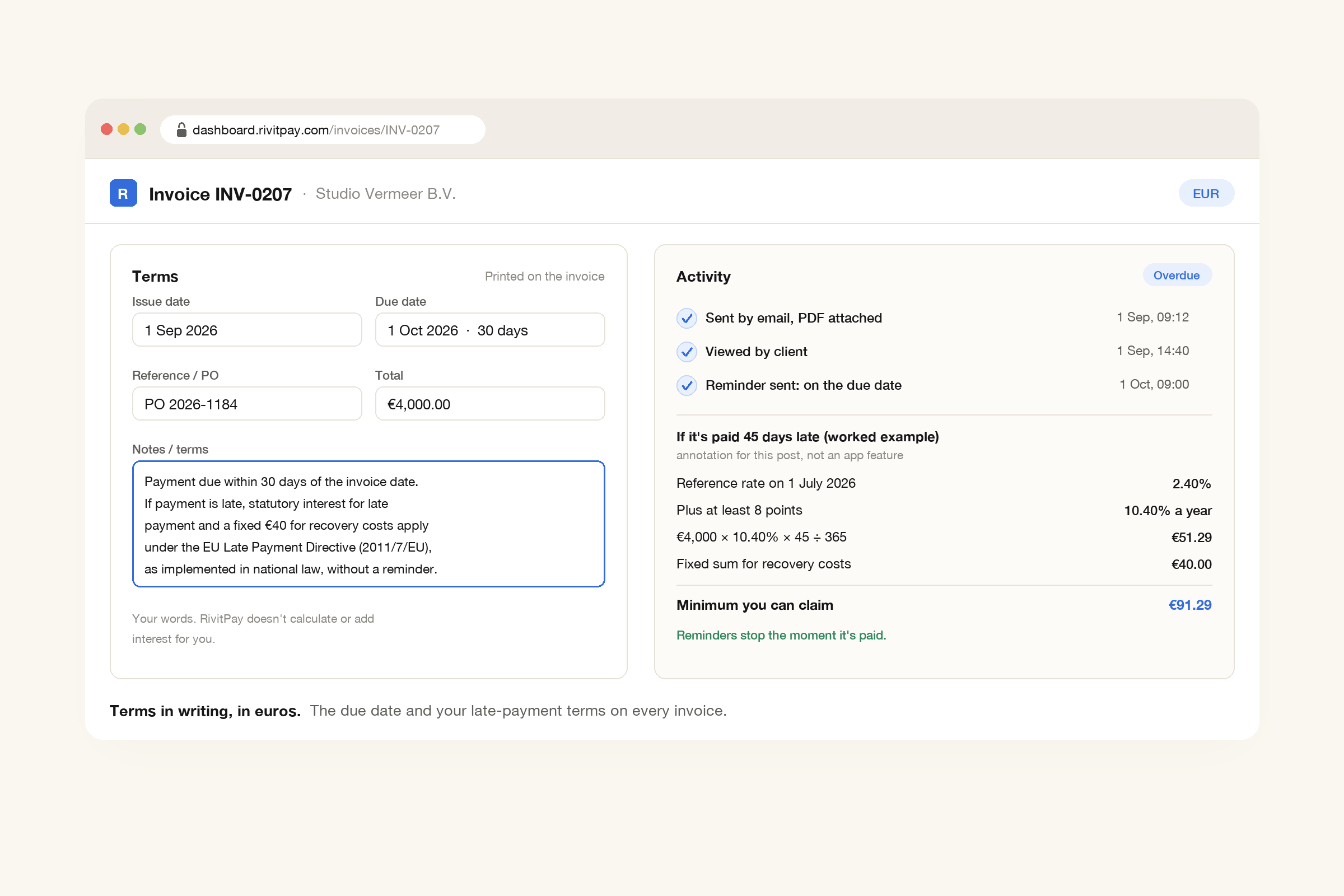
RivitPay won't calculate or add interest for you. If you decide to claim it, the net 30 calculator has a late-fee mode with a "% per year" option for the arithmetic, and you can bill it as a line on a follow-up invoice.
Late isn't free in Europe
Paying a supplier late feels like a free loan to the business doing it. In the EU, it isn't, at least on paper. The interest and the €40 are yours from the day after the due date. Put a due date on every invoice, put the rule in your terms, and decide case by case whether to collect. Knowing it's there changes how the follow-up email sounds.
Due date, IBAN, your late-payment terms and automatic reminders in your own words. Free until you've collected $5,000.
Make an invoice, free