Pricing
Still charging your January 2025 rate? Prices are up 6% since. Here's how to raise it
Say you set your rate at $90 an hour in January 2025 and haven't touched it. Your invoices look the same as they did then. What they pay for doesn't. Prices have gone up by about 6% since then, so the same $90 buys less than it did. Nobody told you, and that's the problem.
Here's the arithmetic, what other freelancers are doing about it, and how to move a rate up without making it awkward: who gets the new rate, when, and what to put in writing.
What your rate is worth now
The Bureau of Labor Statistics' September 2026 CPI release, published October 14, says: "Over the last 12 months, the all items index increased 3.7 percent before seasonal adjustment." The same release puts the index at 336.940. The BLS data series has the index at 317.671 for January 2025 and 325.252 for January 2026.
Divide one by the other and you get the rate you'd need today to buy what your old rate did:
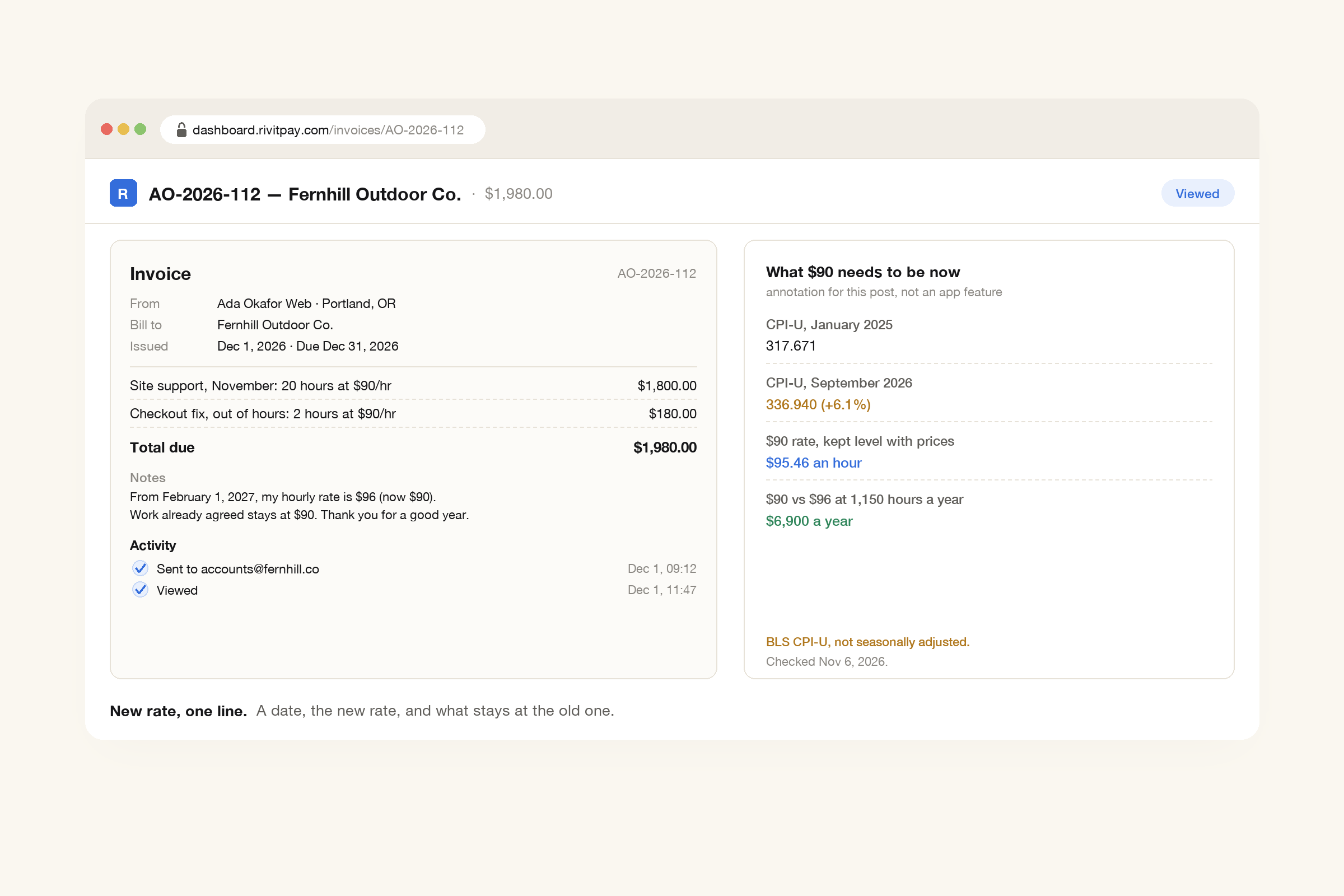
- Unchanged since January 2025: prices are up 6.1%. A $90 rate needs to be about $95.46 to stand still. Put the other way, $90 now buys about 5.7% less than it did.
- Unchanged since January 2026: prices are up 3.6%. That $90 needs to be about $93.23.
Over a year, the gap adds up. At 25 billable hours a week for 46 weeks (1,150 hours), the difference between $90 and $96 is $6,900. That's what standing still costs you, before you've charged anything for a year's more experience.
Two things to keep in mind. The CPI is an average across urban consumers. Your own costs might have gone up more than that, or less. And it's a floor, not a target. Matching inflation only keeps you where you were in January 2025. The October figure comes out on November 10, if you'd rather work from the latest number.
Most freelancers hold their rate anyway
If you've been putting this off, you're in good company. freelancermap's Freelancer Study 2026 surveyed 5,412 freelancers in Germany, Austria and Switzerland between November 17, 2025 and February 8, 2026. Asked how their hourly rate would change in 2026, "62% plan no change, 29% want to increase their prices, and 9% even expect a decrease." The average rate fell from €104 to €103, the first fall since the study began.
The study's own explanation is a slow market: "Many forego adjusting their hourly rates to stay competitive, even though rising living costs and inflation increase their financial burden." Among those raising their rates, about a third gave more experience as the reason, and 29% gave inflation.
That's a European survey, mostly of IT and consulting freelancers, so don't read it as a picture of the US market. But the pattern is familiar. When work feels scarce, raising your rate feels risky, so you don't. Then a year passes, and your rate has fallen in real terms without you deciding anything.
Work out the new number first
Inflation tells you the least you need. To find what you should charge, start from what you need to earn. Our free freelance rate calculator takes the take-home pay you want, your business expenses, your billable hours and weeks off, your state income tax and a buffer for slow months. It adds federal self-employment and income tax and gives you a minimum hourly and day rate. Its default example, $60,000 take-home at 25 billable hours a week, comes out at $79 an hour.
If the calculator's number is above your current rate, the rate itself is the problem, not inflation. If it's below, the inflation-matched figure from the section above is a sensible minimum for the new year.
Who gets the new rate, and when
- New clients: straight away. Anyone you haven't quoted yet gets the new rate on their first estimate. There's nothing to announce.
- Existing clients: with notice. Give a date, not a vague "from next year". Thirty days is the least most clients will think is fair. Sixty is kinder for anyone on a retainer, because they may need to get the budget approved. If you send notice in November, a date in early January or February works.
- Fixed-price work in progress: leave it. You quoted a price for that project, so finish it at that price. The new rate applies to the next piece of work.
- Retainers and contracts: check the wording. If your agreement says how prices change, for example with notice or at renewal, follow it. If it says nothing, the agreed rate usually stands until you both agree a new one, so treat your notice as a proposal and get a reply.
If a freelance protection law covers the work, put the new rate in writing too. New York's statewide law, General Business Law § 1412, and California's, Business and Professions Code § 18103, both require a written contract that includes "the rate and method of compensation". A new rate agreed in a phone call leaves that contract out of date. Our posts on freelance payment laws and California's law cover when they apply.
How to say it
Keep it short. Include the date, the new rate, what it applies to, and a thank-you. Don't apologise, and don't write a long justification. Something like this:
Hi Sam, a quick note on rates: from February 1, 2027, my hourly rate will be $96, up from $90. Anything we've already agreed, including the current site project, stays at the old rate. Happy to talk it through if it affects your budget for next year. Thanks for a good year of work together.
If a client pushes back, you have options other than giving in: a smaller scope at the new rate, a later start date for the new rate, or a prepaid block of hours at the old rate until a set date. Choose one before you send the email, so you're not making it up on the call.
Where Rivit Invoices fits
Put the new rate on paper twice: once for the client to agree to, and once as a reminder on the invoices they're already getting.
- The estimate. In the free estimate generator, put next year's work at the new rate, set a valid-until date, and write the start date in the terms. The estimate has an acceptance line the client can sign. When they say yes, Turn into invoice carries everything into the invoice generator.
- The December invoice. Add one line in Notes / terms: "From February 1, 2027, my hourly rate is $96." It reaches the person who approves your invoices, which isn't always the person you emailed. If you send it from a free account, you'll see when it's been opened.
- Recurring invoices. If you bill the same client every month, you duplicate last month's invoice and send it. On the first invoice after the new date, change the rate on the line before you press Send.
The short version
US prices are up 6.1% since January 2025 and 3.6% since January 2026. If your rate hasn't moved, you've had a pay cut. Work out the rate you need, not just the inflation figure. Charge it to new clients now. Give existing clients a date and 30 to 60 days' notice, and leave fixed-price work in progress alone. Then put the new rate in writing on the estimate, the contract and the next invoice.
A free estimate with the new rate, a valid-until date and an acceptance line, and one click to turn it into an invoice. No signup.
Make an estimate, free