Lost payments
The check you never cashed didn't vanish. Your state may be holding it
You're tidying up your books and find an invoice from 2023 that was never marked paid. You email the client. They reply: "We paid that. Check went out in March 2023."
Maybe it went to your old address. Maybe it's in a drawer. Either way it was never cashed. So where is the money now?
It isn't the client's to keep. In most of the US, a business that issues a payment nobody collects has to hand the money to the state after a few years. The state holds it for you, and you can claim it. Here's how that works in four big states, how to get the money back, and how to avoid losing track of a payment in the first place.
A check goes stale after six months. The debt doesn't
The Uniform Commercial Code, the model law US states use for checks, says in section 4-404 that a bank "is under no obligation to a customer having a checking account to pay a check, other than a certified check, which is presented more than six months after its date, but it may charge its customer's account for a payment made thereafter in good faith."
So after six months the bank can refuse an old check, or it can pay it. That's the bank's choice. But a stale check doesn't cancel what you're owed.
A 1969 California case shows how far that goes. A company paid an employee's bonus with a check printed with a notice that it was void if not cashed in 60 days. He never cashed it. He died on September 19, 1966, "and the uncashed" check "was found among his papers." His estate sued, and the appeals court upheld the finding that the company still owed him $3,045.73. (That case turned on a rule called an account stated, which we cover in a separate post.)
After a few years, the client must hand it to the state
Every state has an unclaimed property law. The business holding the money is called the holder. When a payment sits uncollected for a set time, called the dormancy period, the holder has to report it and send it to the state.
New York's law names your situation exactly. Section 1315 of the Abandoned Property Law covers "outstanding checks" issued "in payment for goods or for services" that have "remained unclaimed by the owner of such amount for three years". The Texas Comptroller's unclaimed property page lists "uncashed checks" and "payroll and vendor checks" among its examples. To a client, a freelancer is a vendor.
| State | Payments owed in the ordinary course of business | The client must warn you first | When it goes to the state |
|---|---|---|---|
| California | 3 years | If it's $50 or more: 6 to 12 months before it becomes reportable | Report before November 1. Money sent about seven months later |
| New York | 3 years (checks for goods or services) | First-class letter at least 90 days before the report. Over $1,000: a second letter by certified mail at least 60 days before | On dates set by the State Comptroller |
| Texas | 3 years | If it's more than $250: by mail or email, at least 60 days before delivery | Report and money by July 1 |
| Florida | 5 years | If it's $50 or more: 60 to 120 days before the report | Report before May 1 |
Wages have a shorter clock: one year in California, Texas and Florida. A freelancer's fee generally isn't wages, so the longer period applies.
The Texas rule has two conditions. Property is presumed abandoned only if, "for longer than three years", the holder doesn't know where the owner is and no claim to the property has been made. So in Texas it matters that the client knows where you are, and that you've asked for the money.
The letter you're supposed to get
Before the money goes to the state, the client has to try to tell you. In California the notice must carry this heading: "THE STATE OF CALIFORNIA REQUIRES US TO NOTIFY YOU THAT YOUR UNCLAIMED PROPERTY MAY BE TRANSFERRED TO THE STATE IF YOU DO NOT CONTACT US".
If one of these arrives, it isn't junk mail. Reply to it. It's the easiest moment to get paid, because the client still has the money. California's law says that if you establish your right to the property "to the satisfaction of the holder before that property has been delivered to the Controller", the holder doesn't send it to the state.
The weak point is the address. Texas requires notice "by mail to the last known address of the owner or by e-mail". If you've moved since the invoice, the letter goes to the old place, and so did the check.
How much is sitting there
The National Association of Unclaimed Property Administrators, the body the state programs belong to, puts it this way: "Do you have unclaimed cash or property waiting for you? Approximately 1 in 7 people do!"
The Texas Comptroller said on October 30, 2026 that the state has "more than $12.5 billion currently waiting to be returned to its rightful owners", and that the agency had processed 107,405 claims since August 1. New York's unclaimed funds page showed "$631,438,131 Returned in 2026" when we checked on November 13, and says: "Every day, the State Comptroller returns over $2 million to entitled owners."
Those totals cover everything: old bank accounts, insurance payouts, deposits, wages. Nobody publishes a figure for freelancers' uncashed checks. But vendor checks are on the list, and a freelancer who has moved, renamed their business or changed banks is exactly the kind of owner a letter doesn't reach.
How to get the money back
- Ask the client first. If the money hasn't gone to the state yet, the client can void the old check and pay you again. Even after it has gone, California and Texas let the holder pay you and get the money back from the state. In Texas, "the holder may pay the amount of the claim", and the comptroller "shall reimburse the holder for a valid claim". No law we read forces a client to reissue, so some will tell you to claim from the state instead.
- Search the state's site. Each state runs its own search. NAUPA says most states also take part in MissingMoney.com, "a free website, managed by NAUPA", for searching several states at once.
- Search every name. Try your own name, your business name, and any older versions of either. New York's page says its database may hold money belonging to "you, your business, friends or family".
- Search more than one state. Try the state you lived in when you did the work, and the client's state. We didn't check which state receives the money in every situation, so search both.
- Don't worry about a deadline in these three. California's law says property it receives "shall not permanently escheat to the state." New York says "there's no fee or time limit to claim it." Texas says "there's no time limit for owners to file a claim."
- Expect to prove it's yours. Texas law says a claim must "include all necessary documentation the comptroller may require". Your invoice, showing the same client, amount and date, is the obvious record to have ready.
- Expect to wait, without interest. In California the Controller has 180 days to consider a claim, and "Interest shall not be payable on any claim paid under this chapter."
You don't need a finder
Some firms search state records and offer to recover your money for a cut. You can do the same search yourself. The states cap what these firms can charge:
- California: the fee can't be "in excess of 10 percent of the recovered property".
- New York: no agreement is valid with "a fee in excess of fifteen percent". The contract must also say, in bold type, that the funds "can be obtained directly from the Office of the State Comptroller by the owner of such funds without paying a fee."
- Texas: no more than "10 percent of the value of the property recovered", plus reasonable attorney's fees.
- Florida: total fees and costs "may not exceed 30 percent of the claimed amount."
One wrinkle on "free". Texas law allows a handling fee to be taken from a claim payment of $100 or more. We couldn't confirm whether the Comptroller charges one today.
How not to end up here
- Notice the missing payment in weeks, not years. A check that never arrives looks the same as a client who hasn't paid. Keep a list of what's outstanding and ask about anything past due.
- Deposit checks when they arrive. After six months a bank can refuse one.
- Keep your address current with old clients. Tell them when you move. The warning letter goes to the address they have.
- Move clients off paper. A bank transfer or card payment can't sit in a drawer. Our post on checks in the mail covers the other risks of paper.
Where Rivit Invoices fits
- An outstanding list that doesn't forget. A free account shows what you're owed, a needs-chasing count, and invoices marked "Late by 6 days" instead of leaving you to notice.
- Reminders. Automatic reminders go out on your schedule and in your words. A client who thinks they paid will usually reply to say so, and then you know to look for the check.
- A way to pay that isn't a check. Each invoice can carry a Pay button for cards and your bank details for transfers. Card payments go to your own Stripe account.
- Your current address on every invoice. The invoice generator prints your name, address and email at the top, so the client's records have somewhere to send a letter.
- A record to claim with. The invoice PDF shows the client, amount, number and date. When the money finally arrives, the receipt generator makes a receipt that quotes the invoice number.
The short version
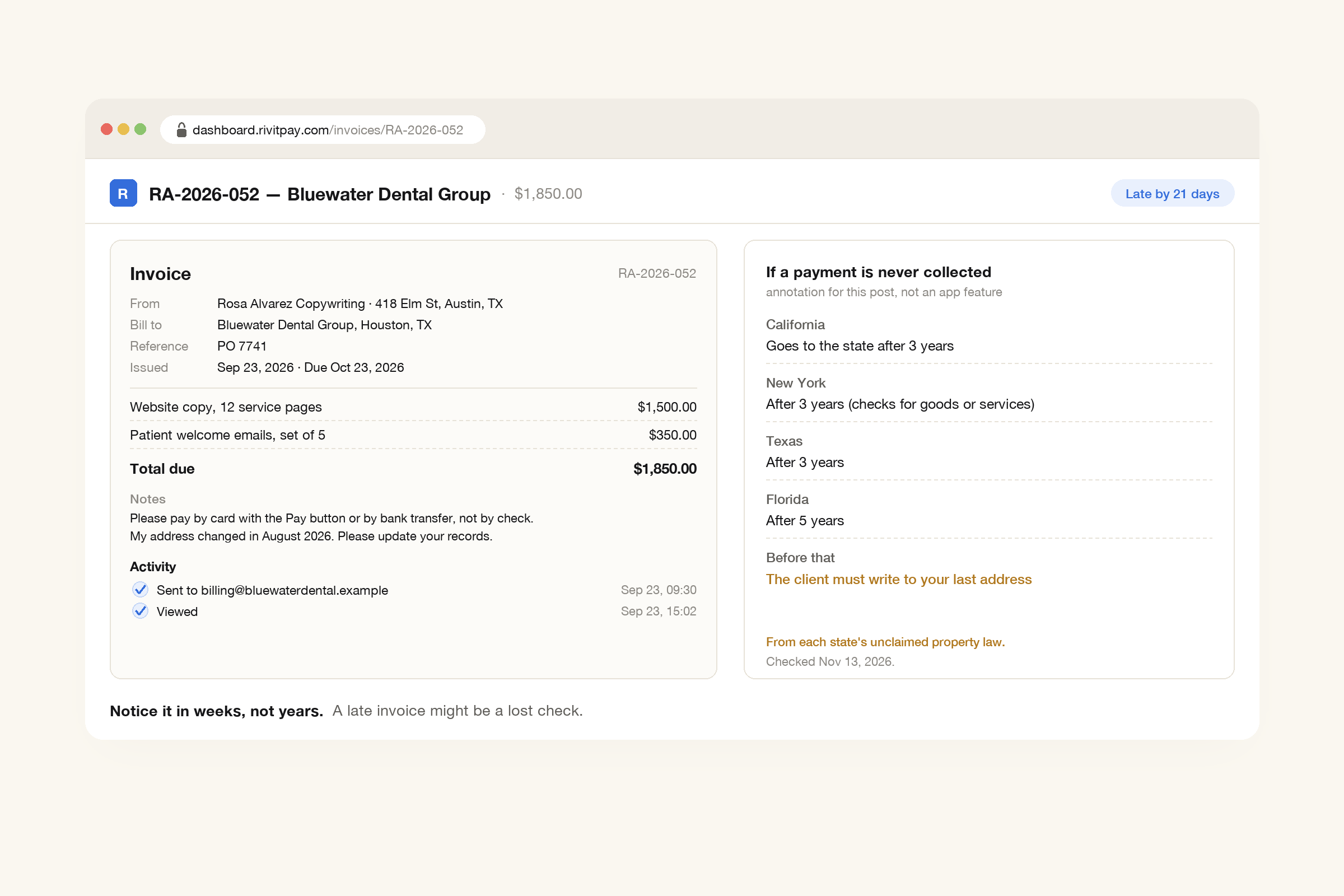
A bank can refuse a check after six months, but the client still owes you. If the payment stays uncollected, the client must send it to the state: after three years in California, New York and Texas, and five in Florida. The client has to warn you first, at the last address it has. California, New York and Texas set no deadline to claim, and you can search and claim yourself. Finder firms are capped at 10% to 30% depending on the state, and you don't need one. Better still, notice a missing payment early, and give clients a way to pay that isn't paper.
A free invoice with your current address, your bank details and a Pay button for cards. No signup.
Make an invoice, free