Unpaid invoices
Your client never disputed the invoice. In court, that silence can count
You send the invoice. Nothing comes back. You send a reminder, then another. The client doesn't complain about the work or question the amount, and doesn't pay.
Four months later you mention small claims court, and the client suddenly has objections. The work was late. The hours look high. They never agreed to that rate.
US courts have an old rule for this situation. It's called an account stated. If you send a client a bill and they keep it without objecting for a reasonable time, a court can treat that silence as agreement that the amount is right. The rule has limits, and it fails more often than freelancers would like. But it's the reason a dated invoice and a record of when it was sent are worth more than they look.
What an account stated is
New York's highest court, in a 1975 decision, used a definition that was already almost a hundred years old. An "account stated is an account balanced and rendered, with an assent to the balance express or implied".
The important word is "implied". A California appeals court explained in 1969 how the agreement usually comes about: "by the creditor rendering a statement of the account to the debtor. If the debtor fails to object to the statement within a reasonable time, the law implies his agreement that the account is correct as rendered."
Texas courts use a three-part test. A Houston appeals court set it out in 2010: there were dealings between the two sides that left one owing the other, "an agreement, express or implied, between the parties fixes an amount due", and the one who owes makes a promise, "express or implied", to pay. The same court said a creditor "need not produce a written contract to establish the agreement between the parties; an implied agreement can arise from the acts and conduct of the parties." That case was about a credit card, not a freelancer, but the test is the general one.
The case to know: five invoices and no reply
The clearest example we found involves a New York law firm and a client who went quiet. It's Morrison Cohen Singer & Weinstein v. Waters, decided in 2004.
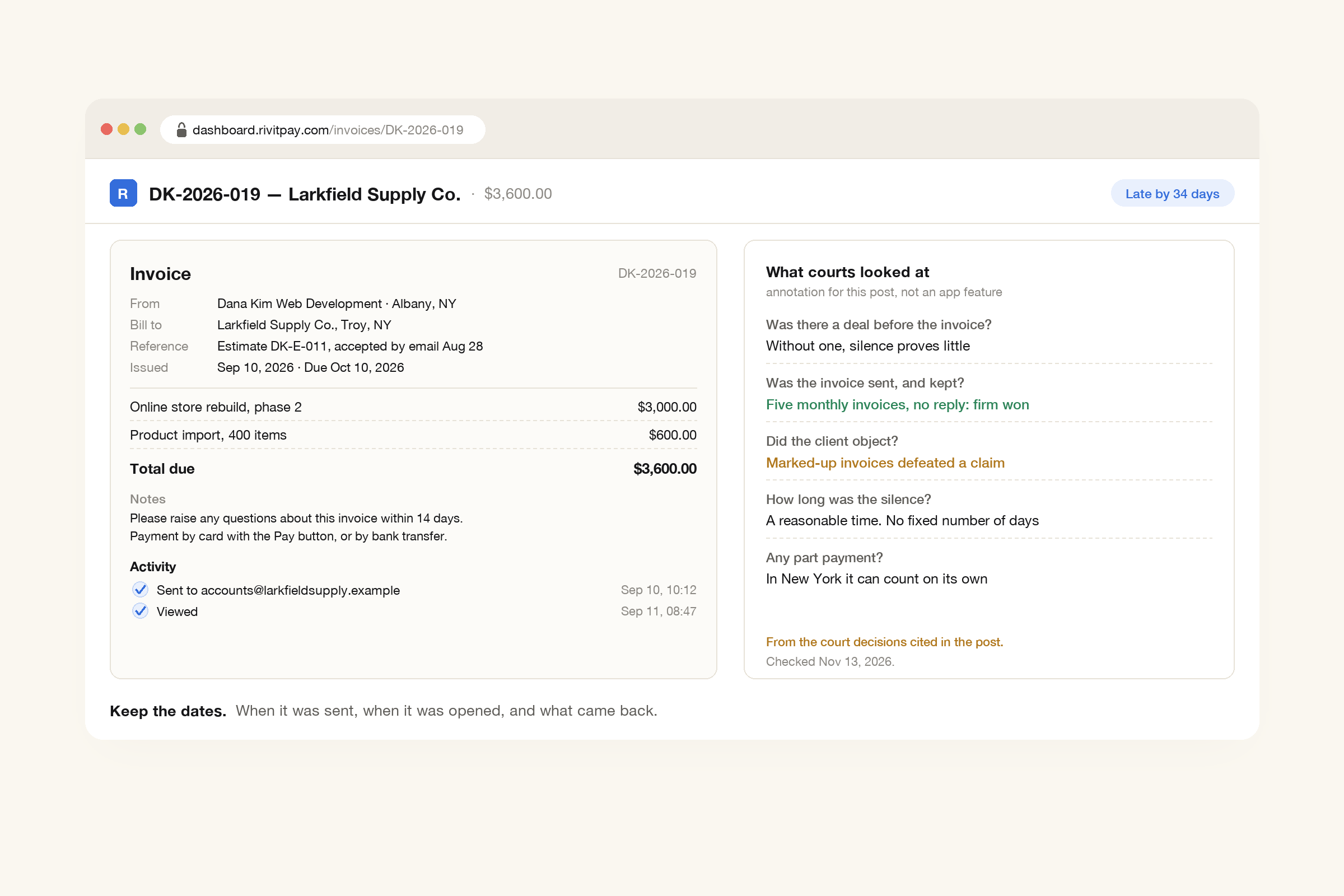
The firm sent the client "five monthly invoices, from October 2002 through February 2003, in a total amount of $40,000." The court's summary of what she did next: "Defendant neither paid nor informed plaintiff of any specific objection to the services rendered."
The firm wrote asking for payment in March 2003 and sued in June. Only then did objections appear. In her formal answer that September she said the fees were not "justly due", and she gave specific objections to the amounts "only months later".
That was too late. The appeals court held that the invoices "were retained without any objection for a sufficient length of time as a matter of law to establish defendant's liability on the account stated cause of action." It ordered judgment for the firm for $40,399.24, plus interest from March 12, 2003.
The court also cleared up a second point. The lower court had thought the firm needed to show both that the client kept the bills and that she paid part of them. Not so: "either retention of bills without objection or partial payment may give rise to an account stated". Either one can be enough in New York.
Silence on its own isn't a promise
This is where it gets less comfortable. The same 1975 New York decision that gave the definition also said that "the mere silence and failure to object to an account stated cannot be construed as an agreement to the correctness of the account". What matters is the whole situation. The facts may be such that "in the absence of an objection made within a reasonable time, an implied account stated may be found".
So there's no magic number of days. None of the decisions we read sets one. The California court called it "a question of fact", which means a judge looks at what happened: the dealings between you, how the bill was sent, how long the client sat on it, and what they said or didn't say.
Three ways it fails
Each of these claims lost, and each one shows a limit.
- There was no deal to begin with. A New York executive search firm billed a company $44,438.88 for a search the company said it never agreed to. When the firm pressed for payment, the company's chairman wrote back: "As far as I am concerned there are no monies due." The appeals court threw out the account stated claim in 1991. An account stated "cannot be made an instrument to create liability when none otherwise exists", and it can't be used "simply as another means to attempt to collect under a disputed contract." The firm still got to argue its contract claim at trial. It just couldn't skip that step.
- The client objected, and could show it. A Florida boatyard sued a yacht owner over repair invoices. The owner testified that he "repeatedly objected to the invoice amounts", and the evidence showed he "had specifically marked the invoices in disagreement as to the amount owed". The court said in 1981 that this was proof no account stated ever existed. The boatyard lost, and lost its claim for attorney's fees with it.
- The work behind the bill couldn't be proved. An Illinois clinic sued for a bill of $9,949.98 and said the patient's family never objected to it. But its billing records were kept out of evidence, and it couldn't prove the underlying debt. The appeals court said in 1992 that an account stated "merely determines the amount of the debt where liability previously existed." With no liability shown, the silence didn't matter.
Put those together and the rule is narrower than it first sounds. An unanswered invoice can settle how much is owed. It can't prove there was a job in the first place.
What this means for your invoices
- Get the deal in writing before the work. A quote the client accepted, even by email, is what shows there was a debt at all. Without it, the silence that follows your invoice proves much less.
- Send every invoice so you can show when it went. Each of these cases turned on what was sent and when. Keep the email, the date and the address you sent it to.
- State the balance plainly. An itemized invoice with one clear total is a statement a client can agree with or object to. A vague "balance outstanding, as discussed" is not.
- Follow up in writing. A reminder that repeats the invoice number and the amount is another statement of the account, and another chance for the client to object. If they still don't, that's part of the picture a court looks at.
- Take every objection seriously. If the client writes back to dispute the amount, even vaguely, the silence is over. Answer it. If only part of the bill is disputed, our post on "paid in full" checks explains why it helps to split the disputed work onto its own invoice.
- Record part payments. In New York a part payment can count on its own. Note the date and amount, and send an updated balance.
- Remember it works on you too. If a subcontractor or supplier bills you for more than you agreed, say so in writing, soon. Marking up the invoice and sending it back worked for the yacht owner.
There can be a second benefit. In the 1969 California case, the debtor complained that the deadline to sue on the original oral agreement was two years, while "the statute of limitations on an account stated is four years." The court's answer: "Where parties by agreement convert a previously existing obligation into an account stated, it frequently results that a longer period of limitation becomes applicable. We see no unfairness in this result." Deadlines differ by state and they change, so check your own before you rely on this.
Texas also has a procedural rule worth knowing about, Rule 185 of its Rules of Civil Procedure. The 1984 text covers a claim "for personal service rendered" on which "a systematic record has been kept". If you swear to the account in an affidavit, it is taken as "prima facie evidence" unless the other side files "a written denial, under oath." We read the 1984 version in a law school archive, not the current official text, so check the current rule or ask the court clerk before you use it.
If you do end up in court, our post on small claims for an unpaid invoice covers limits, fees and what a judgment does and doesn't get you.
Where Rivit Invoices fits
Rivit Invoices doesn't make your client agree to anything. It gives you the records these cases were decided on.
- The deal first. The estimate generator makes a quote with your terms, a valid-until date and an acceptance line. When the client says yes, Turn into invoice carries the same items across.
- A clear statement of the account. The invoice generator gives every invoice a number, an issue date, a due date, itemized lines and one total. It's free and needs no signup.
- Sent and opened, with dates. With a free account, the invoice is emailed with the PDF attached, and each invoice shows when you sent it and when your client opened it. Our post on what to do once a client has opened your invoice covers the follow-up.
- Reminders in your own words. Automatic reminders go out on your schedule and stop when the invoice is paid through the Pay button. Each one puts the balance in front of the client again.
- Notes / terms. You can add a line such as "Please raise any questions about this invoice within 14 days." It won't bind a client by itself, but it tells them when you expect to hear about a problem.
The short version
If you bill a client and they keep the invoice without objecting for a reasonable time, a court can treat that as agreement on the amount. That's an account stated. A New York law firm won $40,399.24 this way after five monthly invoices went unanswered. It doesn't work if there was no deal in the first place, if the client objected, or if you can't prove the work. So agree the job in writing, send dated and itemized invoices, follow up in writing, and answer any objection the day it arrives.
Numbered, dated and itemized, with one clear total. Free, no signup. Add a free account to see when it was sent and when it was opened.
Make an invoice, free