Before you sign
Your big client's payment record is public. Look it up.
A big company wants to hire you. The rate is good, the brief is interesting, and the contract says "payment terms: per our standard supplier terms". You don't know what those are, and asking feels like it might cost you the job. So you sign, invoice, and find out sixty days later.
If the client is a large company in the UK or Australia, you don't have to guess. Both countries make big businesses publish how fast they actually pay their suppliers, and anyone can search the reports for free. It takes about two minutes, and it tells you more than the contract does.
The UK: twice a year, every large company
In the UK, a company or LLP counts as large if it has at least two of these three: £54 million in turnover, £27 million on its balance sheet, or 250 employees. Large businesses have to publish a payment practices report at least twice a year, and they all go into one search box: check-payment-practices.service.gov.uk. Type in the company name or number.
The Department for Business and Trade's latest statistics, published July 14, 2026, show what the averages look like across 11,178 reports for 2025:
- 32 days on average to pay an invoice, down from 35 in 2018 and unchanged since 2023.
- 15% of invoices paid late, down from 25% in 2018. By value, 14% of the money was paid late.
- Manufacturing is the slowest sector, at 45 days on average, with 21% of invoices paid late. Finance and insurance is the fastest, at 21 days.
- Region matters too. London's large businesses paid in 27 days. The East and West Midlands took 38.
Those are averages, though. What you want is your client's own report, and that has much more in it.
What one report actually tells you
I opened one large company's report for July to December 2025, picked more or less at random. Here's what it says, and what each line means for a freelancer:
- Average time to pay: 34 days. A rough guide to when your money arrives, if nothing goes wrong.
- Invoices paid within 30 days: 63%. In 31 to 60 days: 27%. In 61 days or more: 10%. One invoice in ten takes more than two months. Budget for that, not the average.
- Not paid within the agreed terms: 15%. This is the late-payment rate, measured against the company's own terms.
- Standard terms: 60 days from invoice receipt. For small businesses: 30 days. This is the line worth the whole search. The company has a faster track for small suppliers. If you don't ask to be put on it, you may get the 60.
- Longest standard payment period: 150 days. Some suppliers wait five months. Read your contract's terms line carefully.
Every report also says how the company handles disputes, whether it has signed a payment code, whether suppliers can submit and track invoices electronically, and whether it offers supply chain finance, which means a third party pays you early and the company pays them later, usually for a fee taken out of your invoice.
One caution from the statistics release itself: the data is "self-reported and not independently verified". Treat a report as the company's own account of itself. It's usually close, and it's a lot better than nothing.
Australia: small business invoices, specifically
Australia's scheme is built around exactly the question a freelancer is asking. Under the Payment Times Reporting Act 2020, entities with income over A$100 million report how quickly they pay their small business suppliers, and the reports go on the public Payment Times Reports Register.
The regulator's August 2026 update covers the second half of 2025, and its headline is blunt: "Most small businesses can expect to wait almost double the agreed payment term to be paid."
- The average agreed payment term was 29 days, and the average payment time was 27.2 days. That sounds fine.
- But it took 37 days to pay 80% of small business invoices, and 55 days to pay 95% of them.
- 69.8% of invoices were paid within 30 days, up 6.6 percentage points since the scheme started. 5.9% took more than 60 days.
- 161 entities paid 95% of their small business invoices in 20 days or less. Since February 2026 the register has a Fast Small Business Payer List, which recognised 96 of them at the time of the update. A slow payer designation is in the works too, and the regulator says slow payers may have that status published.
That gap between the average and the 95th percentile is the part to plan around. Most invoices get paid near the terms. The ones that don't are the ones that wreck your month.
What to do with what you find
- Ask for the small business terms by name. If the report says they exist, say "I understand you pay small suppliers on 30 days. Can we use those?" That's a much easier ask than negotiating from scratch.
- Price in the real wait. If one invoice in ten takes 61 days or more, a deposit up front or a milestone split stops a single slow invoice from covering the whole project. We wrote about deposits and shorter terms before.
- Put the date on the invoice. A due date the client has to work out is a due date that slips. The free net 30 calculator gives you the exact date for net 30, net 60 or any custom term.
- Get set up as a supplier early. Big companies rarely pay an invoice from a supplier who isn't in their system yet. Send your paperwork before the work starts. In the US, that's usually a W-9.
- Know your rights if they're late. UK business clients who pay late owe you statutory interest, and it adds up fast.
Where RivitPay fits
You can't change a big company's payment run. You can make sure your invoice is the one that's ready for it, and that it gets followed up on the right days without you remembering.
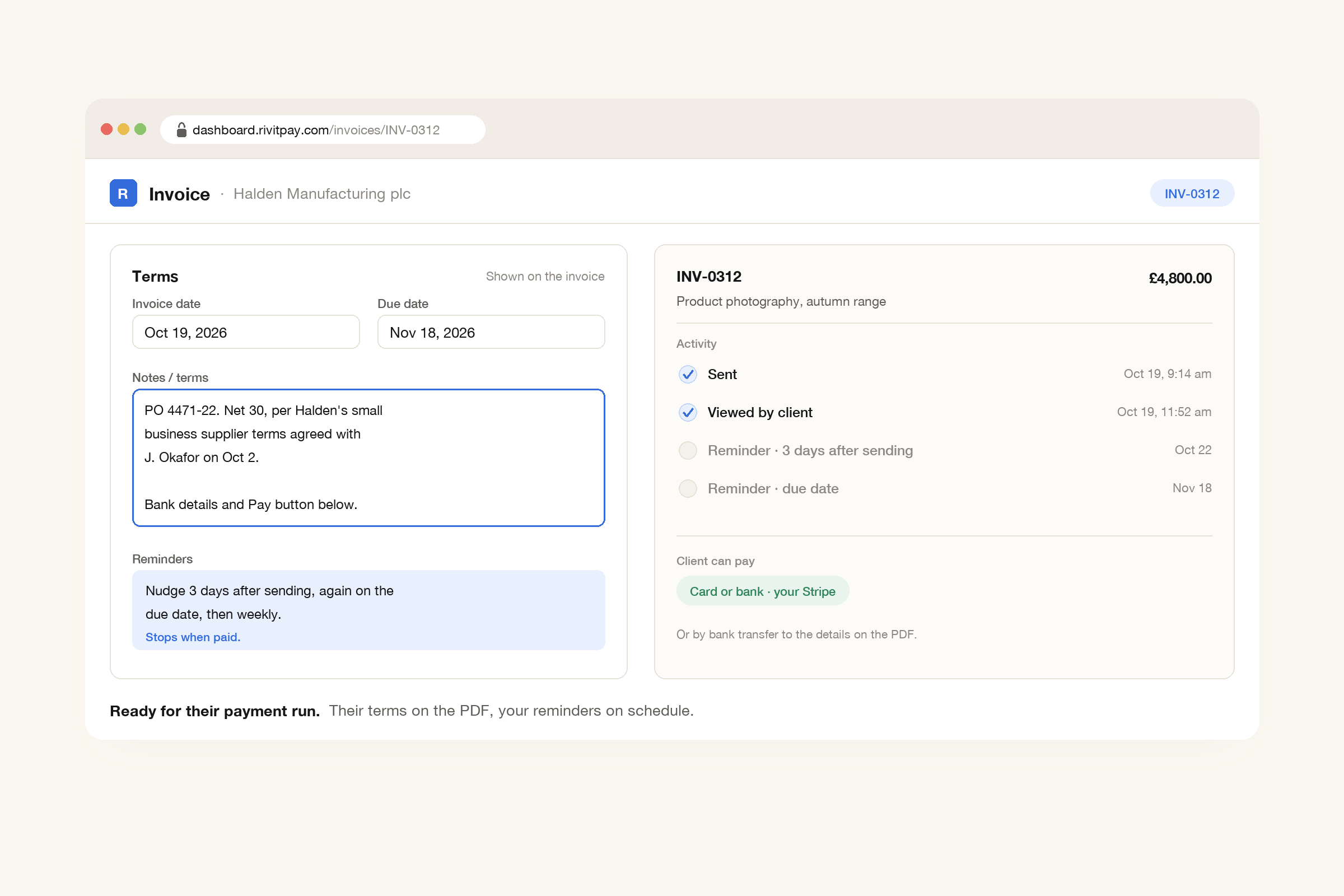
Put the PO number and the agreed terms in Notes / terms so they print on the PDF, which is often what accounts payable needs to match it. With a free account, you'll see when the client has opened it, and automatic reminders go out on a schedule you write as a plain sentence, in your own words, then stop the moment it's paid. For slow payers, a nudge on the due date and weekly after that matches how the late tail actually behaves. Every invoice also gets a Pay button, so the client can pay by card or bank straight into your own Stripe account, in any of 45 currencies. Invoicing is free, and there's no RivitPay fee until you've collected $5,000 through the Pay button. After that it's 1.5% plus Stripe's fees.
Two minutes before you sign
Big clients are worth having, and most of them do pay. But "per our standard terms" can mean 30 days or 150, and the company has already written down which. Search the register, ask for the small supplier terms if they exist, and plan for the slow tail, not the average.
Due dates and terms on the PDF, reminders in your own words that stop when they pay, and a Pay button into your own Stripe account. Free until you've collected $5,000.
Make an invoice, free