Unpaid invoices
Before you hand an unpaid invoice to a collection agency
The invoice is three months late. The client has stopped answering. A friend says what friends always say: "Just send it to collections."
For a business client, that means a commercial collection agency. It chases the debt for you and keeps part of what it recovers. That can be a fair trade for money you'd otherwise never see. But the price is higher than most freelancers expect, some agencies won't take an invoice your size at all, and the federal debt collection law most people have heard of doesn't apply to business debts.
Here's what we could confirm from agencies' own price pages, the statutes and a trade body's rules.
What it costs: the prices we could find in public
Most commercial agencies quote privately. We found two that publish prices, and they show the two common models.
A percentage of what's recovered. The Kaplan Group, a California agency that handles business debts, publishes its rates. "There is no fee unless we collect." The rate depends on the size of the claim:
| Amount collected | Agency keeps |
|---|---|
| Over $500,000 | 10% |
| $50,000 to $499,999 | 15% |
| $10,000 to $49,999 | 20% |
| $3,000 to $9,999 | 25% |
| Debtor outside the USA | 30% |
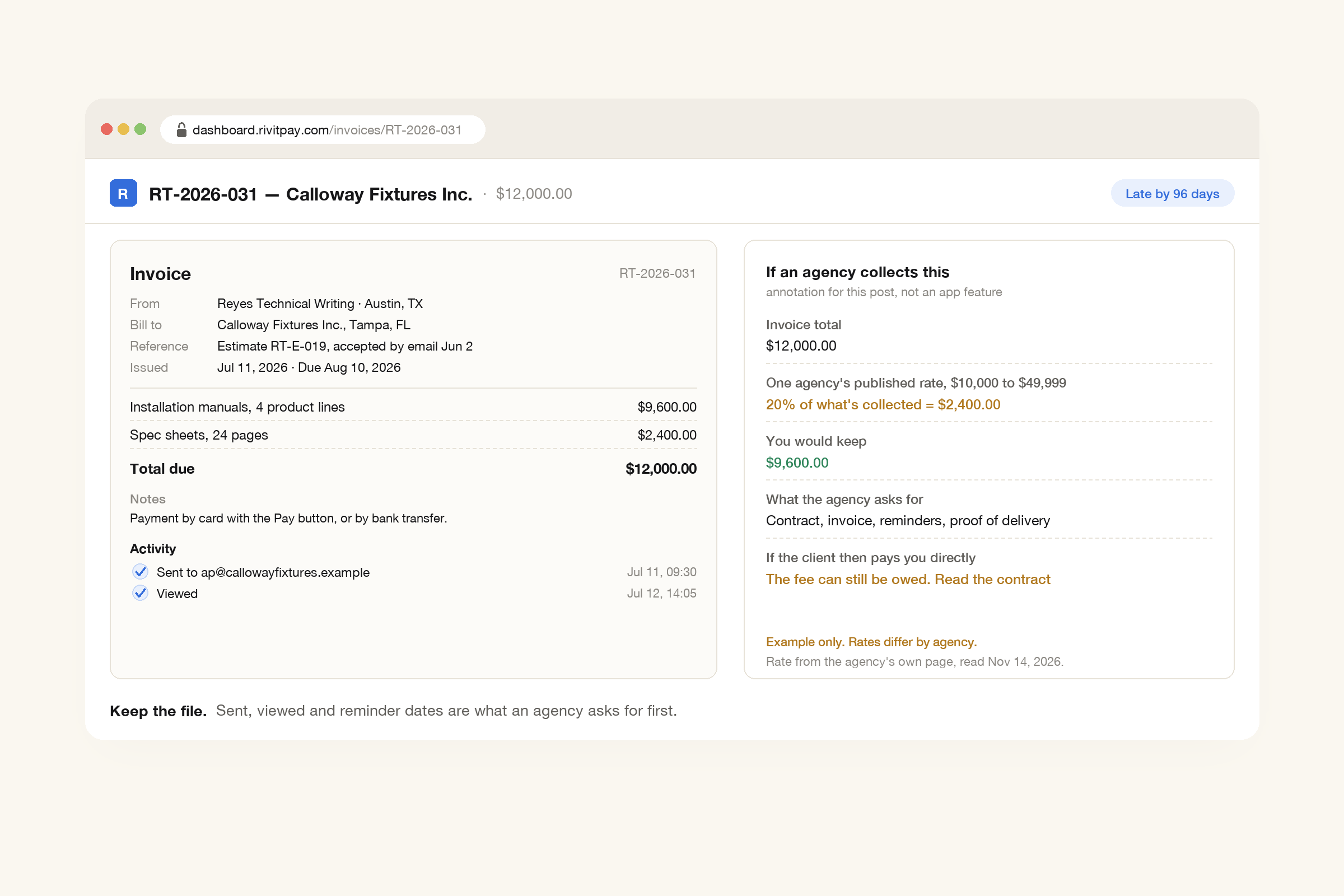
On a $12,000 invoice, 20% is $2,400. You'd keep $9,600.
The same page has a line that matters more to most freelancers: "The minimum size for the first claim for new clients is $10,000". Claims between $5,000 and $10,000 are charged 25%, but "we only handle these as a courtesy" for clients who have already placed several larger ones. A single $2,500 invoice isn't something this agency takes.
A flat fee per account. Rocket Receivables sells a fixed-fee first stage: $21.95 per account in a pack of 10, which is $219.50, falling to $14.95 each in a pack of 50. The page promises "NO percentages taken" at that stage. Its guarantee for that stage only covers accounts less than six months old. If the flat-fee stage doesn't work, the account can move to a second stage, where "we split the recovered amount with you, 50/50." On a $1,500 invoice recovered at that stage, you'd keep $750.
That's two companies' own price lists, read today. It isn't a survey of the market, and we found no official figures on what commercial agencies charge. What the two pages do show is the shape of the deal: on big invoices the agency's cut is a tenth to a quarter, and on small ones you may pay a flat fee, give up half, or find the agency doesn't want the claim.
The federal collection law doesn't cover business invoices
The Fair Debt Collection Practices Act is the federal law that sets rules for debt collectors. It only applies to a "debt" as the Act defines it, and the definition is narrow: an obligation "of a consumer to pay money arising out of a transaction in which the money, property, insurance, or services which are the subject of the transaction are primarily for personal, family, or household purposes".
An agency's logo design or a company's website rebuild isn't for personal, family or household purposes. So a collector chasing your business client isn't working under that Act. The federal regulation that goes with it, Regulation F, uses the same definition.
It cuts the other way if your client is a private person. A wedding shoot or a family portrait session is a personal purpose, so that unpaid invoice is a consumer debt and the collector does have to follow the Act. Tell the agency which kind of client it is.
State rules vary
Some states regulate commercial collectors directly. Florida is one. Its statute says "No person shall engage in business in this state as a commercial collection agency" without "first registering", and registration includes a surety bond.
California widened its own collection law, the Rosenthal Act, to reach some business debts from July 1, 2025. Freelancers shouldn't read much into that. The new category, covered commercial debt, "does not include" trade credit, and trade credit is defined as credit "extended by a person whose primary business is the furnishing or provision of goods, materials, equipment, or services" in connection with providing them. An unpaid invoice for your services looks like exactly that. This is our reading of the text, not a ruling.
We read those two states and Texas, whose debt collection chapter is written around consumer debt. Before you sign with an agency, ask whether it's registered or licensed where your client is, if that state requires it.
What stays your problem
The Commercial Law League of America publishes Operative Guides for the agencies and attorneys who pass commercial claims between them. They aren't law and they aren't your contract. They do show what the trade treats as normal, and three points are worth checking in any agreement you're offered.
- You can owe the fee even if the client pays you directly. Under the Guides, the collecting attorney "is entitled to fees in accordance with the forwarding contract, if payment was made by the debtor after demand was made". If the agency's letter is what finally makes the client pay, expect to owe the percentage whoever receives the money.
- No fee on a claim that's handed back. The Guides say no compensation is due where the claim is returned as uncollectible before any lawsuit, "or where it has been properly withdrawn", and the client pays afterwards. Ask how you withdraw a claim, and what happens if the client pays later.
- Going to court is a separate decision and a separate cost. The Guides define a "suit fee" as "a fee payable to the receiver in addition to the contingent fee for legal services", and a cost advance as money you put up for court costs. They also say that "the mere acceptance of a claim" doesn't "imply any authority to sue." Nobody should be suing in your name without asking you first.
There's also the cost that never shows on a rate card. Once a collector calls, you probably won't work for that client again. If you would still take their next job, it's too early for an agency.
What an agency will ask you for
ABC-Amega, a commercial agency, lists the documents that speed a claim up. Among them:
- "Clear and concise Statement of Account"
- "Summary of in-house collection efforts"
- "Accurate and complete debtor information including the legal name of the customer, not a dba"
- "Copies of invoices, purchase orders, credit application, contract"
- "Any correspondence (letters, faxes, emails) related to the past due account, especially anything from the customer admitting to the debt"
- "Proof of delivery"
The list is written for companies that ship goods, but it translates. For a freelancer it means the accepted estimate or contract, the invoice, your reminders with their dates, any email where the client says they'll pay, and something that shows the work was delivered.
Questions to ask before you sign
- What's the rate on a claim this size and this old? What's your minimum?
- Is the fee owed if my client pays me directly after your first letter?
- Can I withdraw the claim, and what does that cost?
- If you recommend suing, who pays the filing fees and the attorney, and do I get to say no?
- Are you registered or licensed in my client's state, where that's required?
- How will you contact my client, and will I see the letters?
Try these first
- One last written demand with a date. State the invoice number, the amount and the day you'll pass it on. Sometimes the deadline is enough.
- Make paying easy. A client who is short of cash may pay by card today, or agree to two instalments, when a bank transfer for the full amount isn't happening.
- Small claims court. For an invoice below an agency's minimum, it may be the only formal route. Our post on small claims for an unpaid invoice covers limits, fees and the catch that a judgment isn't the same as money.
- Check the client hasn't gone under. If they've filed for bankruptcy, collection has to stop. See our post on what to do when a client files.
In the UK the law gives a business supplier something extra. On top of statutory interest and the fixed sum, the Late Payment Act says that if "the reasonable costs of the supplier in recovering the debt are not met by the fixed sum, the supplier shall also be entitled to a sum equivalent to the difference". So a late-paying business client can be asked to cover a reasonable agency fee. Northern Ireland's government site says of debt recovery agencies: "They may charge a fixed fee or take an amount of the money they recover on your behalf. It's possible the agency might not use legally trained staff." Our post on UK late-payment interest has the interest rate and the fixed sums.
Where Rivit Invoices fits
Rivit Invoices isn't a collection agency and doesn't chase debts for you. It helps with the two stages before one: getting paid without an agency, and having the file ready if you need one.
- The agreement and the bill match. The estimate generator makes the quote, and Turn into invoice carries the same items into the invoice with the estimate number as the reference.
- A clear statement of the account. The invoice generator gives each invoice a number, issue and due dates, itemised lines and one total. Put the client's legal name in the Client field, not just the brand name.
- Dates for your follow-up. With a free account, each invoice shows when it was sent and when the client opened it, and automatic reminders go out in your own words. That is most of a "summary of in-house collection efforts".
- A way to pay on the spot. When a final demand works, the Pay button lets the client pay by card straight away, and the invoice also carries your bank details for a transfer.
The short version
A commercial collection agency works for a share of what it recovers. One agency's published rates run from 10% to 30%, with a $10,000 minimum for a new client's first claim. Another sells a flat-fee stage from $21.95 an account and splits later recoveries 50/50. The federal Fair Debt Collection Practices Act covers consumer debts, not business invoices, and state rules differ. Read the contract for what happens if the client pays you directly, how you withdraw, and who pays if it goes to court. For smaller invoices, a dated final demand and small claims court are usually the realistic options.
Numbered, dated invoices with one clear total. Free, no signup. Add a free account to see when each one was sent and opened.
Make an invoice, free