Agency work
The agency says it'll pay you when its client pays. Read that clause twice
You did the work for an agency. The agency did the work for its client. You sent your invoice, it got approved, and then a short email arrived: "We'll pay you as soon as the client pays us." Two months later, the client still hasn't paid the agency, so nobody has paid you.
If you subcontract for agencies or do white-label work, you've probably seen this line, either in an email or written into the contract. It can mean two very different things. One means you'll be paid a bit later. The other means you might never be paid at all. Which one you've agreed to depends on a few words, and you can usually spot them before you sign.
Every link in the chain adds days
Waiting on someone else's client stacks one payment delay on top of another. Xero's latest Small Business Insights for the US, published October 29, 2026, found that small businesses waited an average of 29.7 days to be paid in the September quarter and were paid 8.6 days late. The waits ranged from 24.0 days in Florida to 36.5 days in Illinois and 36.8 days in Texas. Xero says US small businesses have the second-longest late payment times of the five countries it tracks.
Those are averages, and they describe the agency waiting on its client, not you. Then your wait starts. Here's an example: the end client pays the agency on day 38, and your contract gives the agency 10 days after that. You're paid around day 48, and that's if the client pays at all.
Two clauses that look almost the same
Lawyers split these clauses into two kinds, and the difference is who carries the risk that the end client never pays.
- Pay-when-paid is about timing. The agency still owes you. The clause just gives it some time to collect from its client first. If the client never pays, the agency has to pay you anyway once a reasonable time has passed.
- Pay-if-paid is a condition. The agency only owes you if its client pays it. If the client goes bust or refuses to pay, you carry that loss.
Courts generally start from the first reading. To get the second, the contract has to say so clearly.
The case that set the default
The leading case is Thos. J. Dyer Co. v. Bishop International Engineering Co., decided by the US Court of Appeals for the Sixth Circuit in 1962. A plumbing subcontractor's contract said "no part of which shall be due until five (5) days after Owner shall have paid Contractor therefor." The owner, a racetrack company, went into reorganization under the bankruptcy laws without paying for the extra work. The contractor said it owed nothing more. The court disagreed.
It held that the clause was "a reasonable provision designed to postpone payment for a reasonable period of time after the work was completed". Reading it as requiring the subcontractor "to wait to be paid for an indefinite period of time until the general contractor has been paid by the owner, which may never occur" would be "an unreasonable construction". To move the risk of the owner not paying onto the subcontractor, the contract "should contain an express condition clearly showing that to be the intention of the parties." The subcontractor got judgment for $108,519.11, plus $9,224.12 in interest.
Dyer was a construction case, but the court built its rule on older cases that weren't, including one about an architect. In that case, a church said it would pay the architect's fee once it could afford to build. The court there held the fee was still owed, and payment "was to be made within a reasonable time." Dyer is a federal appeals decision, so it doesn't bind state courts, and states differ. But it's still cited, including in the Ohio case below.
And the case that went the other way
Wording matters, and Transtar Electric, Inc. v. A.E.M. Electric Services Corp. (Ohio Supreme Court, 2014) shows what a clear clause looks like. An electrical subcontractor had done all its work and been paid $142,620.10. The general contractor didn't pay the last three invoices, worth $44,088.90, because the owner hadn't paid it. The subcontract listed the owner's payment as one of four conditions for being paid, then added in capitals: "RECEIPT OF PAYMENT BY CONTRACTOR FROM THE OWNER FOR WORK PERFORMED BY SUBCONTRACTOR IS A CONDITION PRECEDENT TO PAYMENT BY CONTRACTOR TO SUBCONTRACTOR FOR THAT WORK."
The court held that the term "condition precedent" "clearly and unequivocally shows the intent of those parties to transfer the risk of the project owner's nonpayment from the general contractor to the subcontractor." The subcontractor lost.
So the words to look for in an agency contract are "condition precedent", "if and only if", "solely from funds received", or anything saying you take the risk that the client doesn't pay. "Within 10 days of receiving payment from the client" on its own reads more like timing. One more thing: both of these are construction cases, and construction comes with its own protections, such as mechanics' liens, that a designer or developer doesn't have. So they're a guide to how courts read the words, not a rule for your contract.
Some states' freelance laws ask for a date
New York, California and Illinois have freelance payment laws that require a written contract above a small dollar amount. An agency that hires you counts as a hiring party under them. Each one says the contract must state when you'll be paid. New York's General Business Law 1412 requires "the date on which the hiring party must pay the contracted compensation or the mechanism by which such date will be determined". California's version uses almost the same words.
If the contract gives no date and no mechanism, New York and California both set the deadline at 30 days after you finish the work. Neither statute says whether "when our client pays us" counts as a mechanism, and we haven't found a court that has decided it. Don't assume either way.
Illinois goes further. Its Freelance Worker Protection Act requires the payment date or mechanism, and adds: "which shall be no later than 30 days after the products or services are provided". Read plainly, an open-ended "when the client pays" doesn't meet that. A short pay-when-paid window that falls inside the 30 days might.
All three laws also cover a different move: once you've started work, the hiring party can't make on-time payment depend on you accepting less than the agreed amount. In California, it also can't depend on you doing extra work. So "the client cut the budget, so we can only pay 70%" isn't something an agency can make you accept in those states.
Before you sign
- Search the contract for the risky words. Look for "condition precedent", "if and only if", "contingent upon" and "solely from". If any of them is tied to the end client paying, that's a pay-if-paid clause.
- Ask for a fixed date instead. For example: "Payment is due 30 days after invoice, whether or not Client has received payment from its customer." Many agencies will agree. They chose the client and they know its payment record. You don't.
- If they insist on timing, add an end date. "Within 10 days of receipt of payment from the client, and in any case no later than 45 days after invoice" still gives them time to collect, but it has a limit.
- Take a deposit. A deposit paid before you start doesn't depend on anyone's client. Here's how deposits and payment terms work together.
- Ask who the end client is and how it pays. If the agency is working for a government body or a large company with 60-day terms, you'll know roughly how long the wait will be before you agree to it.
If it's already happening
Find the clause in your contract, or the email where payment terms were agreed. If it only says when, the agency still owes you, and the question is how much time is reasonable. Ask in writing what the client's status is and when the agency expects to pay you. Keep your invoice open with its due date, and keep following up. If the clause is pay-if-paid and the client has failed, talk to a lawyer before you write the money off. Whether the clause holds up depends on its exact words, your state's law and the facts. If it comes to court, small claims may be enough for a typical freelance invoice.
Where Rivit Invoices fits
Agree the terms before the work starts. The free estimate generator makes an itemized quote with your terms and an acceptance line, so a fixed payment date is in writing before you begin. When the agency accepts, Turn into invoice carries everything into the invoice generator. There, the Reference / PO field can hold the agency's job number and the end client's project name, so their accounts team can match your invoice quickly. Put your due date on the invoice, and a line in Notes / terms such as "Payment due by December 4, 2026, as agreed on October 6."
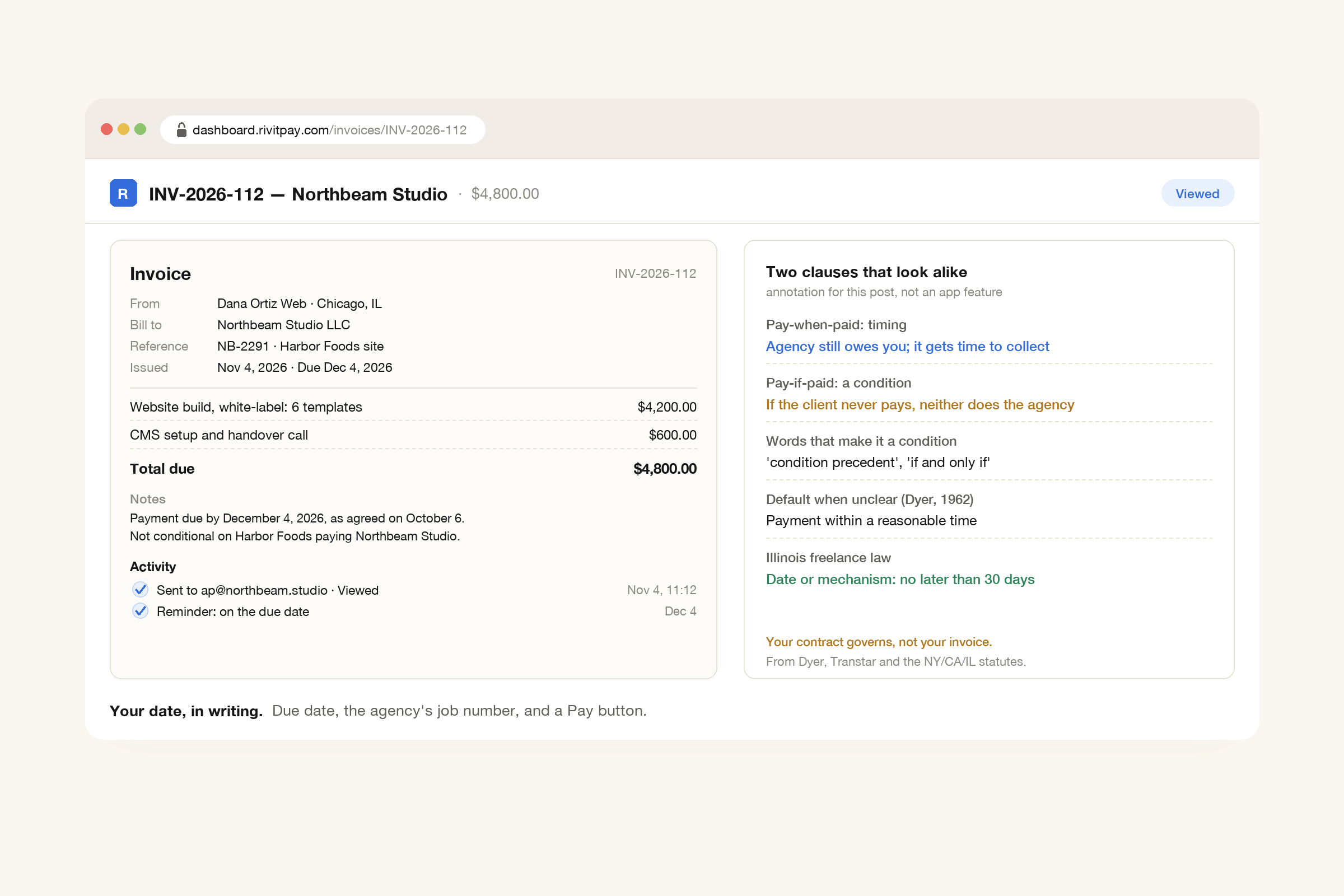
With a free account, you can email the invoice and see when it's opened. Automatic reminders follow up in your own words and stop as soon as the agency pays through the Pay button. The agency can pay by card or bank, and the money goes straight into your own Stripe account.
The agency picked the client. You picked the agency.
When you work through an agency, your contract is with the agency, and so is the debt. A pay-when-paid clause only delays when the agency pays you. A pay-if-paid clause makes its client's problem your problem. Before you sign, ask for a date, and if the clause says "condition precedent", either cross it out or price that risk into your rate.
An estimate with your terms, then an invoice with a due date, the agency's reference and a Pay button. Invoicing is free.
Make an estimate, free