Your rights
What happens when you file a freelance pay complaint? A year of numbers from New York and Illinois
A client is 60 days late, and you're in New York City or Illinois. You've read that there's a law for this. Our post on freelance payment laws explains what they say. This one is about what happens when you use them. New York City and Illinois have now both published official numbers on freelance complaints, and they show what filing one gets you, how long it takes, and what helps.
In short, the laws give you real leverage, but the complaint process is slow, and most of the money comes from cases against repeat offenders. Your own paperwork does more of the work than you'd expect.
New York City: 829 complaints in 2025
New York City's Department of Consumer and Worker Protection (DCWP) runs the Freelance Isn't Free Act, in force since 2017. Its Worker Protection Data 2025 report lists 829 Freelance Isn't Free complaints last year. One complaint can include more than one allegation:
- 751 alleged "unlawful payment practices".
- 207 alleged a failure or refusal to sign a written contract.
- 155 alleged retaliation.
So the complaints are overwhelmingly about getting paid.
What most complaints lead to: a navigator, not an investigator
Most freelance complaints in New York City go to the Freelance Isn't Free navigation service. The city calls the law's court navigation program "one avenue to assist freelancers in getting paid and accessing resources." DCWP's report says navigation services "do not involve investigation or enforcement action." Here's what it did in 2025:
- 734 cases opened and 890 closed.
- A median of 145 days from start to finish.
- 44 complaints ended in a recovery the freelancer reported, worth $123,326 in total.
Read that last line carefully. Freelancers report recoveries themselves, so DCWP says the figures "undercount the true totals". The real number is higher, and nobody knows by how much. But even allowing for that, the navigation service isn't a collections agency. It gets you heard, and it can take months.
Where the big money comes from: cases against repeat offenders
The law also lets the city act against a business with a "pattern or practice" of violations, together with the city's Law Department. That's where the large sums are. In 2025 those cases produced $549,241 in restitution for 366 freelancers, plus $21,106 in penalties, from two settlements. The median case took 330 days.
The biggest of them was announced on February 24, 2026: a $528,817 settlement with Splashlight, a creative production company, covering 350 freelancers. DCWP said the case "follows a cascade of complaints from freelance workers." Freelancers who were never paid get full compensation, and those who were paid late get extra damages for the delay. The year before, a settlement with BuzzFeed secured "more than $45,000 in relief for 16 freelance workers who filed complaints with DCWP."
The same announcement gives the totals since 2017: 4,832 complaints, 4,394 cases closed, and "over $3,526,572" recovered for freelancers.
The takeaway is that your complaint matters even if it doesn't get your money back quickly. Pattern cases start from a pile of individual complaints. If a client pays everyone late, your complaint might be the one that tips it into an investigation.
Illinois: 24 complaints, and 14 it couldn't take on
Illinois's Freelance Worker Protection Act took effect on July 1, 2024. The Illinois Department of Labor's first report on the law, dated July 1, 2025, covers its first year. It's short:
- "The IDOL has received 24 complaints under the Act from July 1, 2024, through June 30, 2025."
- It "lacked jurisdiction to initiate the information facilitation process for 14 complaints." The most common reasons were that "the contract was entered into prior to the effective date of the Act" and that "the complainant was an employee rather than an independent contractor."
- 21 of the 24 complaints involved payment, and 15 were about payment alone. The contracts ranged from under $500 to between $481,500 and $481,999, but most were under $10,000.
- The report records a response from the hiring party in 5 cases and no response in 3. The other 16 are marked "N/A".
Twenty-four complaints for a whole state in a year is very few, which suggests many freelancers either don't know about the law or settle things without it. The department says its model contract and fact sheets, in eleven languages, were downloaded "over 2000 times". When a complaint is accepted, the department starts what it calls an "information facilitation process between the parties." It's a structured conversation, not a court order. Its plans include possibly adding mediation. The report makes no legislative recommendations, and the next one isn't due for five years.
What actually helps
- Check that you're covered before you rely on it. Illinois couldn't take on more than half of its first-year complaints, mostly because the contract was signed before the law began or the person was an employee. Our posts on New York, Illinois and city laws and California's law explain the thresholds and who counts.
- Get the terms in writing before you start. In New York City, 207 complaints were about not having a written contract at all. Without one, you're arguing about what was agreed before you can argue about payment. A written estimate the client has signed is evidence of the work, the price and the payment date.
- Make the due date impossible to miss. Both laws have a fallback: if the contract doesn't say when you'll be paid, payment is due 30 days after you finish the work. A clear due date on every invoice means nobody has to work it out.
- Mention the law before you file. A polite reminder that names the law and the due date often works better than a complaint, and costs nothing. Keep it factual: the invoice number, the amount, the due date and the law.
- File anyway if it's a pattern. If the client pays other freelancers late too, tell DCWP or IDOL. In New York City, call 311 or go to nyc.gov/workers. In Illinois, use the online form on the Department of Labor's freelance page.
- Know your other options. If you need the money rather than a conversation, small claims court may be faster than waiting months for a navigator.
Where Rivit Invoices fits
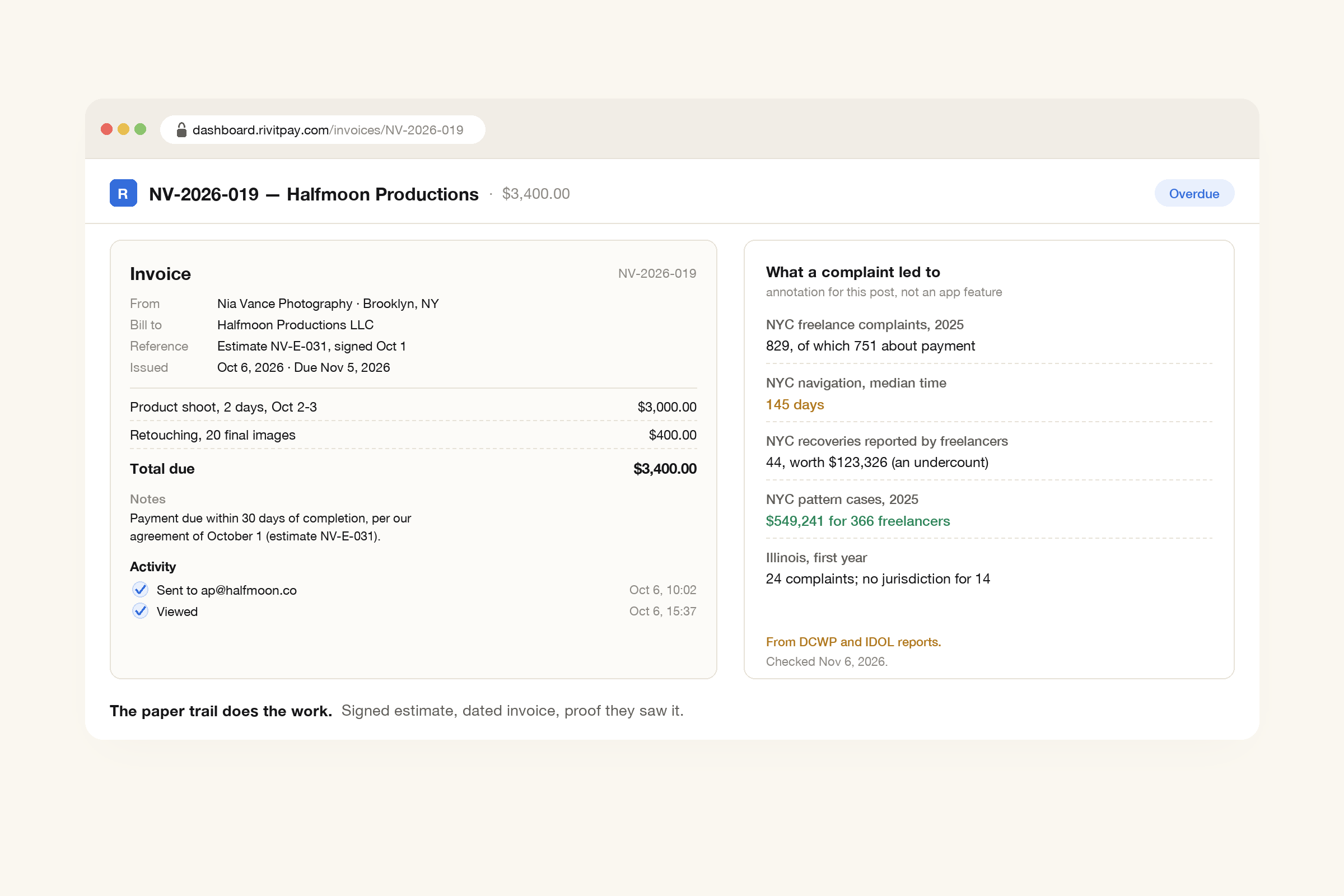
A complaint goes better with a clear paper trail: what you agreed, what you sent, when it was due, and when they saw it.
- Before the work: the free estimate generator has your details and the client's, itemised work with rates, terms where you can write the payment date, a valid-until date and an acceptance line for the client to sign. Check it against the law's list of required contract terms. Our state-law posts list them.
- The invoice: when the client accepts, Turn into invoice carries everything into the invoice generator, with an invoice number and a due date. Add a line in Notes / terms, such as "Payment due within 30 days of completion, per our agreement of October 1."
- After you send it: with a free account, the invoice shows when it was sent and when it was viewed. That's useful when a client says they never got it. Automatic reminders in your own words follow up on the schedule you set, and they stop when the client pays through the Pay button.
The short version
New York City had 829 freelance complaints in 2025, nearly all about payment. Its navigation service took a median of 145 days, and freelancers reported 44 recoveries worth $123,326, which is an undercount. The big recoveries come from pattern cases, such as $528,817 for 350 freelancers from one production company. Illinois had 24 complaints in its law's first year and lacked jurisdiction over 14 of them. File if you're covered, especially against a repeat late payer. But your best protection is the paper trail: a signed estimate, a dated invoice, and proof the client saw it.
A free estimate with itemised work, rates, payment terms and a line for the client to sign. Turn it into an invoice with one click. No signup.
Make an estimate, free