Records
How long do you have to keep your invoices?
Most freelancers can tell you what they invoiced last month. Far fewer could produce the invoice they sent a client in March three years ago, with the date it was paid. Usually that's fine. Then a tax letter arrives, or a mortgage lender asks for two years of records, or a client claims they already paid, and suddenly an old PDF is the most important document you own.
The tax rules on how long to keep records are short, and they're stricter in some countries than in others. Here's what the US, UK and Canada actually require, and the places your invoices quietly go missing.
The US: three years, with some long exceptions
The IRS page How long should I keep records? (last reviewed June 30, 2026) ties everything to the period of limitations, the window in which you can amend a return or the IRS can assess more tax. The basic rule is three years from filing. Then the exceptions:
- 6 years if you don't report income you should have, and it's more than 25% of the gross income on your return. An invoice paid in late December and forgotten in January can push you toward this one.
- 7 years if you claim a loss from a bad debt deduction or worthless securities. (Most freelancers can't deduct an unpaid invoice anyway. Here's why.)
- 4 years for employment tax records, if you have employees.
- Indefinitely if you don't file a return, or file a fraudulent one.
- 3 years from filing or 2 years from paying the tax, whichever is later, if you file a claim for a credit or refund after your return.
The IRS also lists what counts as supporting documents for your income. Under gross receipts it names invoices, deposit information, receipt books and Forms 1099-MISC. Digital copies are fine, but they're held to the same standard: "All requirements that apply to hard copy books and records also apply to electronic records."
Before you shred anything, the IRS adds a line worth reading twice: "your insurance company or creditors may require you to keep them longer than the IRS does."
The UK: five years after the January deadline
HMRC's rule for sole traders is longer than people expect. You must keep records "for at least 5 years after the 31 January submission deadline of the relevant tax year". HMRC's own example: if you filed your 2022 to 2023 return online by January 31, 2024, you keep the records until at least the end of January 2029. For a single invoice, that can mean nearly seven years.
Not keeping them has a price. HMRC's Self Assessment manual says "a penalty of up to £3,000 may be charged for each failure" to keep or preserve adequate records, though it's normally sought only in serious cases. In practice, HMRC's claims manual says a first failure often gets a warning, and the full penalty without warning is for records it can prove were deliberately destroyed. And SALF211 confirms you don't need the paper originals for most things. Complete copies count.
There's a newer reason to get organised. Under Making Tax Digital for Income Tax, sole traders and landlords with qualifying income over £50,000 in 2024 to 2025 should have started on April 6, 2026. The threshold drops to £30,000 from April 6, 2027 and £20,000 from April 6, 2028. It means keeping digital records of your income and sending quarterly updates through compatible software. Your invoices are the income side of those records.
Canada: six years
The Canada Revenue Agency generally wants business records kept "for a period of six years from the end of the last tax year they relate to". For a sole proprietor, the tax year is the calendar year, so an invoice from March 2026 stays until the end of 2032. There's one twist: records kept outside Canada and accessed from Canada don't count as kept in Canada unless the CRA has given written permission.
The non-tax reasons are often longer
The tax clock isn't the only one running. Your invoices are also the evidence for:
- Suing for an unpaid bill. Contract claims have their own deadlines, which vary by state and are often longer than the IRS's three years. See small claims for an unpaid invoice.
- Proving your income. Mortgage lenders and landlords usually want past tax returns and a current profit and loss. More on that here.
- A client's bankruptcy. A proof of claim needs copies of the invoices behind it. What to do if it happens.
- A card dispute. Your evidence is the invoice, the client's approval and the payment. How disputes work.
Where invoices actually go missing
Hardly anyone loses invoices on purpose. They lose them in a sent-mail folder from an email account they've since closed, in an invoicing tool they stopped paying for, in a laptop that died, or in a free generator that never saved anything in the first place.
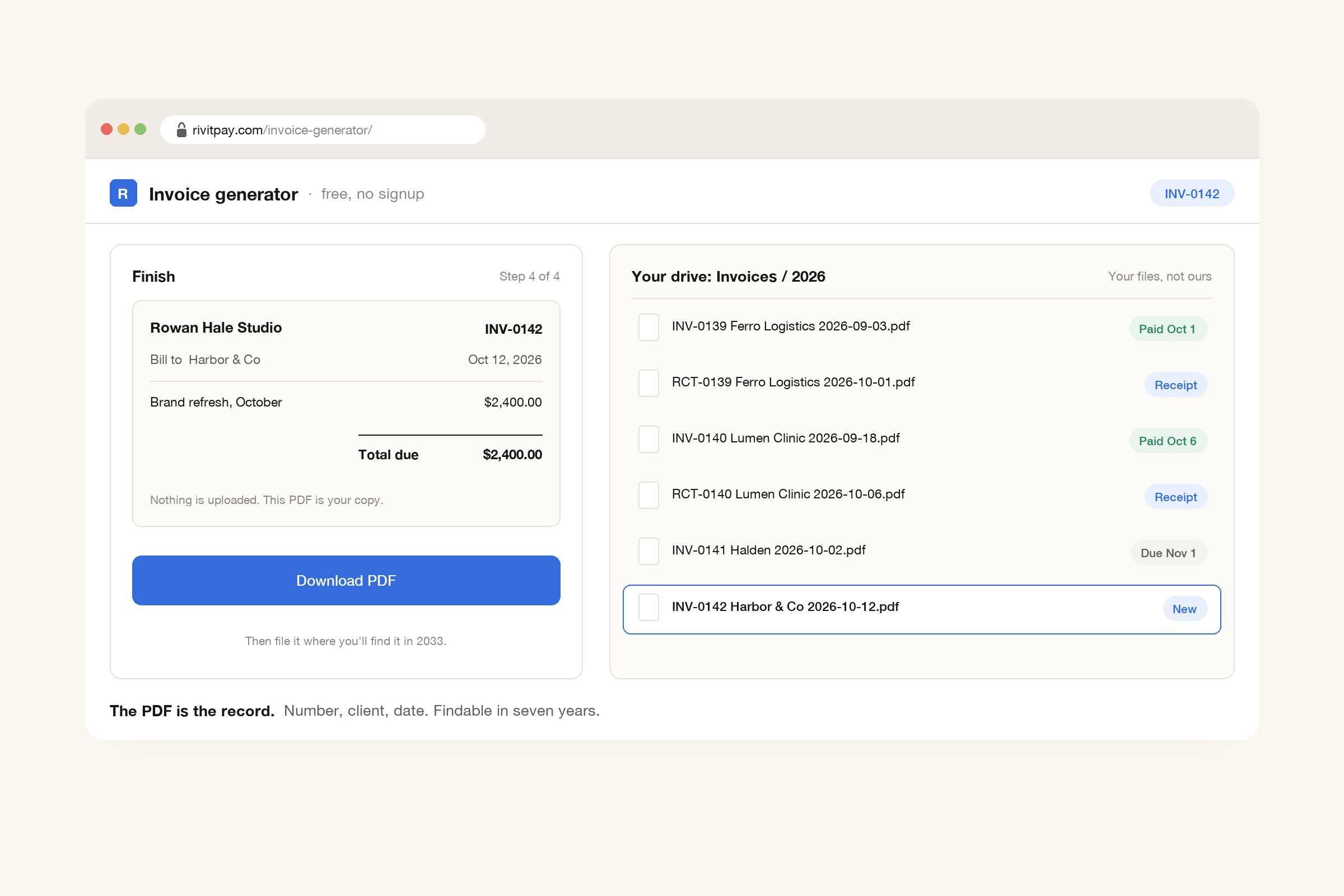
That last one includes ours, and it's worth being plain about it. RivitPay's free invoice generator runs entirely in your browser. Nothing you type is uploaded, and the share link carries the invoice inside the URL itself, so there's no database. That's good for privacy. It also means we have no copy. If you use the free generator, the PDF you download is your record. Save it somewhere you'll still have in seven years.
A simple system that works anywhere:
- One folder per tax year, in storage that isn't a single laptop.
- Name each file the same way: invoice number, client, date. "INV-0142 Harbor & Co 2026-10-12.pdf" is findable in 2033. "invoice (3).pdf" isn't.
- Pair each paid invoice with its receipt. The free receipt generator lets you put the invoice number in the reference field, so the two documents point at each other.
- Write down the date you were paid, not just the date you invoiced. For cash-method taxes, the receipt date decides which year the income lands in.
A free RivitPay account takes some of this off you. Invoices in your account are stored so sending and tracking can work, and each one goes out by email with the PDF attached, so your sent mail holds a copy too. You can see when each was sent and opened, and when it's paid through the Pay button, the payment settles by card or bank straight into your own Stripe account, which keeps its own record of every charge. Automatic reminders in your own words stop the moment it's paid. Invoicing is free, and there's no RivitPay fee until you've collected $5,000 through the Pay button.
Seven years is a long time for a PDF
You won't need most of your old invoices. The trouble is that you can't know in advance which one you will. Pick one folder, one naming pattern, and one place that will outlive your laptop. It takes ten seconds an invoice, and it's the cheapest insurance you'll ever buy.
A clean PDF for every invoice, a matching receipt when it's paid, and a Pay button into your own Stripe account. Free until you've collected $5,000.
Make an invoice, free