Contracts
Your client replied with a thumbs-up. A court has called that a signature
You send the estimate. An hour later the client writes back: "Looks good, go ahead." Or just a thumbs-up.
Nobody signed anything. So you start the work and hope the reply is enough if there's ever an argument about what was agreed.
Courts in Canada, the US and the UK have all had to answer that question, and the short version is that a short reply can count. A Canadian farmer's thumbs-up emoji cost him $82,200.21. A typed "Thanks Brenda Greene" at the end of an email settled a $230,000 case in New York. But the same decisions show where a casual yes falls short, and the gaps are the useful part for anyone who works from estimates.
The thumbs-up that cost $82,200.21
In March 2021 a grain buyer in Saskatchewan, South West Terminal, agreed by phone to buy flax from a farming company, Achter Land & Cattle. The buyer's rep wrote up the contract, signed it, photographed it and texted the photo to the farmer with the words "Please confirm flax contract". The farmer texted back a thumbs-up emoji.
The contract was for 87 tonnes at $17.00 a bushel, for delivery that November. The flax never arrived. By the end of November the market price was $41.00 a bushel, and the buyer sued for the difference.
The farmer said the thumbs-up only meant he had received the contract, not that he agreed to it. The judge didn't accept that, because of what the two had done before. The buyer had texted earlier contracts with the words "Please confirm terms of durum contract", and the farmer had answered "Looks good", "Ok" and "Yup". He delivered the grain each time. In the judge's words, "The parties clearly understood these curt words were meant to be confirmation of the contract and not a mere acknowledgement of the receipt of the contract".
So the judge found the farmer "okayed or approved the contract just like he had done before", this time with an emoji. He also dealt with the warning that courts would be flooded with emoji cases: "this Court cannot (nor should it) attempt to stem the tide of technology and common usage". Judgment went to the buyer for $82,200.21 in Canadian dollars, plus interest and costs.
Saskatchewan's Court of Appeal upheld that in December 2024, two judges to one. The Supreme Court of Canada refused to hear a further appeal on July 24, 2025, so the result stands.
The appeal judges were careful about how far it goes. The majority rejected the idea that their ruling "means that every text message constitutes a signature", and added: "context matters." The one dissenting judge would have decided the signature point the other way.
What US law says about ink
In the US, the starting point is a federal law from 2000, the E-SIGN Act. It says a signature or contract "may not be denied legal effect, validity, or enforceability solely because it is in electronic form".
Its definition of an electronic signature is broad: "an electronic sound, symbol, or process, attached to or logically associated with a contract or other record and executed or adopted by a person with the intent to sign the record." A typed name fits that. Whether an emoji does would depend on the last few words, the intent to sign.
States have their own versions too.California's says "If a law requires a signature, an electronic signature satisfies the law." New York's says an electronic signature "shall have the same validity and effect as the use of a signature affixed by hand."
California adds a condition. Its law "applies only to a transaction between parties each of which has agreed to conduct the transaction by electronic means", and whether they agreed is "determined from the context and surrounding circumstances, including the parties' conduct." If you and your client have done the whole deal by email, that is the kind of conduct it means.
None of this says an email is automatically a contract. It says the email can't be thrown out just for being an email. The usual questions still apply: was there an offer, was it accepted, and did both sides mean to be bound.
Two New York emails: one binding, one not
In Forcelli v. Gelco, decided in 2013, an insurance adjuster settled an injury claim by phone and then sent an email: "Per our phone conversation today, May 3, 2011, you accepted my offer of $230,000 to settle this case." It ended "Thanks Brenda Greene." A week later a court ruling went the insurer's way, and it tried to drop the deal.
The appeals court enforced the email. Its holding: where an email "contains all material terms of a settlement and a manifestation of mutual accord", and the sender "types his or her name under circumstances manifesting an intent that the name be treated as a signature", it can count as a signed writing. Judgment was entered for $230,000.
The court noted that she had typed her name herself. That, it said, is different from "a situation where the sender's email software has been programmed to automatically generate the name of the email sender".
Three years earlier, in Naldi v. Grunberg, the same state's courts had said that "an e-mail will satisfy the statute of frauds so long as its contents and subscription meet all requirements of the governing statute." The buyer in that case still lost. A broker's email had offered a right of first refusal tied to a $52 million price, and the buyer had never agreed to that price. The court found "there was never any meeting of the minds". The email was fine as a form. The agreement inside it was missing.
In the UK, an automatic email footer counted
English courts have gone a step further than New York on automatic signatures. In Neocleous v Rees, decided in 2019, two solicitors agreed by email to settle a land dispute for £175,000. One of them typed "Many thanks", and his email program added his name and firm underneath. His client later argued that an automatic footer wasn't a signature.
The judge disagreed: "Looked at objectively, the presence of the name indicates a clear intention to associate oneself with the email – to authenticate it or to sign it." The deal held.
In an earlier Court of Appeal case about a guarantee made through a chain of emails, Golden Ocean v Salgaocar, both sides accepted "that an electronic signature is sufficient and that a first name, initials, or perhaps a nickname will suffice." The broker had signed off as "Guy". The court said that by doing so he "took responsibility for the contents."
The Law Commission summed up the position for England and Wales in 2019: "An electronic signature is capable in law of being used to execute a document (including a deed) provided that (i) the person signing the document intends to authenticate the document and (ii) any formalities relating to execution of that document are satisfied." Its list of forms the courts have accepted includes "a name typed at the bottom of an email".
Where a casual yes falls short
- The terms aren't all there. "Go ahead" only accepts what was on the table. If your estimate doesn't state the price, the scope and when you're paid, the reply doesn't settle them. That's what sank the buyer in Naldi.
- One side said it isn't final yet. New York's highest court put it this way in 1970: if the parties "do not intend it to be binding upon them until it is reduced to writing and signed by both of them, they are not bound". The UK Supreme Court, in a 2010 decision, calls this "the ordinary 'subject to contract' case." So "looks good, our legal team will send the paperwork" may not be a yes.
- There's no history to explain the reply. The emoji case turned on earlier deals confirmed with "Looks good" and "Yup". A thumbs-up from a new client, to a message that doesn't ask them to confirm anything, is much weaker. The appeal court's phrase was "context matters".
- The law asks for more than a yes. In New York, an agreement that "By its terms is not to be performed within one year from the making thereof" has to be in writing and signed. A transfer of copyright has to be "in writing and signed by the owner of the rights conveyed". We didn't check how an emailed yes fares under the copyright rule, so for a rights transfer or a long retainer, get a proper signed agreement. Our post on who owns the work before the client pays covers the copyright side.
How to get a yes that holds up
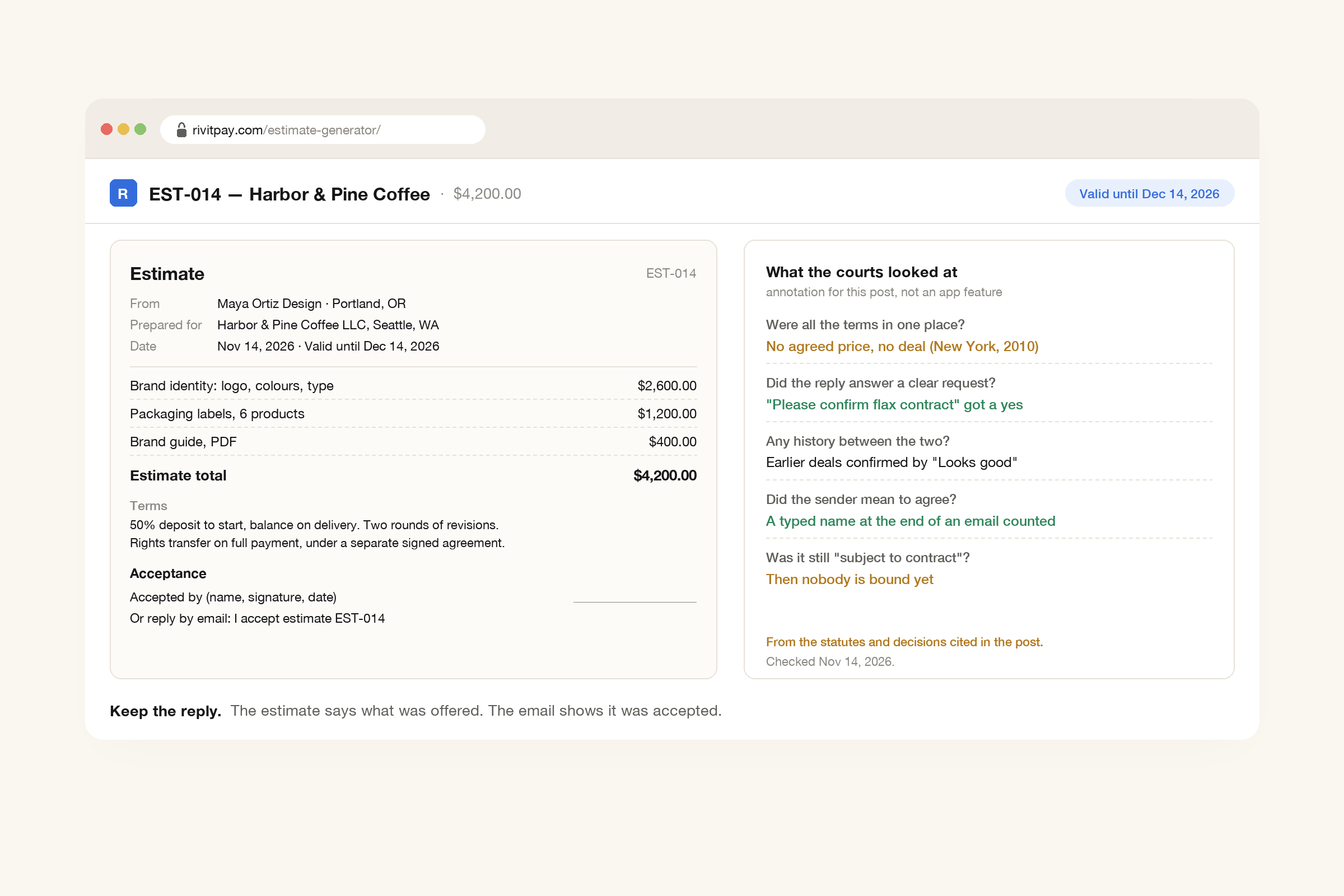
- Put the whole deal in one document. Scope, price, what's excluded, the deposit, when payment is due and how long the price is good for. The reply can only accept what the estimate says.
- Ask for the reply you want. End your email with something like: "To accept, reply 'I accept estimate EST-014' and I'll book the work in." The Canadian buyer's "Please confirm flax contract" did that job. It made the meaning of the answer hard to argue with.
- Ask the right person. A yes from someone who can't commit the company is a weaker yes. If you're not sure, ask who approves the spend and copy them in.
- Keep the reply with the estimate. Same email thread, PDF attached, dates showing. Screenshot text messages and save them with the job.
- Clear up a vague answer before you start. "Thanks, will take a look" isn't acceptance. Neither is a thumbs-up to a message that asked three questions. One more email costs less than a dispute.
- Say so when you don't mean to be bound. If your figures are a rough guide, write that on them. The rule works in both directions.
- Watch your own replies. If a client texts "can you add the product pages for the same price?" and you answer with a thumbs-up, you may have just agreed. Our post on scope creep covers how to price extra work instead.
Some US freelance payment laws separately require a written contract for larger jobs. Our posts on the state and city laws and California's rules cover what has to be in it.
Where Rivit Invoices fits
Rivit Invoices doesn't collect signatures. It makes the document the yes refers to.
- One estimate with everything on it. The estimate generator gives you a title (Estimate or Quote), a number, a date, a valid-until date, itemised lines and a terms section. It's free and needs no signup.
- An acceptance line. The estimate includes a line the client can sign. A client who would rather reply by email can quote the estimate number instead.
- PDF or share link. Send whichever suits the client. Attach the PDF to the email you want answered, so the reply and the terms stay in one thread.
- The same terms on the invoice. When the client accepts, Turn into invoice carries the client, line items, tax and notes into the invoice generator, with the estimate number as the reference. The invoice then points back to what was agreed.
The short version
A short reply can be a binding yes. Electronic signature laws in the US and decisions in New York, England and Saskatchewan have accepted a typed name, an email footer and, once, a thumbs-up emoji. What the courts looked for each time was a complete set of terms and a clear sign that the person meant to agree. So put the whole deal in the estimate, ask the client to reply with words that name it, and keep that reply. For copyright transfers and long contracts, get a real signature.
Scope, price, valid-until date, terms and an acceptance line on one page. Free, no signup.
Make an estimate, free