Sales tax
Your web design invoice might need sales tax now
For a long time, freelance web, software and IT work sat comfortably outside sales tax in most of the US. You sold a service, you invoiced a fee, and sales tax was something for people who sold physical things. In 2025, two states changed that for a big slice of freelance tech work: Maryland on July 1, and Washington on October 1.
Washington's Department of Revenue put it plainly: if you provide one of the newly taxable services, "you must start collecting sales tax on your invoices and submit it when filing your taxes." A year in, plenty of freelancers still haven't. Here's what changed, who it reaches (including people who don't live in either state), and how to put it on an invoice.
Maryland: 3% on a long list of tech services
Since July 1, 2025, Maryland has charged a 3% sales and use tax on data, IT and software publishing services, defined by reference to federal industry codes (NAICS 518, 519, 5415 and 5132). The Comptroller's Technical Bulletin 56 spells out the list, and it reads like a freelancer's services page: "Custom webpage design services", "Custom computer programming services", "Custom search engine optimization (SEO)", "Computer software consulting", "Data entry", "Web hosting".
A few rules that matter for solo work:
- It's the service, not your label. The bulletin says the code you report as your primary business activity "is not determinative." Each service is checked on its own.
- Retainers are taxed payment by payment. "Each subscription payment is considered a separate sale," and an automatically renewing contract counts as a new sale too. So a month-to-month arrangement that started before July 1, 2025 didn't get the old-contract pass. Each payment after that date was its own taxable sale.
- Old contracts got a pass, change orders didn't. Contracts signed before July 1, 2025 were generally left untaxed. But a change order that adds services not in the original contract "is considered a new sale." That's one more reason extra scope deserves its own paperwork.
- Out-of-state freelancers can be caught. The Comptroller's guidance for remote sellers says you must collect if, in the previous or current calendar year, your taxable sales delivered into Maryland exceed $100,000 or you make 200 or more separate transactions there.
The tax has been contested. In the 2026 session, a bill to exclude certain business purchases of technology services, SB 600, got a Senate committee hearing on February 25 and went no further. For now, the bulletin is the rule.
Washington: websites, IT, software and advertising
Washington's law, ESSB 5814, made a set of services retail sales from October 1, 2025. The list includes information technology services, custom website development, custom software and the customization of prewritten software, advertising services, live presentations, investigation and security, and temporary staffing. Washington's retail sales tax then applies at the combined state and local rate where the sale is sourced.
Some of the definitions are broader than you'd guess:
- Website development means "the design, development, and support of a website," and the department treats website consulting and training as part of it. Web hosting and domain registration are excluded.
- IT services include help desk, troubleshooting, onboarding, network security and consulting or project management on IT work.
- Advertising services include ad design, ad placement, campaign planning and lead generation. If you design ads or run campaigns for Washington clients, read this one closely.
Where the sale lands depends on where your client receives the service, generally where they first use it. The department's worked examples make the edges clear. A Washington developer building a site for a client whose only known address is in Louisiana doesn't collect Washington sales tax. An out-of-state developer who has passed Washington's $100,000 economic nexus threshold and builds a $12,000 mobile site for a company headquartered in Walla Walla does. The department also says developers "should document in their contracts, invoices, or service agreements where they will be sourcing the services."
Contracts signed before October 1, 2025 got a grace period, but it's over. Unaltered existing contracts could keep the old treatment through March 31, 2026, and from April 1, 2026 sellers "must collect and remit retail sales tax." A contract that's materially changed after October 1, 2025 becomes taxable from the moment it's altered.
Washington is also being sued over parts of the law. The department notes the ongoing legal proceedings, and adds that until a court says otherwise, "affected taxpayers must report, collect, and remit taxes in accordance with current guidance."
If you've been invoicing without it
Washington has opened a door. Its ESSB 5814 penalty relief program waives certain penalties on uncollected sales tax caused by the change, for reporting periods from October 1, 2025 through December 31, 2026. You apply by September 30, 2027. It's penalties only: "Businesses must still pay the tax owed and any applicable interest." And the program page says evasion, negligence and tax avoidance penalties aren't eligible.
When you haven't collected the tax, it usually comes out of your own pocket, because asking a client to pay sales tax on an invoice they settled months ago is awkward at best. The sooner the rate is on your invoices, the smaller that hole gets. In either state, an hour with an accountant who handles sales tax is money well spent.
Putting it on the invoice
Once you know a job is taxable, the invoice should say so clearly:
- Show tax as its own line, with the rate, under the subtotal.
- Use the right rate for where the client receives the work. In Maryland it's 3% on these services. In Washington it's the combined state and local rate for the client's location, which the department's rate tools look up.
- Write down the sourcing. A line in the notes saying where the service is received is exactly what Washington asks you to keep.
- Keep taxable and non-taxable work apart. In Washington, hosting and domain fees are excluded from website development. Billing them separately keeps the math honest.
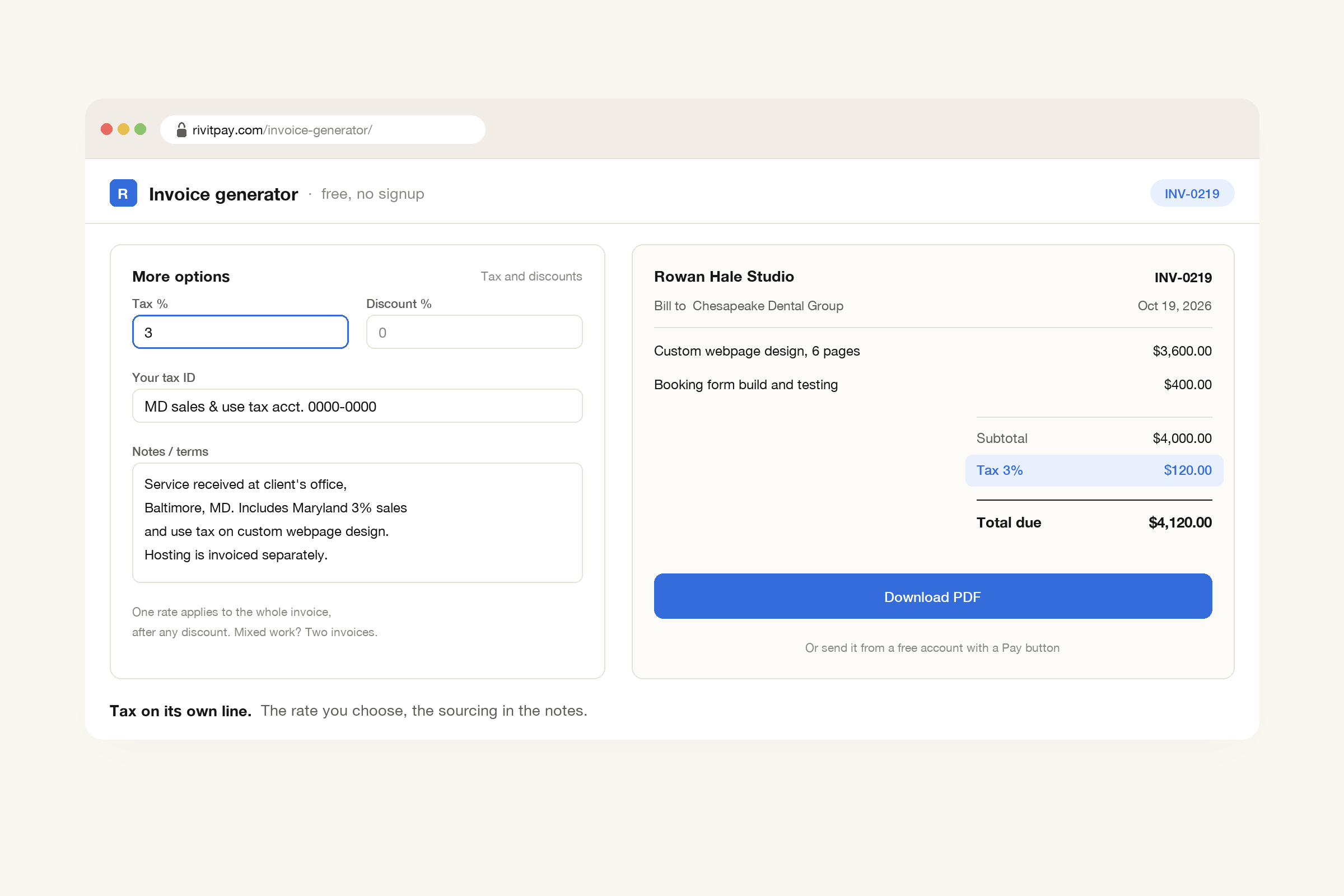
RivitPay's free invoice generator has a Tax % field under More options. Enter the rate and the invoice shows a "Tax" line with the percentage and recalculates the total as you type. There's a field for your tax ID and a notes box for the sourcing line. One thing to know: the tax rate applies to the whole invoice, after any discount. So if a job mixes taxable and non-taxable work, like a website build plus hosting in Washington, send them as two invoices. If you use a free account, your client pays the total, tax included, by card or bank through the Pay button, and it settles into your own Stripe account. The invoice and your Stripe records show what you collected when it's time to file.
A service can be a retail sale now
The old freelancer instinct, "I sell services, so sales tax isn't my problem", is no longer safe in these two states, and both rely on the client's location, not yours. If you build websites, write code, run IT or design ads for clients there, find out once whether your work is in scope, put the rate and the sourcing line on your invoices, and keep the tax in a separate pot until you file. Next year's version of you will be grateful.
A tax line, your tax ID and a notes box for sourcing, plus a Pay button into your own Stripe account. Free until you've collected $5,000.
Make an invoice, free